
Silver Y moth
Cornutiplusia circumflexa
Description
How to identify
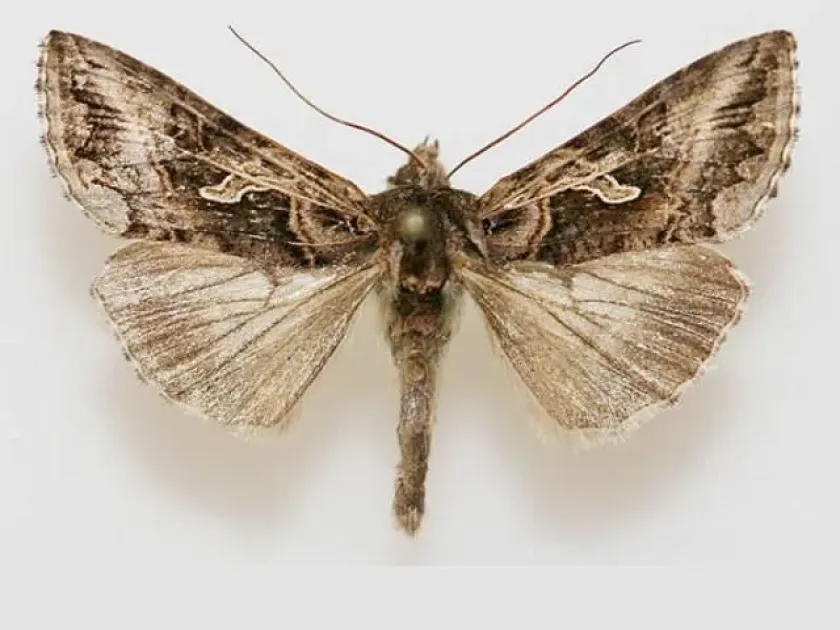
The Silver Y moth (Cornutiplusia circumflexa) is a member of the Noctuidae family within the order Lepidoptera. It is named for the distinctive silvery-white markings on its forewings, which often resemble a stylized letter 'Y' or a complex loop shape.
The adult moth has a wingspan of approximately 35–40 mm. Its forewings display various shades of grey and brown with a subtle metallic sheen, providing excellent camouflage against soil, bark, and foliage, which helps the moth remain inconspicuous during the day.
The larvae, or caterpillars, are typically bright green with thin, pale longitudinal lines running down their bodies. A key diagnostic feature is their movement: they possess fewer prolegs than other caterpillars, causing them to move with a characteristic looping motion, similar to inchworms.
The pupa is dark brown and develops within a loose, silken cocoon. These cocoons are typically attached to the undersides of leaves or hidden among plant debris, offering protection as the insect undergoes its transformation into an adult moth.
The lifecycle involves a complete metamorphosis: egg, larva, pupa, and adult. Depending on the geographical region and climate, the species can complete multiple generations within a single growing season, leading to rapid population growth in favorable conditions.
What it damages
This pest is highly polyphagous, meaning it feeds on a wide array of host plants. It is considered a significant threat to various agricultural crops, including vegetables, industrial crops, and ornamental species grown both in open fields and greenhouses.
Commonly affected crops include tomatoes, potatoes, brassicas, beans, and beets. The larvae are voracious eaters, and a high density of these caterpillars can result in substantial defoliation, which severely limits the plant's ability to produce a viable harvest.
Larval feeding causes ragged holes in the leaves. In cases of severe infestation, the larvae may skeletonize the entire leaf, leaving only the veins intact. This destruction reduces the leaf surface area available for photosynthesis, leading to stunted growth and lower yields.
Beyond direct tissue consumption, the damage caused by caterpillars can create entry points for secondary pathogens, such as bacteria and fungi. These infections can lead to soft rot or other diseases, further compromising the quality and shelf life of the produce.
The damage is most severe during the larval stage. While adult moths are harmless to vegetation as they only feed on nectar, their ability to travel long distances and lay hundreds of eggs makes them a potent source of potential infestation across large areas.
When it appears
Adult moth activity typically begins in the spring, once temperatures are sufficiently high. Migration patterns can play a role in their appearance, as these moths are known to travel significant distances in search of suitable host plants for oviposition.
The peak period for larval damage occurs throughout the summer months. Given that the moth can have multiple overlapping generations, the presence of caterpillars can be observed almost continuously until late autumn, provided the weather remains warm.
Optimal conditions for development involve warm, humid weather. Humidity is particularly important for the survival of eggs and first-instar larvae. Conversely, extreme heat or prolonged dry spells can suppress population levels, though localized irrigation often provides a microclimate for the pest.
Overwintering usually occurs as pupae in the soil or as young larvae in the crown of weeds. These life stages are resilient to the cold, allowing the pest to successfully emerge and start a new cycle as soon as the growing season resumes in the spring.
Monitoring using pheromone traps is the standard practice for detecting the arrival of adult moths. Early detection is vital for forecasting the potential pressure of larvae, allowing farmers to implement control measures before significant crop damage occurs.
Signs of infestation
The first signs of an infestation are small, irregularly shaped holes in the leaves. As the caterpillars grow, their appetite increases significantly, leading to larger and more frequent damage patterns across the foliage.
- Dark, granular excrement (frass) visible on leaves or on the ground beneath the plants.
- Thin webbing spun by the caterpillars, often used to bind leaves together for protection.
- The presence of looping, green-colored caterpillars when inspecting the underside of leaves.
- Yellowing or premature senescence of leaves that have been heavily grazed by larvae.
Inspecting the underside of leaves is the most reliable method for finding eggs. Eggs are small, semi-spherical, and usually laid singly, which makes them harder to spot than mass egg clusters of other moth species, requiring careful examination.
Increased moth flight activity around lights or within the canopy at dusk is a clear warning sign. If these observations are made, it is time to initiate more frequent field scouting to assess the larval population and determine if economic thresholds have been exceeded.
Control measures
Integrated pest management (IPM) is crucial for controlling this moth. Cultural practices, such as removing weeds around field borders, reduce the availability of alternative food sources and nesting sites for moths, thereby lowering the initial infestation pressure.
Biological control methods are effective, particularly when targeting younger larvae. Products containing Bacillus thuringiensis are widely used as they selectively target caterpillars while preserving beneficial predatory and parasitic insects in the agroecosystem.
Chemical control is employed when pest populations exceed economic thresholds. Insecticides, including pyrethroids or insect growth regulators, are effective. However, applications should be timed carefully to avoid damaging pollinators during bloom periods.
Resistance management is an essential aspect of chemical control. It is recommended to rotate insecticides with different modes of action to ensure long-term efficacy and prevent the pest population from developing resistance to common chemical treatments.
Deep plowing at the end of the season disrupts the pupae in the soil, which helps to reduce the survival rate of the overwintering generation. Coupled with routine field monitoring, these steps help keep the population of the Silver Y moth under control throughout the season.
Taxonomy
- Latin name
- Cornutiplusia circumflexa
- Order
- Lepidoptera (butterflies)
- Family
- Noctuidae
- EPPO code
- CRNICI
Discussion
No discussions yet — be the first.