
Golden-ringed dragonfly
Cordulegaster boltonii
Description
How to identify
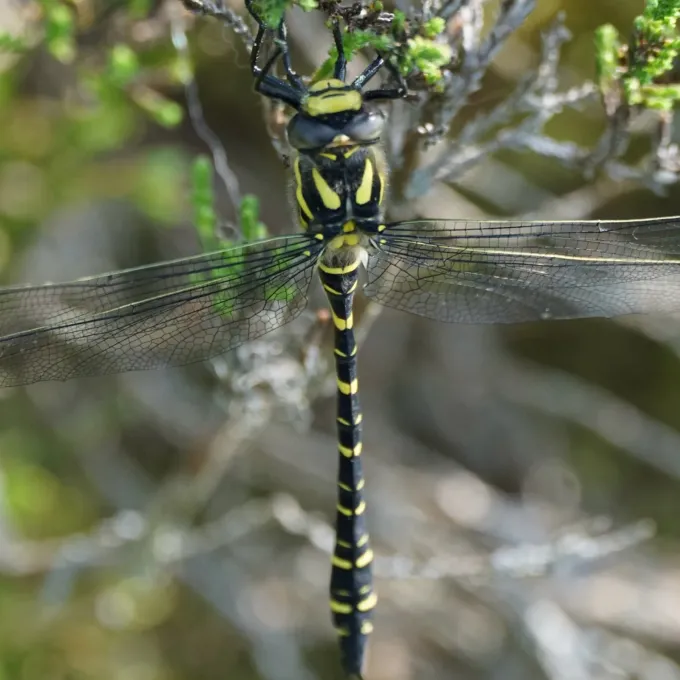
The Golden-ringed dragonfly (Cordulegaster boltonii) is a large, striking dragonfly species belonging to the Cordulegastridae family. Adult insects can reach lengths of up to 85 mm.
The species is distinguished by its vivid yellow rings on a black abdomen, which is a diagnostic feature. The eyes meet at a single point, which is typical for this family.
The larvae are also large, often measuring 45–50 mm. They are robust, burrowing creatures adapted for life in the silty, sandy bottoms of flowing water bodies.
Their body shape is flattened to facilitate movement through the substrate, while their coloring ranges from dark brown to black, providing perfect camouflage.
The life cycle of this species is complex, with larval development lasting between three and five years depending on the water temperature and food availability.
What it damages
The Golden-ringed dragonfly is not considered an agricultural pest. It acts as a predator in aquatic ecosystems, feeding on various small water organisms.
There is no record of this species damaging agricultural crops, seeds, or farm infrastructure. On the contrary, adult dragonflies consume many flying insects.
While their larvae reside in streams and drainage channels, they do not impact the efficiency of irrigation systems in a way that would require control measures.
In fact, the presence of these dragonflies is often a sign of a clean, healthy environment, suggesting that the nearby farmland is not polluted by heavy chemicals.
Their role in the ecosystem as predators helps maintain the balance of local insect populations, which can be beneficial to nearby agricultural areas.
When it appears
Adults of Cordulegaster boltonii are typically on the wing from late May through August, with peak activity observed during the warmest summer months.
During the flight season, males can be seen patrolling along the edges of brooks and rivers, protecting their territories from intruders.
Female dragonflies lay their eggs by thrusting their ovipositor into the silt of the stream bed, ensuring the larvae have a suitable environment to develop.
The larval stage is spent entirely in the water, where they remain active throughout the year, even during the winter months, provided the water does not freeze solid.
The emergence of the adult dragonfly from the larval skin usually occurs on emergent vegetation along the stream banks during the day.
Control measures
Since the Golden-ringed dragonfly does not cause harm to agricultural crops, there is no need for active pest control measures against this species.
If habitat reduction is desired for engineering purposes in drainage channels, routine maintenance like dredging can naturally discourage larval populations.
The use of insecticides in or near water sources should be strictly avoided, as these chemicals are highly toxic to aquatic life and disrupt the local ecological balance.
Effective water management and maintaining clear, flowing conditions in irrigation channels are sufficient to keep the dragonfly population at natural levels.
Preserving natural predators like fish and aquatic birds is the most sustainable approach to maintaining the health of the drainage system and its ecosystem.
Discussion
No discussions yet — be the first.