
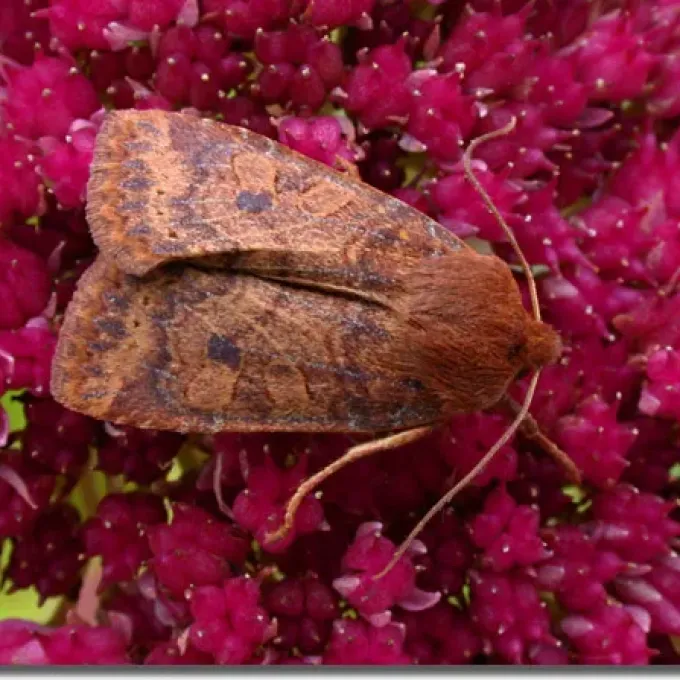
Chestnut-colored moth
Conistra vaccinii
Description
How to identify
The Chestnut-colored moth (Conistra vaccinii) is a member of the Noctuidae family. This nocturnal moth has a wingspan of approximately 30–40 mm. Its forewings display various shades of ochre and brown, often with dark markings, which provides excellent camouflage against tree bark.
The larvae of this species pass through several instars, eventually growing up to 40 mm in length. Their bodies vary from grayish-brown to yellowish-green, featuring fine white speckles and lighter lateral stripes, making them difficult to spot on foliage.
Taxonomically, it is classified under the order Lepidoptera. It is a hibernating species, meaning adults overwinter in sheltered locations, such as leaf litter, bark crevices, or soil, emerging as soon as the first spring temperatures allow.
The life cycle involves only one generation per year. Pupation takes place in the soil within protective cocoons. Moths emerge in late summer, remain active through the autumn, and then seek overwintering sites.
Identification is easiest in early spring when larvae emerge to feed on developing buds. Monitoring with pheromone traps during the late summer flight period is a standard practice for assessing population levels.
What it damages
The Chestnut-colored moth is a polyphagous pest that damages a wide range of fruit trees and shrubs. Primary hosts include apple, pear, plum, and cherry trees, as well as blueberry bushes, which are part of their natural habitat.
Larvae cause the most significant economic damage in early spring by feeding on swelling buds. By consuming the flower buds, they destroy the crop potential of the tree before blossoms can even open.
During the summer months, the caterpillars feed on leaves and young fruit. Damage to fruit manifests as irregular, deep holes, which often lead to secondary fungal infections, fruit deformation, and premature drop.
Large populations of this pest can result in substantial yield losses. Because larvae are highly mobile in later instars, they can migrate between plants, causing damage to spread across an entire orchard section.
The combination of bud destruction in spring and fruit damage in summer makes this moth a serious threat to productivity in both commercial orchards and private gardens.
Signs of infestation
The primary sign of infestation in early spring is the noticeable lack of flower buds or the presence of hollowed-out, damaged buds. If you carefully inspect the branches, you may find larvae hiding inside or near these buds.
Leaf damage appears as irregular holes or skeletonized tissue. Small, dark, granular frass (droppings) on the leaf surface is a reliable indicator that larvae have been feeding in the immediate vicinity.
Fruit damage appears as deep, darkened cavities or gouges. In cases of severe feeding, the fruit may become severely deformed as the surrounding tissue stops growing normally.
Evening inspections with a flashlight are highly effective for detecting the presence of caterpillars, as they feed primarily at night and remain inactive during the day.
Monitoring for adult moths using light traps or pheromone traps in the autumn serves as an early warning system, helping growers decide whether control measures will be needed the following spring.
Control measures
Cultural control methods include regular cultivation of the soil around the base of trees in autumn and early spring, which disrupts the overwintering pupae and reduces the next generation's size.
Sticky bands applied to tree trunks can help prevent the movement of larvae, particularly in gardens where chemical application is restricted or avoided.
Biological control, including the use of Bacillus thuringiensis-based products, is highly effective against young larvae and poses minimal risk to beneficial insects and the surrounding environment.
Chemical control should be timed carefully, targeting the period of bud burst when larvae are most vulnerable, to prevent damage to the reproductive organs of the plants.
- Timely application of contact or systemic insecticides in spring.
- Removal of weeds that provide alternative food sources for larvae.
- Encouraging natural predators such as birds and parasitic wasps.
- Using pheromone traps for accurate monitoring and timing of sprays.
Taxonomy
- Latin name
- Conistra vaccinii
- Order
- Lepidoptera (butterflies)
- Family
- Noctuidae
- EPPO code
- CONSVA
Discussion
No discussions yet — be the first.