
Alder casebearer
Coleophora fuscedinella
Description
How to identify
The Alder casebearer (Coleophora fuscedinella) is a moth species belonging to the Coleophoridae family. Adult moths have a wingspan of approximately 10–12 mm, with narrow wings and a brownish-grey color typical of the genus.
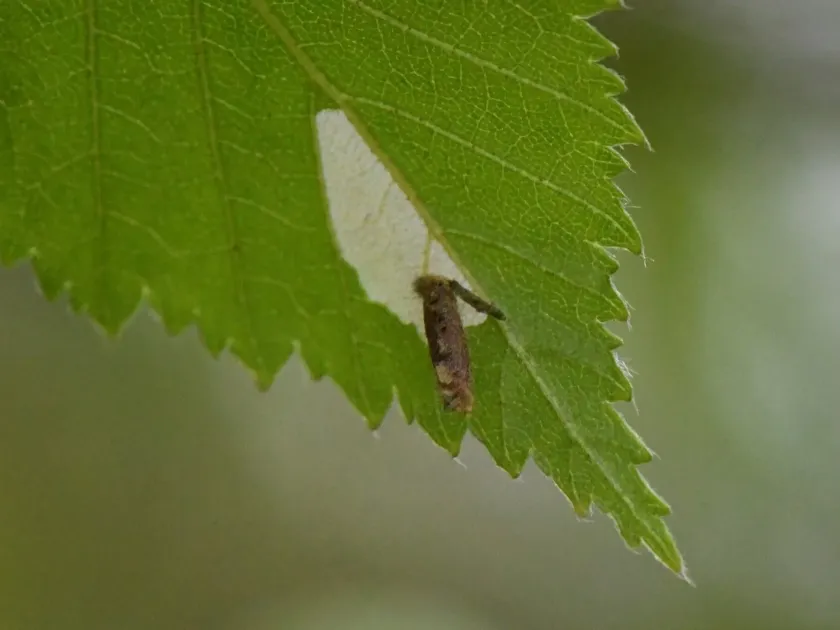
The larvae are distinct for their portable cases, which are constructed from silk and small leaf fragments. These cases serve as both protection and camouflage, often resembling small dry twigs or seeds found on the host plant.
The head and thorax of the larva are usually dark brown or black, a feature that helps specialists distinguish this species from other related Coleophora moths. As the larva grows, it enlarges its case to accommodate its increasing body size.
This species is widely distributed across temperate regions of Europe and Asia, thriving in areas where its primary hosts, such as alder and birch, are abundant.
The moth has a univoltine life cycle, meaning it produces only one generation per year. Adults are nocturnal, making them elusive and difficult to monitor without specialized pheromone traps.
What it damages
The Alder casebearer primarily attacks deciduous trees, most notably alder (Alnus), birch (Betula), and hazel (Corylus). In cases of high population density, it may also spread to other hardwoods like elm.
The damage is caused by the larvae, which feed on the leaf parenchyma. They create mines inside the leaf by eating the interior tissue while leaving the epidermis intact, resulting in characteristic translucent spots.
Heavy infestations lead to widespread leaf browning and premature defoliation. This significantly stresses the tree, reducing its ability to photosynthesize and slowing down overall growth rates.
Early in the spring, the larvae may feed on dormant buds, which can lead to stunted shoot growth and malformed branches, especially in younger saplings or decorative nursery stock.
The cumulative effect of annual damage can weaken mature trees, making them susceptible to secondary infections by wood-boring insects and pathogenic fungi.
When it appears
The larvae overwinter in their cases, typically attached to the bark of branches or near buds. Activity resumes early in the spring as soon as temperatures rise and buds begin to swell.
Pupation occurs in late spring or early summer, usually on the surface of the leaves. The pupal stage lasts about two to three weeks before the adult moth emerges.
Adult flight occurs from June through July. Females lay their eggs individually on the underside of leaves, usually near the midrib, ensuring the newly hatched larvae have immediate access to food.
Young larvae emerge in mid-summer and immediately begin constructing their protective cases. They feed and grow throughout the summer months, skeletonizing leaf tissues.
As autumn approaches, the larvae cease feeding and migrate to their overwintering sites, where they secure themselves with silk to survive the winter period.
Signs of infestation
The most prominent sign of infestation is the appearance of numerous small, irregularly shaped pale spots on the foliage. These are the result of the larvae mining the leaf interior.
The presence of the portable larval cases, which look like tiny debris or dried leaf scraps attached to the underside of leaves, is the definitive sign of the species' activity.
Trees affected by a large population may show a scorched appearance in mid-summer due to the extensive browning of leaves. Premature leaf drop is also common in heavily infested trees.
The accumulation of larval frass (droppings) under the tree canopy can sometimes indicate a significant infestation level that requires intervention.
Bud damage in early spring, characterized by dried or hollowed-out buds that fail to open properly, is a reliable indicator that the population density is high.
Control measures
Monitoring using pheromone traps is the most effective way to track adult emergence and determine the optimal timing for management actions.
Chemical control involving systemic insecticides can be highly effective when applied during the period of peak larval hatching. This ensures the target insects ingest the toxin while feeding.
Biological control, including the encouragement of natural predators like parasitic wasps (ichneumonids), is often sufficient to maintain the pest population below economic injury levels.
Sanitary pruning and removal of infested branches during the dormant winter season can significantly reduce the number of overwintering larvae and decrease next season's impact.
- Application of Bacillus thuringiensis based bio-insecticides for larval management.
- Enhancing habitat biodiversity to support natural populations of insectivorous birds and predatory insects.
- Regular canopy inspections in nurseries during the spring months.
Discussion
No discussions yet — be the first.