
Willow Moth
Cleoceris viminalis
Description
How to identify
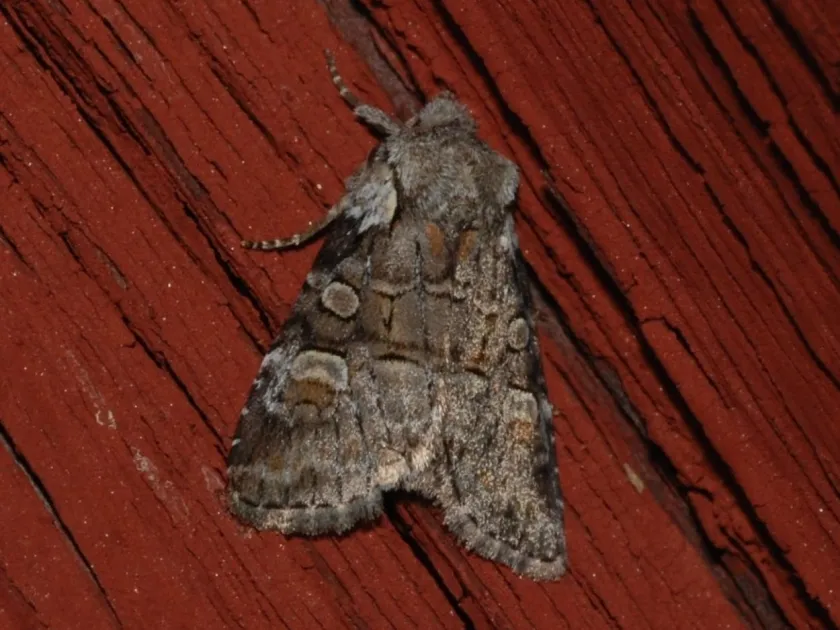
The Willow Moth (Cleoceris viminalis) belongs to the order Lepidoptera, family Noctuidae. The adult moth has a wingspan of approximately 28 to 32 mm.
The forewings have a greyish-brown or ashen colour pattern with darker cross-lines, providing excellent camouflage when the insect rests on tree bark.
The larvae, or caterpillars, possess a cylindrical body that is typically greenish or yellowish-green, often marked with light longitudinal stripes.
The head of the caterpillar is usually brown or yellowish, and the body is covered with sparse, fine hairs which assist during its developmental phases.
Pupation occurs within a silken cocoon, which the larvae usually construct among debris in the soil at the base of the host tree or within bark crevices.
What it damages
The primary host plants for this pest include various species of willow (Salix) and poplar (Populus), which are vital in many forest ecosystems.
Caterpillars feed on the leaves, starting with minor damage and progressing to extensive defoliation, leaving only the primary veins of the leaves.
In years of population outbreaks, this pest can cause significant damage to forest stands, plantations, and urban green spaces.
Severe defoliation weakens the host trees, reducing their annual growth rates and making them more susceptible to secondary environmental stressors.
Young trees and nursery stock are particularly vulnerable to larval feeding, which can lead to stunted growth or mortality if left unmanaged.
When it appears
Adult moths are typically active during the summer months, with the primary flight period occurring in July and August.
After mating, females lay eggs on the bark or near the buds of host trees, where they remain throughout the winter.
Larvae hatch in early spring, precisely when the host trees begin to bud and leaf out, providing an immediate food source.
The peak larval feeding period occurs during May and June, as the caterpillars grow rapidly before entering the pupal stage.
The species completes one generation per year, making it a univoltine insect that responds directly to seasonal temperature cues.
Signs of infestation
The first signs of infestation are ragged leaves where the interveinal tissue has been consumed, leaving behind a skeletal appearance.
The accumulation of frass (larval droppings) on the leaves or on the ground beneath the tree canopy is a clear indicator of larval presence.
Look for silken webs or rolled leaves, which the caterpillars use as protective retreats during daylight hours.
A rustling or clicking sound within the canopy during calm weather can indicate a high density of feeding larvae.
Deformation of growing shoot tips is another common sign, often occurring when larvae feed on tender new growth early in the season.
Control measures
Biological control methods, such as the application of Bacillus thuringiensis, are highly effective against larval populations while being environmentally friendly.
Chemical control using systemic or contact insecticides may be necessary during severe outbreaks in high-value plantations or nursery settings.
Cultural practices, including the removal and destruction of leaf litter and debris from under the trees, can help reduce overwintering populations.
Promoting a diverse environment to support insectivorous birds and parasitic wasps provides a natural suppression mechanism for the Willow Moth.
Regular monitoring using light or pheromone traps allows land managers to determine the optimal timing for intervention before significant damage occurs.
Taxonomy
- Latin name
- Cleoceris viminalis
- Order
- Lepidoptera (butterflies)
- Family
- Noctuidae
- EPPO code
- CLECVI
Discussion
No discussions yet — be the first.