
Cleoceris viminalis
Cleoceris
Description
How to identify
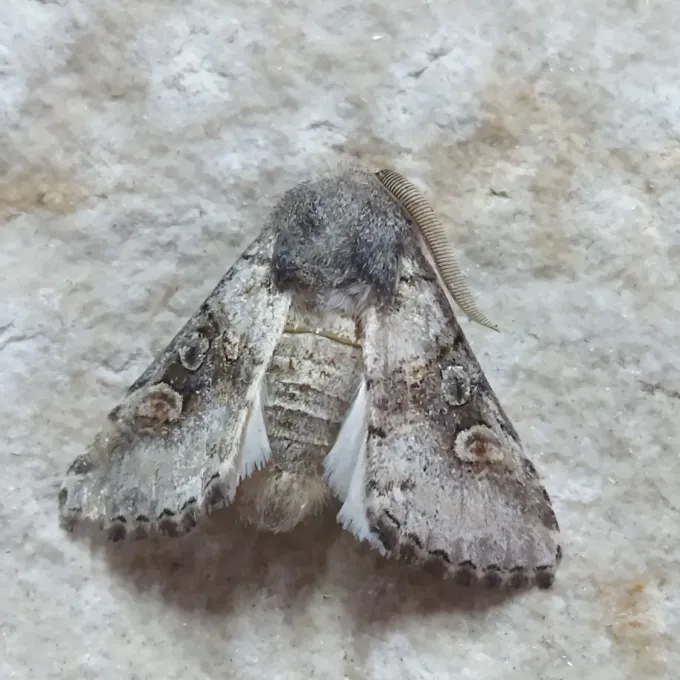
Cleoceris viminalis is a species of moth in the family Noctuidae, belonging to the order Lepidoptera. The adult moth has a wingspan of approximately 30–35 millimeters, and the color of its forewings ranges from gray to brownish-gray with a distinct pattern, providing excellent camouflage against tree bark.
The larvae (caterpillars) of this species can grow to 30–40 millimeters in length. Their bodies have a greenish or grayish-green hue, allowing them to hide effectively among the foliage of their host plants. The head is usually darker than the body, which is a diagnostic feature used to identify the larvae.
The biology of this species is closely linked to woody plants. The moths are nocturnal, remaining stationary on tree trunks during the day, mimicking small twigs or patches of bark. Adult activity occurs in the second half of the summer when mating and egg-laying take place.
The species usually overwinters in the egg stage, with eggs deposited on the bark or buds of host plants. This survival strategy allows the species to successfully withstand winter temperatures and synchronize larval emergence with the beginning of the plant's vegetation period in spring.
For accurate identification, tree canopies should be inspected at night using light traps, or branches should be visually examined for young larvae in early spring.
What it damages
The primary food source for Cleoceris viminalis larvae are plants from the willow family (Salicaceae). The pest mainly targets various species of poplars, including black poplar and aspen, and less frequently, willows.
In cases of mass outbreaks, the caterpillars can cause significant damage to young plantations and shelterbelts. They actively feed on emerging buds and young leaves, leading to severe defoliation of the trees during the spring season.
Damage to buds and tender shoots in early spring negatively affects the growth rate of seedlings and young trees. Intense larval feeding weakens the plant's immune system, making it vulnerable to other pathogens and secondary pests.
In forestry and the cultivation of ornamental avenue trees, the presence of Cleoceris viminalis can lead to a loss of aesthetic appeal due to leaf tissue damage.
Significant damage is observed in nurseries, where the consumption of terminal buds leads to stem curvature and disrupts the proper development of the tree's crown architecture.
When it appears
The life cycle of Cleoceris viminalis shows clear seasonality tied to the phenological phases of willow species. The primary damage occurs in spring when larvae are actively feeding after emerging from their eggs.
The larval feeding period coincides with the bud-burst phase and the active growth of the poplar canopy. During this time, the larvae are at their most voracious and visible on the tree branches.
Pupation usually occurs in the soil or within crevices of bark in early summer. The flight of the next generation of moths occurs in the second half of summer, typically in July and August.
The adult moth flight continues until autumn, at which point females begin laying eggs on potential host plants. In this state, the species awaits the arrival of spring, passing through a diapause.
Monitoring of the population is recommended in early spring, at the moment of bud burst, when the larvae are most susceptible to protective treatments.
Control measures
Both biological and chemical methods of control are used to manage Cleoceris viminalis. The use of systemic and contact insecticides is effective during the early larval development stages.
In parks and nurseries, it is recommended to use products based on bacterial entomopathogens (such as Bacillus thuringiensis), which demonstrate high selectivity and environmental safety.
Mechanical removal of caterpillars from young trees is only feasible in small areas, as it is labor-intensive and does not provide control over the population on mature, tall trees.
An important element of agricultural management is maintaining the health of the plantings, as robust trees tolerate short-term foliage loss better. Proactive sanitary pruning helps reduce the pest's egg load.
- Use of pheromone traps to monitor adult moth flight activity.
- Application of chemical insecticides during the "green cone" phenological phase.
- Encouraging the presence of entomophagous insects and insectivorous birds in the area.
Taxonomy
- Latin name
- Cleoceris
- Order
- Lepidoptera (butterflies)
- Family
- Noctuidae
- EPPO code
- CLECSP
Discussion
No discussions yet — be the first.