
Claassenia stonefly
Claassenia
Description
How to identify
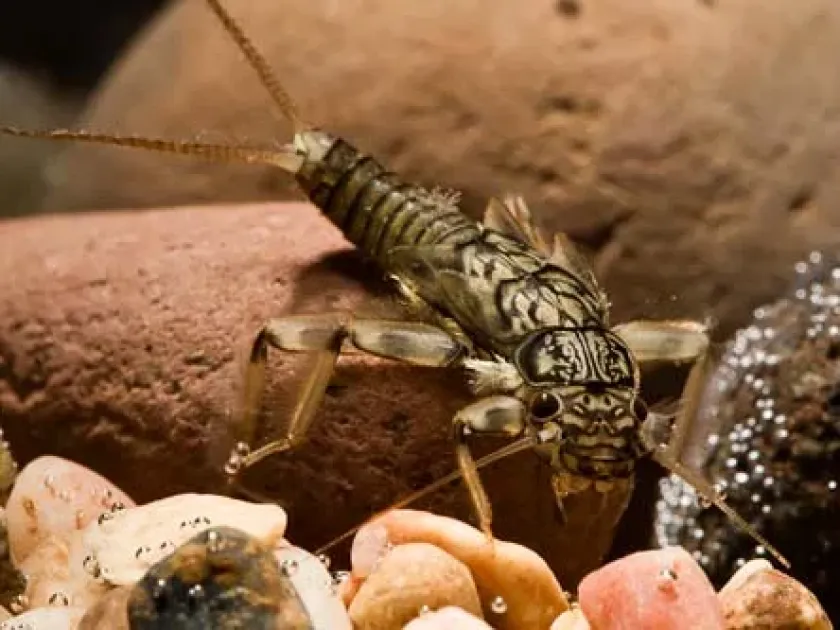
Claassenia is a genus of stoneflies belonging to the order Plecoptera and the family Perlidae. These insects are known for their specific morphological traits and relatively large body size.
Adult stoneflies in this genus possess a soft, elongated body, typically measuring 25-40 mm in length, with distinctive veined wings that lie flat over the abdomen.
The larvae are aquatic and live in flowing water bodies, characterized by two long cerci at the end of the abdomen and a robust body shape adapted to current.
Adults exhibit cryptic behavior, often hiding in cool, shaded areas during the day to avoid desiccation, and are most active during the night.
Identification of the genus involves examining the wing venation and the male genitalia, as external appearances can be similar across several stonefly species.
What it damages
While stoneflies are primarily aquatic and ecologically beneficial as water quality indicators, they can occasionally cause damage to crops located near water sources.
Adults emerging from the water may feed on the foliage of agricultural or horticultural plants near riverbanks or streams, leading to localized leaf consumption.
Young sprouts and leaves of vegetables or berries are most susceptible to damage, especially when the insect population density is high during peak emergence.
The damage caused by feeding manifests as irregular notches or missing tissue on the leaf blades, which can affect the plant's overall photosynthetic capacity.
Economic damage is typically minimal and restricted to fields bordering riparian zones, though it can become a nuisance in specific years with massive emergence events.
When it appears
The life cycle of Claassenia is intrinsically tied to the aquatic environment, where larvae spend one to several years before metamorphosing into adults.
The emergence of adults usually occurs in late spring or early summer, depending on local climate conditions, water temperature, and regional factors.
This peak activity period is relatively short, focusing on mating and the return of females to the water to deposit eggs for the next generation.
During the day, adults seek shelter in dense vegetation or under rocks, making early morning or dusk the best times to perform crop inspections for their presence.
Monitoring should be focused on the transition period between water and land, particularly in fields adjacent to cold, oxygen-rich flowing waters.
Signs of infestation
The presence of Claassenia can be detected by observing ragged, irregular feeding patterns on the leaves of crops located near water sources.
Spotting adult stoneflies on leaves, stems, or ground near the field border is a clear sign of their presence in the immediate vicinity.
Discarded larval exoskeletons found on stones or plant stems near the water edge provide confirmation of recent emergence and potential presence of the pest.
Plants with significant tissue loss may exhibit reduced growth rates, and large necrotic patches might appear where the feeding was particularly intense.
Nighttime observation with artificial lighting near the stream edges can reveal the presence of numerous adults, confirming high population pressure.
Control measures
The most effective strategy for managing these insects is to maintain a buffer zone of native vegetation between agricultural fields and water sources.
Physical barriers or hedges can reduce the immigration of adult stoneflies from the riparian zone into the cultivated areas of the farm.
Using light traps in the evening can help manage the adult population without the need for broad-spectrum chemical insecticides, which is crucial near water.
Regular maintenance of fields and clearing weeds near water access points discourages stoneflies from seeking refuge in the vicinity of crops during the day.
Integrated Pest Management (IPM) practices focusing on non-chemical deterrents ensure the protection of crops without harming the aquatic ecosystem.
Taxonomy
- Latin name
- Claassenia
- Family
- Perlidae
- EPPO code
- CLAASP
Discussion
No discussions yet — be the first.