
Pine aphid
Cinara pinea
Description
How to identify
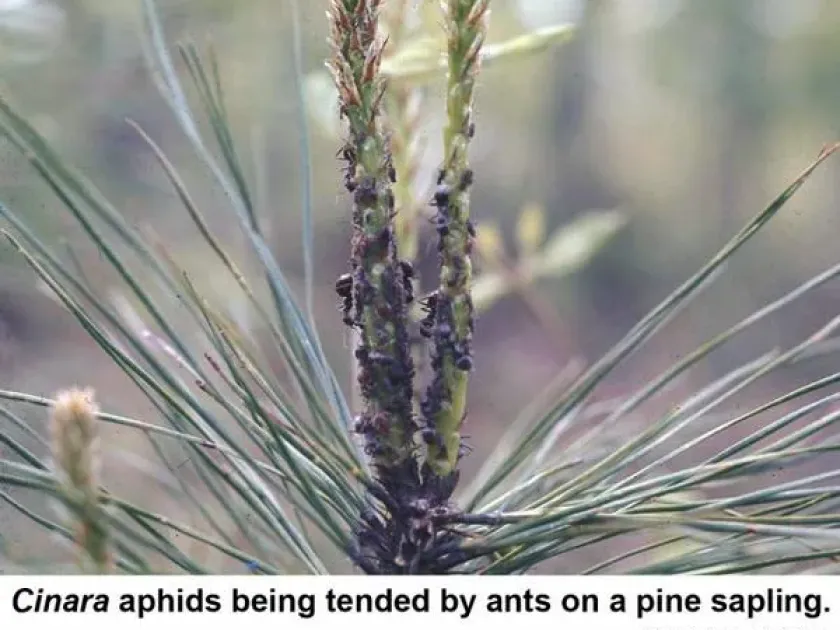
The pine aphid (Cinara pinea) belongs to the order Hemiptera and the family Aphididae. These are relatively large insects, typically measuring 3–4 mm in length, with a coloration ranging from brown to nearly black, often covered in a fine, powdery wax coating.
Adults and nymphs possess a strong proboscis designed to pierce the thick bark of young shoots. They are often sedentary, forming dense colonies along branches, which makes them quite visible during detailed tree inspections.
Reproduction occurs through both sexual and parthenogenetic pathways. Several generations develop throughout the season, and eggs overwinter on needles and bark, ensuring high survival rates for the species in temperate climates.
The presence of these aphids is frequently signaled by ants, which tend the colonies to feed on the honeydew secreted by the insects. This symbiotic relationship acts as a crucial indicator for foresters and gardeners to locate infestations.
The colonies tend to cluster on one- to two-year-old shoots, preferring well-lit sections of the tree crown. Population growth is highly dependent on weather conditions, with warm and dry spring weather accelerating their reproductive cycle.
What it damages
The primary hosts for Cinara pinea are various species of pine, including Scots pine and Crimean pine. The aphids extract sap from tender shoots, which drains the tree of vital nutrients and weakens its overall physiological state.
Beyond direct feeding damage, the pest acts as a vector for various infections. Through the micro-wounds created by their proboscis, pathogens can enter the tree tissues, leading to bark necrosis and the subsequent drying out of branches.
Heavy infestations significantly reduce needle growth and detract from the ornamental value of the tree. Severely stressed saplings may lose their resistance to adverse environmental factors, such as drought or frost.
The secretion of honeydew provides a substrate for sooty mold growth, which coats the needles in a black layer. This prevents photosynthesis, further depriving the tree of the energy needed for growth and recovery.
In nurseries and commercial forest stands, Cinara pinea poses a significant risk to young trees. Without timely intervention, persistent infestations can result in the loss of saplings, leading to considerable economic losses.
When it appears
The lifecycle begins in early spring when the overwintered eggs hatch into nymphs. This timing usually aligns with the start of active sap flow in conifers, providing the necessary nutrition for the rapidly growing aphid population.
Multiple generations succeed one another throughout the spring and summer months. Peak population density is typically observed between late May and June, marking the period when vigilant monitoring is most critical.
As autumn approaches, sexual individuals appear, mate, and lay eggs. These eggs enter a state of diapause and are firmly attached to the bark of young shoots, where they remain throughout the winter months.
In years with a prolonged, warm autumn, an additional batch of eggs may be laid, increasing the risk of a population outbreak in the following year. The eggs are highly cold-resistant, ensuring high survival during the winter season.
Regular inspections should commence as early as April to check the undersides of shoots. Early detection is vital for successful management, as it allows for control before the aphid colonies reach unmanageable densities.
Signs of infestation
One of the most obvious signs of infestation is the premature yellowing and shedding of needles. If a tree appears stressed or stunted for no apparent reason, a thorough search of the branches for aphid colonies is recommended.
A sticky residue on the foliage, often attracting ants, wasps, and flies, is a reliable sign of aphid activity. The subsequent appearance of a black sooty mold on the needles confirms the presence of these sap-sucking pests.
Close observation may reveal deformation of young shoots, which can become twisted or stunted due to the toxins injected by the aphids while feeding. This causes long-term structural issues for the tree.
- Yellowing of needles early in the growing season.
- Persistent ant activity on branches and stems.
- Sticky honeydew secretions on the needles and bark.
- Growth of black sooty mold on foliage.
- Deformation and drying out of succulent young shoots.
In extreme cases, the needles turn brown and drop off at the slightest touch. This indicates a severe infestation that may require aggressive treatment to prevent the permanent loss of the tree's health or survival.
Control measures
The most effective management strategy involves the use of systemic insecticides. Products containing active ingredients like imidacloprid can be absorbed into the tree's tissues, effectively targeting aphids that feed on the sap.
Biological control agents, including lady beetles, lacewings, and hoverflies, serve as natural predators. Enhancing the environment to attract these beneficial insects can significantly suppress aphid populations naturally.
Proper cultural practices are essential for boosting the tree's immune system. Adequate watering, balanced fertilization without excessive nitrogen, and maintaining optimal spacing help make the trees less attractive to pests.
For localized infestations on small trees, mechanical removal of aphid colonies followed by applications of insecticidal soap or horticultural oils can be safe and effective alternatives to broad-spectrum chemical sprays.
Monitoring and scheduled preventative treatments should be based on the local emergence of nymphs. An integrated pest management (IPM) approach is recommended to balance efficacy with environmental stewardship.
Discussion
No discussions yet — be the first.