
Eucalyptus leaf beetle
Chrysophtharta
Description
How to identify
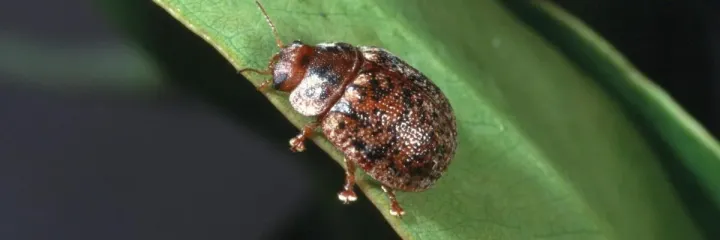
The Eucalyptus leaf beetle belongs to the family Chrysomelidae within the order Coleoptera. Adult beetles are typically oval or rounded, measuring between 6 to 12 millimeters in length.
Their color varies from golden-green to brown, often displaying a metallic sheen that provides camouflage against the foliage. The larvae, which are the primary feeding stage, are often slug-like in appearance.
The life cycle encompasses four distinct stages: egg, larva, pupa, and adult. Females lay clusters of eggs on the underside of leaves, creating protected sites for the developing larvae.
Depending on climatic conditions, the species can complete several generations within a single growing season. Optimal temperatures and high humidity significantly accelerate the development of these insects.
Adults are typically active during the warm months, seeking out young and succulent foliage for feeding and oviposition.
What it damages
The primary hosts for this pest are species within the genus Eucalyptus. The beetle shows a preference for young trees and saplings, which possess less chemical defense compared to mature foliage.
Both adults and larvae feed on leaves and tender terminal shoots, causing significant defoliation. This damage hinders the tree's photosynthetic capacity and reduces overall vigor and growth rates.
Severe infestations can lead to the death of young seedlings or terminal dieback, permanently altering the tree's architecture. In forestry plantations, this pest can cause substantial economic losses.
Repeated defoliation places trees under stress, making them susceptible to opportunistic secondary pathogens. The aesthetic quality of ornamental eucalypts is also severely compromised.
While mature trees are generally more resilient, heavy outbreaks can still cause crown thinness and branch death in susceptible species.
Signs of infestation
Initial signs of an infestation include the presence of irregular "windows" or jagged edges on leaves. These symptoms occur when adults consume leaf tissue while leaving tougher veins intact.
Larval feeding is often more destructive, appearing as large patches where the leaf epidermis has been completely removed. Insect frass (excrement) is commonly visible on the surface of the leaves.
Stunted growth or curling of young shoots often indicates that the larvae are targeting the apical meristems. A strong, pungent aroma may be detected near infested trees due to essential oils released by damaged tissues.
Pupae may be found attached to leaves, stems, or even the bark of the host tree, marking the conclusion of a life cycle stage. Early morning surveys are most effective for observing live beetles.
Widespread yellowing or browning of the canopy is a late-stage symptom of severe infestation and indicates a need for immediate intervention.
Control measures
Management strategies require an integrated approach focusing on early detection and targeted treatments. Systemic insecticides are highly effective as they protect the foliage from within.
Biological control using naturally occurring predators and parasitoids is a key component in sustainable management programs. These natural enemies help maintain population levels below the economic threshold.
Cultural practices, such as maintaining optimal soil health and proper hydration, ensure that trees have the resources required to regenerate lost foliage quickly. Manual removal is feasible in small-scale nurseries.
Regular monitoring using traps allows foresters to time chemical applications precisely when larvae are most vulnerable. Rotating different classes of pesticides is essential to prevent the development of resistance.
- Deployment of pheromone-based monitoring stations.
- Sanitary pruning of heavily infested branches to reduce local populations.
- Implementation of beneficial insect release programs.
Discussion
No discussions yet — be the first.