
Soybean looper
Chrysodeixis includens
Description
How to identify
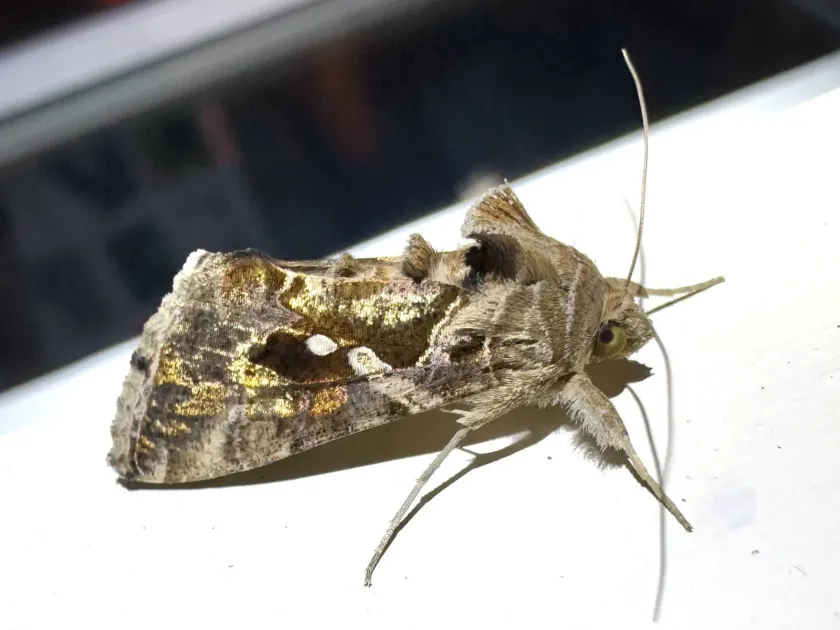
The soybean looper (Chrysodeixis includens) is a member of the Noctuidae family, order Lepidoptera. The adult moth has a wingspan of approximately 30–35 mm, with golden-brown forewings featuring distinct silver markings.
Larvae go through six distinct instars during their development. Young larvae are pale green, gradually deepening in color as they mature, often showing white stripes along their bodies.
A key identification feature of the looper larvae is the presence of only two pairs of abdominal prolegs, which causes them to move in a characteristic looping motion, typical for the Plusiinae subfamily.
The pupa is initially green and darkens to brown or black as it nears eclosion. It is enclosed in a light, white, mesh-like silk cocoon, often spun on the underside of a leaf.
Eggs are hemispherical in shape with a ribbed surface. They are typically laid individually on the underside of host plant leaves.
What it damages
While soybeans are the primary host, the soybean looper is highly polyphagous and feeds on over 150 different plant species across various families, including legumes and solanaceous crops.
Other common hosts include beans, tomatoes, corn, sunflower, and cotton, as well as various weed species that serve as early-season reservoirs for the population.
Early-instar larvae feed on the leaf epidermis and parenchyma, creating small, non-penetrating "windows" or translucent spots on the leaf surface.
As larvae reach later instars, they skeletonize the leaves, consuming all but the major veins, which significantly impairs the plant's photosynthetic capacity and reduces yield.
In cases of severe infestation, the larvae may feed on pods and seeds, causing direct damage and opening pathways for opportunistic fungal and bacterial pathogens.
When it appears
The lifecycle duration of the soybean looper is highly dependent on ambient temperature and humidity, with the generation time often ranging from 3 to 4 weeks under optimal conditions.
Adult moths are primarily nocturnal. In warmer climates, the insect can produce multiple generations per growing season, leading to significant pressure on crops.
The flight periods of the moths typically align with the vegetative and flowering stages of soybeans, providing ample opportunities for oviposition and development.
Peak larval activity is usually observed in the second half of the growing season, during the pod-filling stages, which are critical for yield determination.
The insect typically overwinters as a pupa in the soil or within plant debris, emerging as temperatures rise in the spring to start a new cycle.
Signs of infestation
The first sign of an infestation is the appearance of small, translucent "window-pane" spots on the lower canopy leaves, indicating the presence of young larvae.
Frass (larval droppings) accumulating on the leaves beneath feeding sites is a reliable indicator of active larval presence and increasing infestation levels.
Extensive leaf skeletonization, where only the vein structure remains, signals that the population has transitioned to larger, more destructive larval instars.
Feeding damage on pods, manifested as deep holes or tunnels, indicates a transition of the larvae to reproductive plant parts, significantly impacting seed quality.
Premature leaf drop and generalized chlorosis of the canopy are late-stage symptoms that correlate with significant yield losses if not managed in time.
Control measures
Integrated Pest Management (IPM) is essential for soybean looper control, utilizing pheromone traps to monitor adult flight patterns and determine optimal treatment windows.
Cultural practices, such as deep tillage to destroy overwintering pupae and rigorous weed management, are crucial for reducing the initial pest population density.
Biological control includes the use of natural enemies like Trichogramma wasps and microbial insecticides based on Bacillus thuringiensis, which are effective against young larvae.
Chemical control is implemented when thresholds are exceeded, utilizing insecticides from various mode-of-action groups to suppress larval populations.
- Regular scouting of fields during the flowering stage.
- Crop rotation to break the pest's host-preference cycle.
- Rotation of insecticide classes to mitigate the risk of resistance development.
- Maintaining field borders free of host weeds to limit re-infestation.
Taxonomy
- Latin name
- Chrysodeixis includens
- Order
- Lepidoptera (butterflies)
- Family
- Noctuidae
- EPPO code
- PSEPIN
Discussion
No discussions yet — be the first.