
Golden twin-spot moth
Chrysodeixis chalcites
Description
How to identify
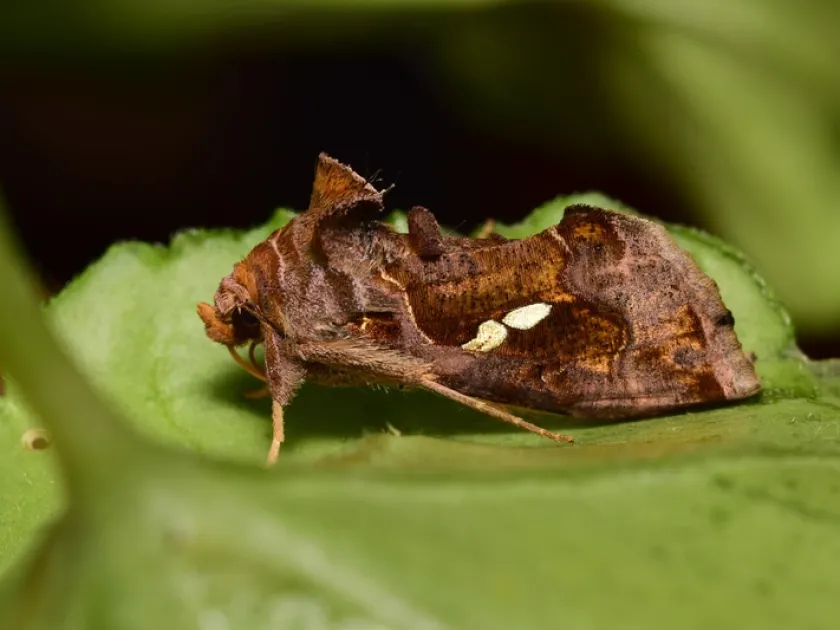
The golden twin-spot moth is a widespread polyphagous pest belonging to the Noctuidae family. Adult moths have a wingspan of 30–45 mm, with forewings displaying metallic gold and brown patterns.
The most distinctive feature of the imago is two silvery, metallic spots in the center of the forewings, often appearing as a small droplet or the Greek letter 'gamma', making identification straightforward.
Larvae pass through five instars, growing up to 40 mm. They are bright green with faint lateral white lines and possess a characteristic looping movement due to their specific proleg arrangement.
Pupation occurs within a loose white silken cocoon, usually spun on the underside of host plant leaves, where the pupa remains protected during development.
Eggs are hemispherical with a ribbed surface, typically cream-colored, and are deposited singly or in small clusters on the foliage of preferred host plants.
What it damages
This pest affects a vast array of crops, including vegetables like tomatoes, peppers, cucumbers, and potatoes, as well as many ornamental flowering species.
In greenhouses, the golden twin-spot moth is a major threat to chrysanthemum and geranium production, where larvae can quickly devastate decorative foliage.
Early-instar larvae skeletonize leaves by feeding on the mesophyll tissue, leaving the veins intact, which significantly reduces the plant's photosynthetic efficiency.
As larvae mature, they consume entire leaf blades and frequently move to flowers and fruit, boring deep, irregular cavities into the plant tissue.
Fruit damage not only renders the produce unmarketable but also opens entry points for secondary pathogens, leading to rot and further yield losses.
When it appears
In warmer climates, the golden twin-spot moth can reproduce year-round, especially in greenhouse environments where host plants are always available for larval feeding.
The developmental cycle from egg to adult takes approximately 30–45 days under optimal conditions, allowing for multiple generations per year in temperate regions.
Adult flight activity typically peaks during late spring and throughout the summer, as warmer temperatures significantly accelerate the larval growth rate.
The pest overwinters as pupae or larvae, often sheltered within the soil, under crop debris, or in protected structures that maintain sufficient warmth.
In field conditions, population density often reaches its maximum in late summer and early autumn, coinciding with the maturation of many vegetable crops.
Signs of infestation
The presence of frass (larval droppings) on the leaves beneath feeding sites is one of the first indicators of an infestation in the field or greenhouse.
Visible feeding damage includes irregular holes in leaf blades and clear windows where only the upper or lower epidermis of the leaf remains.
Larvae often web leaves together using thin silken threads to create a sheltered environment, which is a key sign of their presence during routine scouting.
Active larvae can be spotted by shaking the foliage or inspecting the underside of leaves, especially during the cooler hours of the early morning.
Damage to fruits, characterized by unsightly holes and decaying tissue, indicates a severe infestation that requires immediate pest management intervention.
Control measures
Effective management begins with robust sanitation practices, such as removing crop residues and weeds that serve as alternative food sources for the larvae.
Deploying pheromone traps is essential for monitoring moth flight patterns, enabling growers to time their insecticide applications for maximum effectiveness.
Biological control using formulations based on Bacillus thuringiensis is highly effective against young larvae and is safer for non-target beneficial insects.
Chemical control should be employed strategically, targeting larvae before they bore into the fruit, based on established economic thresholds for specific crops.
- Implementing crop rotation to break the pest's reproductive cycle.
- Utilizing egg parasitoids like Trichogramma to reduce population growth.
- Installing fine-mesh screening on greenhouse vents to physically exclude adult moths.
Taxonomy
- Latin name
- Chrysodeixis chalcites
- Order
- Lepidoptera (butterflies)
- Family
- Noctuidae
- EPPO code
- PLUSCH
Discussion
No discussions yet — be the first.