
Silver Y moth
Chrysodeixis argentifera
Description
How to identify
The Silver Y moth, Chrysodeixis argentifera, belongs to the family Noctuidae within the order Lepidoptera. The adults are nocturnal moths with a wingspan ranging from 30 to 35 mm.
The forewings are characterized by bronze-brown coloration with a prominent silvery-white patch in the center, often shaped like a drop or a comma, which distinguishes this species.
The hindwings are usually paler, displaying a grayish-brown hue. The moth's body is covered in dense scales and hairs typical of the Plusiinae subfamily members.
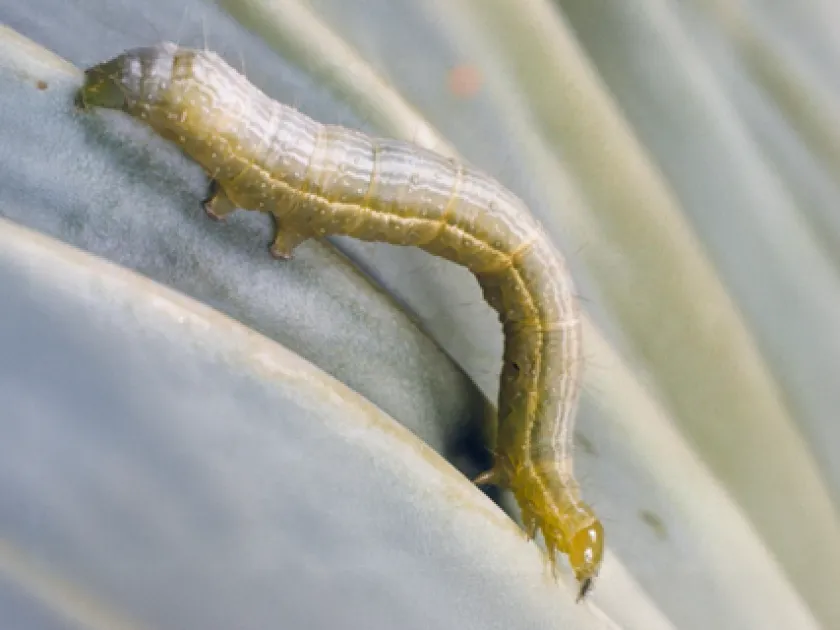
Young larvae are green, providing excellent camouflage against the foliage. As they mature, their body color becomes more vibrant, often featuring thin, light longitudinal stripes.
A distinctive behavioral trait of these larvae is the presence of only three pairs of abdominal prolegs, causing them to move in a characteristic looping motion common to "looper" moths.
What it damages
This pest is a significant polyphage known to cause economic damage to a wide array of agricultural crops, including both vegetable and field varieties.
Preferred hosts include tomatoes, potatoes, brassicas, lettuce, and various legumes such as soybeans, making it a major concern for greenhouse and open-field producers.
Larvae feed aggressively on leaf blades, leaving behind irregular, ragged holes. In cases of high infestation, they may consume entire leaves, leaving only the midribs intact.
Beyond leaf consumption, the larvae can damage buds, flowers, and developing fruits, significantly reducing the market quality and overall yield of the agricultural output.
High population densities can lead to rapid defoliation of young plants, potentially causing total crop failure if immediate protective measures are not implemented.
When it appears
The development cycle of the Silver Y moth is highly dependent on environmental temperature. The adult flight period begins in late spring and continues throughout the summer until autumn.
Females lay eggs singly or in small clusters on the underside of leaves. The duration of the life cycle from egg to adult can be as short as three weeks under warm conditions.
Due to the short developmental time, several generations can occur within a single growing season, leading to rapid increases in pest pressure during peak summer months.
Pupation takes place on the host plant inside a loose, silk cocoon, often spun within folded leaves or between the plant foliage, providing protection for the pupa.
Overwintering typically occurs in the pupal or larval stage in sheltered areas. In climate-controlled greenhouses, the life cycle may continue uninterrupted throughout the winter.
Signs of infestation
Early signs of infestation include small, irregular "windows" on the leaf surface where young larvae have grazed on the tissue without puncturing the cuticle completely.
The presence of dark, granular fecal pellets on leaves or the soil surface is a clear indicator that active feeding is occurring in the immediate vicinity.
Adult moths are often visible during the evening hours, hovering near light sources or feeding on nectar from flowering plants, which can be monitored with light traps.
Curled or webbed leaves indicate the presence of cocoons, marking the transition stage where the larva is transforming into an adult moth.
Stunted growth or wilting of individual plant parts due to extensive leaf damage are major indicators of a high pest population that requires urgent intervention.
Control measures
Effective management begins with strict field hygiene, including the removal of weeds that act as alternate hosts and deep plowing to disturb overwintering sites.
Pheromone traps are essential tools for monitoring adult moth populations, allowing farmers to predict the emergence of larvae and schedule pesticide applications precisely.
- Application of bio-rational pesticides like Bacillus thuringiensis for safe and selective larval control.
- Use of targeted insecticides applied during the peak hatching period to maximize mortality of early-stage larvae.
- Biological control using parasitoids such as Trichogramma wasps to suppress egg populations in the field.
Insecticide applications are most effective when carried out during twilight or night hours, as the larvae are nocturnal and more active during these times.
In greenhouse environments, installing insect-proof netting on vents and doorways prevents the influx of migratory moths from surrounding areas, reducing the risk of infestation.
Taxonomy
- Latin name
- Chrysodeixis argentifera
- Order
- Lepidoptera (butterflies)
- Family
- Noctuidae
- EPPO code
- PYTOAR
Discussion
No discussions yet — be the first.