
Army cutworm
Chorizagrotis agrestis
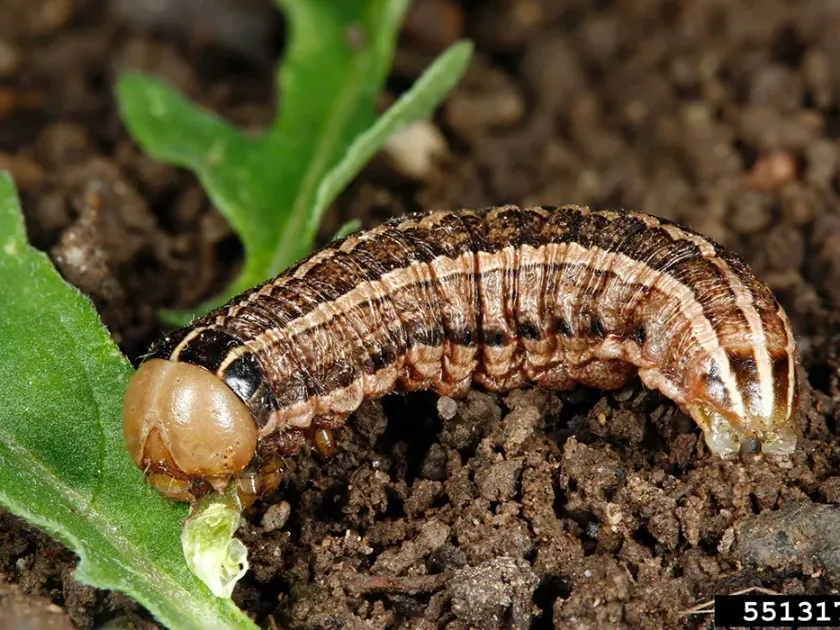
Description
How to identify
The army cutworm (lat. Chorizagrotis agrestis) belongs to the Noctuidae family, order Lepidoptera. The adult is a nocturnal moth with a wingspan of up to 40 mm, exhibiting gray or brownish tones with a distinct pattern on its forewings.
The larvae, known as cutworms, vary in color from light gray to almost black, allowing them to camouflage effectively in soil or plant debris. As they develop, the larvae go through several instars, increasing in size and becoming highly voracious.
Pupation takes place in the soil at a depth of several centimeters within specialized earthen cells. This species is characterized by high adaptability to diverse climatic conditions, which contributes to its widespread geographic range.
Systematically, this pest falls into the "cutworm" group, defining its primary feeding strategy during the early growth stages of plants. The high fecundity of the females ensures rapid population recovery under favorable conditions.
The life cycle includes complete metamorphosis: egg, larva (caterpillar), pupa, and adult. Depending on the region, the developmental speed may vary, but the fundamental biological principles remain consistent across its range.
What it damages
This pest affects a wide range of agricultural crops, including cereals such as wheat, barley, and oats. Other crops at risk include corn, sugar beets, alfalfa, and various vegetable varieties.
Early-instar larvae feed primarily on foliage, eating the leaf edges or skeletonizing the leaves. As they mature, they switch to a more destructive feeding style, causing severe damage to vegetative plant parts.
The greatest danger is posed by older-instar larvae, which are capable of cutting through the stems of young plants near the base. This leads to mass seedling mortality and thin, patchy stands over large areas.
During outbreak years, these insects can destroy entire fields in a short period, justifying their "army" moniker. Moving in large groups, they completely strip the vegetation in their path.
Beyond direct biomass loss, damaged plants become highly vulnerable to secondary infections, including fungal and bacterial diseases that enter through the stem wounds.
When it appears
Adult moth flights usually occur in late spring or summer, depending on the temperature regime of the specific region. Females lay eggs directly on the soil surface or the undersides of host plant leaves.
The emergence of larvae often coincides with the onset of winter crop growth or the sprouting of spring crops. This is the period when the pest inflicts the most significant economic damage on agricultural operations.
In summer months, development may pause under drought conditions, as the pest enters diapause within the soil. With the return of moisture, larval activity can resume rapidly.
In autumn, larvae may continue feeding until consistent cold weather arrives, preparing for overwintering in the soil layer. Hibernating individuals resume active feeding in the spring, posing a major threat to early crops.
Monitoring population density should be conducted systematically, starting from early spring, to ensure control measures are taken before the economic injury threshold is reached.
Signs of infestation
The primary visual sign of infestation is the appearance of "bare patches" in fields where seedlings have been completely destroyed. Inspecting the soil around damaged areas often reveals caterpillars curled into a C-shape during the day.
The presence of frass (droppings) on leaves and characteristic jagged leaf edges also indicate the pest's presence. During night scouting, larvae can be observed actively feeding on plants.
- Thinning of crop stands and mass lodging of stems at the base.
- Presence of irregular holes in leaf blades and eaten-off leaf margins.
- Clustering of insects under soil clumps or mulch during daylight hours.
In cases of major outbreaks, a characteristic mass movement of larvae from the edge of the field toward the center may occur. This creates a "wave" effect, serving as a critical signal to begin management interventions.
Instrumental monitoring using pheromone traps helps determine the timing of the moth flight, which is crucial for scheduling protective treatments.
Control measures
Agrotechnical measures include deep fall plowing, which destroys pupal overwintering sites and exposes them to the surface, where they perish due to birds and frost. Effective weed management is also essential, as weeds serve as reservoirs for the pest.
Practicing crop rotation reduces the risk of pest population buildup on a specific field. It is important to rotate crops in a way that avoids creating favorable conditions for continuous feeding throughout the season.
Chemical control remains the most effective method during the mass emergence of larvae. Application of stomach-contact insecticides should be performed strictly based on field scouting and when economic injury thresholds are exceeded.
Biological control options, such as using products based on Bacillus thuringiensis, show positive results when timing is correctly selected. These options are more environmentally friendly and help preserve populations of natural enemies.
Regular monitoring and the use of forecasting systems allow for the minimization of pesticide applications, reducing the chemical load on the agroecosystem while maintaining economic profitability.
Taxonomy
- Latin name
- Chorizagrotis agrestis
- Order
- Lepidoptera (butterflies)
- Family
- Noctuidae
- EPPO code
- CHOZAG
Discussion
No discussions yet — be the first.