
Cheyletid mites
Cheyletus
Description
How to identify
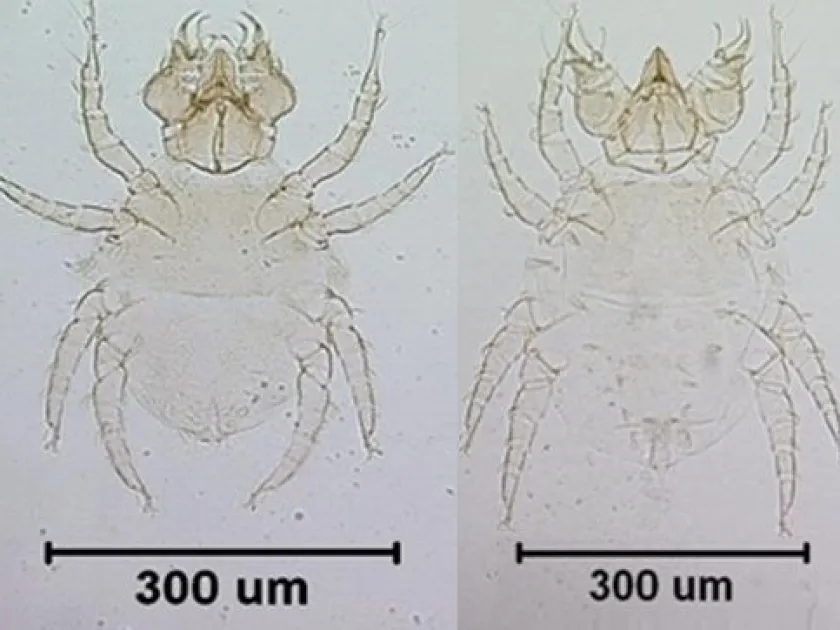
Cheyletid mites belong to the family Cheyletidae within the order Trombidiformes. They are easily identified by their distinctively large, pincer-like pedipalps used to grasp prey.
These mites are generally small, ranging from 0.2 to 0.5 mm in length. Their bodies are typically flattened and pale, ranging from white to yellowish or reddish in color depending on their diet.
Unlike many other mite families, Cheyletids are primarily predatory. They actively hunt other small arthropods, including grain mites and insect larvae, making them beneficial in some natural ecosystems.
Their systematic position within the superfamily Cheyletoidea places them as highly specialized predators, though their presence in agricultural settings can still pose management challenges.
They are often observed under a microscope, where their elongated bodies and powerful grasping mouthparts become clearly visible for taxonomic identification.
What it damages
Cheyletid mites do not feed directly on plant tissues in the way phytophagous mites do. Instead, their impact is primarily related to the contamination of stored agricultural commodities.
They are commonly found in grain silos, flour mills, and warehouses, where they follow populations of prey species like Acarus siro or Tyrophagus putrescentiae.
The damage they cause is secondary, characterized by the accumulation of mite bodies, exuviae, and feces, which degrade the quality and market value of the infested grain.
Contaminated products often suffer from off-odors and increased moisture levels, which can further facilitate the growth of mold and bacteria in the grain pile.
In addition to quality degradation, the presence of these mites can trigger allergic reactions in workers handling the infested material in grain processing facilities.
When it appears
The development of Cheyletid mites is strictly tied to environmental conditions, particularly humidity and temperature levels within storage facilities.
They thrive at temperatures between 20°C and 30°C, and relative humidity above 70% provides the optimal environment for rapid population growth and year-round activity.
In outdoor environments, their activity follows the seasonal cycles of their prey, peaking during warmer months when natural populations of small arthropods are high in the soil and leaf litter.
In controlled storage environments, they may remain active continuously if moisture levels in the stored goods are not properly regulated.
The mites can survive short periods of colder temperatures by entering a state of reduced metabolic activity, only to reactivate once conditions improve.
Signs of infestation
The presence of Cheyletid mites is often indicated by a fine, dusty appearance on the surface of grain or within the crevices of storage bins.
A musty or sweet-tasting, stale odor emanating from a grain pile is a classic sign of high mite density and the resulting chemical changes in the commodity.
In cases of severe infestation, the grain may clump together due to the accumulation of mite debris and the movement of the mite population within the mass.
Small crawling specks can sometimes be seen moving on the walls of storage containers or on the bags containing cereals and flour.
Diagnostic laboratory tests involve sieving grain samples and using stereomicroscopic examination to detect the presence of adults, nymphs, and shed skins.
Control measures
Effective management focuses on limiting the prey population and maintaining unfavorable conditions for mite development through strict environmental control.
Reducing grain moisture content below 14% is the most effective way to prevent mite proliferation, as it dehydrates both the mites and their food sources.
Sanitation is critical; cleaning grain dust, spillages, and residual materials from storage facilities removes the necessary habitats for these pests.
Fumigation with professional-grade compounds is necessary when infestations have already reached economic thresholds, ensuring penetration into all areas of the silo.
- Aeration and ventilation of storage units
- Regular inspection and cleaning of handling equipment
- Maintaining dry storage conditions
- Laboratory monitoring of bulk grain samples
Taxonomy
- Latin name
- Cheyletus
- Order
- Mites
- Family
- Cheyletidae
- EPPO code
- CHEYSP
Discussion
No discussions yet — be the first.