
Pea moth
Ceramica pisi
Description
How to identify
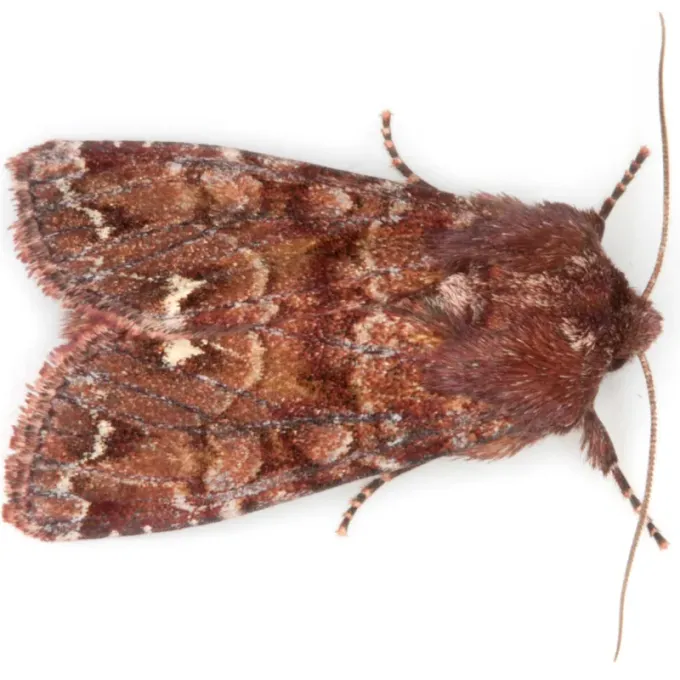
The Pea moth (Ceramica pisi), also known as the Broom moth, is a member of the Noctuidae family. The adult moth has a wingspan of 32–40 mm, with reddish-brown forewings marked by a distinctive white, wavy line near the outer edge.
Larvae (caterpillars) can grow up to 50 mm long and exhibit a wide range of colors, from light green to dark brown or black, often with light longitudinal stripes. These larvae are hardy and highly adaptable to various environmental conditions.
The life cycle undergoes complete metamorphosis. Pupation typically occurs in the soil at a depth of 10–15 cm, where the insect remains throughout the winter inside a firm cocoon, protected from surface frost and predators.
Adult moths emerge in late spring or early summer. Females deposit eggs in clusters, primarily on the underside of host plant leaves. A single female can produce several hundred eggs during her lifespan.
Depending on the latitude and climate, this species typically produces one generation per year, although warmer regions may see a second generation, which often causes more severe damage to late-season crops.
What it damages
This species is highly polyphagous, meaning it feeds on a wide variety of plants. Primary agricultural hosts include peas, beans, soybeans, and lentils, but it also readily attacks vegetable crops like cabbage, potatoes, and beets.
Young caterpillars skeletonize the leaves, while older larvae consume entire leaf blades, leaving behind only the veins. This severe defoliation significantly reduces the plant's ability to photosynthesize and produce grain.
Beyond foliar damage, the larvae often attack flowers, buds, and young pods. This leads to direct yield losses, as the damaged pods fail to develop properly or become susceptible to secondary infections.
In cases of heavy infestation, the entire crop quality can be compromised, leading to economic losses in terms of both quantity and market value. Their movement between weeds and crops makes them persistent pests.
The feeding activity of large caterpillars is rapid and intensive. Once a population establishes itself in a field, the damage can spread across the planting in a matter of days if left unchecked.
When it appears
The flight of adult moths usually begins in June, aligned with the peak vegetative growth of legume crops. The timing of egg-laying is critical for pest management, as it dictates the appearance of the most vulnerable larval stages.
Caterpillars are most active and damaging during mid-summer. This period coincides with the flowering and pod-filling stages of legumes, making it a high-risk time for yield loss.
As summer draws to a close, the larvae cease feeding and burrow into the soil to pupate. The overwintering pupae are the primary source of the following year's infestation, surviving the winter in a state of diapause.
Environmental conditions, especially rainfall patterns, significantly influence the success of pupal development and adult emergence in the spring. Dry springs can occasionally limit population spikes.
Monitoring for the first signs of larval activity in early summer is essential. Successful management relies on identifying the timing of peak larval emergence to apply control measures when the caterpillars are young.
Signs of infestation
The first signs of infestation are small "windows" in the foliage created by young caterpillars. Closer inspection of the leaf undersides often reveals batches of eggs that indicate a coming infestation.
Significant defoliation and the presence of frass (caterpillar droppings) on leaves or plant stems are clear indicators of active feeding. Large caterpillars are often seen feeding at night or resting in the lower foliage during the day.
Using pheromone traps is an effective way to monitor adult moth activity. By tracking the number of moths caught in these traps, agronomists can estimate the timing of egg-laying and larval emergence.
In pods, larvae may create entry holes, causing the seeds to rot or develop prematurely, which is a major quality issue for pea and bean production destined for fresh or dry markets.
Visible patches of thinned foliage within the crop field often mark the center of the infestation. Early detection in these pockets allows for targeted control, preventing the spread across the entire acreage.
Control measures
- Deep autumn plowing to bring pupae to the surface for predation or freezing.
- Crop rotation to break the pest's cycle and reduce localized populations.
- Removal of weeds around the field boundaries to eliminate alternative food sources.
- Biological control using Bacillus thuringiensis (Bt) sprays on young larvae.
- Targeted insecticide applications when pest levels exceed the economic threshold.
Cultural control is the cornerstone of management. Plowing the soil after harvest destroys the overwintering sites of the pupae, reducing the pressure of the next generation significantly.
Chemical control is most effective when targeted at the first and second larval stages. Due to the rapid growth of caterpillars, timing is everything, and delay usually results in poor control and higher chemical costs.
Biological alternatives, such as using specific viral or bacterial pathogens, offer a sustainable way to suppress populations without leaving residues on the harvested produce, which is highly valued in modern farming.
Integrated Pest Management (IPM) strategies, which combine pheromone monitoring, weather tracking, and selective insecticide usage, provide the most stable and cost-effective approach to controlling the Pea moth.
Constant field scouting remains the most reliable method for identifying infestation levels. By taking timely action based on these observations, farmers can minimize the impact of the pest while maintaining a profitable harvest.
Taxonomy
- Latin name
- Ceramica pisi
- Order
- Lepidoptera (butterflies)
- Family
- Noctuidae
- EPPO code
- POLIPI
Discussion
No discussions yet — be the first.