
Cabbage moth
Ceramica
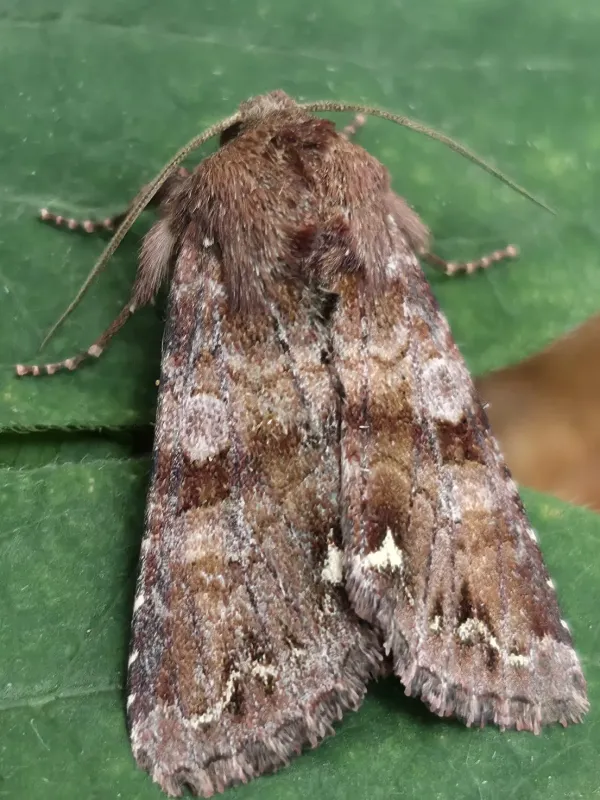
Description
How to identify
The Cabbage moth (Mamestra brassicae) is a member of the Noctuidae family, widely known for being a destructive agricultural pest. Adult moths have a wingspan of 34–50 mm, featuring brownish-grey forewings with distinctive wavy lines and a kidney-shaped spot.
The larvae, or caterpillars, undergo several growth stages, changing color from pale green to dark brown or black as they mature. Their bodies are relatively smooth, often marked with a light stripe along the side and sparse hairs.
Eggs are spherical and yellowish-white, typically deposited in large batches on the underside of leaves. A single female can produce up to 2,000 eggs during her lifecycle, making this pest highly prolific.
Pupation occurs in the soil, usually at a depth of 5–10 cm. This protective environment allows the pupae to survive winter conditions effectively, emerging as adults when spring temperatures consistently rise.
Adult moths are primarily nocturnal, remaining inactive during the day under leaf debris or in dense foliage. This makes them difficult to spot without specialized monitoring techniques or evening inspection.
What it damages
The Cabbage moth is a polyphagous pest, meaning it attacks a wide range of plants. It is primarily associated with Brassicaceae crops, including cabbage, cauliflower, broccoli, Brussels sprouts, and kale.
Beyond brassicas, the moth frequently targets other important vegetables such as sugar beet, peas, onions, and lettuce. Ornamental plants in the garden, including petunias and chrysanthemums, are also prone to infestation.
Early-stage larvae feed on the epidermis and mesophyll of leaves, creating transparent "windows" or small holes. As they grow, their appetite increases, leading to the skeletonization of foliage.
Older caterpillars migrate toward the center of the cabbage head. They bore deep, winding galleries into the plant tissue, which causes significant structural damage and introduces pathogens.
The accumulation of larval excrement within the tunnels accelerates the decay of the cabbage head, often leading to secondary bacterial rots. This ruins the commercial quality and shelf-life of the produce.
When it appears
The first flight of adults usually begins in late May or early June, corresponding with the early development phases of host crops. This generation is often responsible for the primary infestation.
A second generation typically emerges in late summer, often coinciding with the harvest season of late-maturing cabbage varieties. This generation is usually the most damaging due to the size of the larvae and the timing of crop development.
Environmental conditions such as temperature and humidity significantly influence the lifecycle duration. In optimal conditions, a generation can complete its development in about 30 to 45 days.
During hot, dry summers, larvae growth may slow down, but the pest remains persistent. The availability of host plants throughout the season ensures that the population can be sustained even with fluctuating weather patterns.
The transition into the pupal stage takes place in late autumn. The pupae stay dormant in the soil throughout the winter months, preparing for the new emergence in the following spring.
Signs of infestation
The most noticeable sign of a Cabbage moth infestation is the presence of irregular, ragged holes in the leaves. As the caterpillars grow, these holes become larger and more frequent across the plant.
Dark, granular excrement pellets (frass) are a key diagnostic feature. These pellets are usually found on leaf surfaces or trapped within the tightly packed leaves of a cabbage head.
Internal damage is indicated by the presence of tunnel openings on the outer leaves of the head. Cutting into the head often reveals decay or the presence of mature caterpillars hidden inside.
Wilting or discoloration of leaves despite adequate watering can suggest that the stem or inner tissue of the plant has been compromised by boring larvae, affecting the plant's nutrient transport.
- Batches of eggs on the undersides of leaves.
- Windowing of leaves caused by young larvae.
- Dark frass piles at the base of the plant.
- Rotting spots inside the head of cabbage or cauliflower.
Control measures
Cultural control is a primary line of defense. Deep autumn plowing exposes pupae to harsh winter weather and natural predators. Maintaining clean fields by removing cruciferous weeds also eliminates alternate hosts.
Biological control methods, such as the application of Bacillus thuringiensis (Bt), are highly effective against young larvae while posing minimal risk to beneficial insects and the environment.
Chemical insecticides should be used as a last resort and strictly according to the economic threshold. Rotating products with different modes of action is essential to prevent the development of resistant pest populations.
Pheromone traps serve as an excellent monitoring tool to detect the arrival of adult moths. This allows farmers to time their protective measures precisely, maximizing efficiency and minimizing chemical residues.
Physical exclusion methods, such as covering crops with fine-mesh insect nets, effectively prevent egg-laying by female moths. This is a highly recommended practice for small-scale and organic gardens.
Taxonomy
- Latin name
- Ceramica
- Order
- Lepidoptera (butterflies)
- Family
- Noctuidae
- EPPO code
- CRMCSP
Discussion
No discussions yet — be the first.