
Catoptes weevil
Catoptes
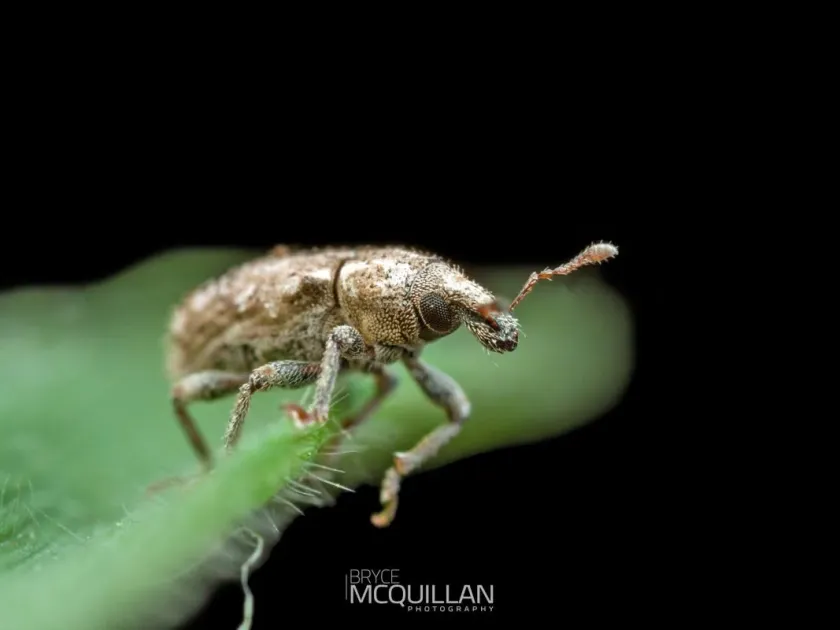
Description
How to identify
The Catoptes genus belongs to the Curculionidae family, a diverse group of beetles commonly known as weevils. These insects are well-adapted to various environments and are recognized by their characteristic snout and hard exoskeleton.
Adult Catoptes weevils typically have a robust, compact body often covered in scales, which provides effective camouflage against soil or plant debris. They generally lack the ability to fly, which influences their dispersal patterns.
The larvae are subterranean, C-shaped, legless, and creamy-white with a distinct dark head capsule. They spend their entire developmental period in the soil, feeding on the roots of their host plants.
The life cycle involves complete metamorphosis: egg, larva, pupa, and adult. Development times can vary depending on temperature and soil moisture conditions, sometimes extending over a full year.
Identification at the species level is challenging and often requires detailed morphological examination, as many species within this genus share very similar external features.
What it damages
The primary damage is caused by the larvae, which feed on the root systems of various plants. This root-pruning reduces the plant's ability to uptake water and nutrients, leading to stunted growth or death.
Adult weevils feed on leaves, creating distinct semi-circular notches along the margins. While this foliage loss is rarely lethal to established plants, it reduces photosynthetic capacity and vigor.
Host plants include a wide variety of horticultural crops such as strawberries, raspberries, and blueberries, as well as pasture legumes and various ornamental shrubs.
In high densities, Catoptes populations can cause significant economic losses in nursery and berry-growing operations, creating patches of declining or dead vegetation.
- Berry crops (strawberries, raspberries)
- Forage legumes and clover
- Young nursery seedlings
- Ornamental perennials
When it appears
Adult weevil activity peaks during the spring and summer months when plant growth is optimal. They are primarily nocturnal, spending daylight hours hiding in the soil or under vegetation at the plant base.
Eggs are deposited in the soil near the host plant. The survival of emerging larvae is highly dependent on sufficient soil moisture during these critical early stages.
Peak larval feeding, and thus peak damage to plant roots, typically occurs during the autumn and early spring as larvae increase in size before pupation.
Overwintering occurs primarily in the larval stage deep within the soil profile, which provides protection from extreme temperatures and desiccation.
Agronomists should initiate monitoring efforts in late spring by checking foliage for feeding notches and inspecting soil cores for the presence of larvae.
Signs of infestation
The most recognizable sign of infestation is the characteristic notched foliage. These "U-shaped" bites on leaf edges indicate the presence of adult beetles in the area.
Wilting of plants despite adequate soil moisture is a primary indicator of larval damage to the root system. Affected plants often appear yellowed or lack vigor compared to healthy neighbors.
When an infested plant is excavated, larvae can often be found in the root ball or the surrounding soil. This is the most definitive way to confirm the pest's presence.
Small patches of dying plants or gaps in crop rows may suggest the presence of a localized infestation that has been building up over time.
Increased activity of birds or insect predators in a specific area can sometimes be a secondary clue that a high density of larvae is present in the soil.
Control measures
Cultural control methods such as soil cultivation can disrupt larval habitats and reduce their survival rates by exposing them to desiccation and natural predators.
Crop rotation is an effective strategy to manage populations, as it removes the host plants required for the larval stage of the weevil's life cycle.
Biological control using entomopathogenic nematodes (e.g., Heterorhabditis spp.) has proven effective for targeting soil-dwelling larvae without chemical residue concerns.
Chemical control should be targeted at adult weevils during their nocturnal activity window. Foliar applications can prevent egg-laying if timed correctly in the spring.
Integrated Pest Management (IPM) is essential for long-term success, combining monitoring, mechanical disturbance, biological controls, and targeted chemical applications.
Discussion
No discussions yet — be the first.