
Birch leaf moth
Carpatolechia proximella
Description
How to identify
The birch leaf moth (Carpatolechia proximella) is a member of the Gelechiidae family, commonly found in regions where birch trees are widespread.
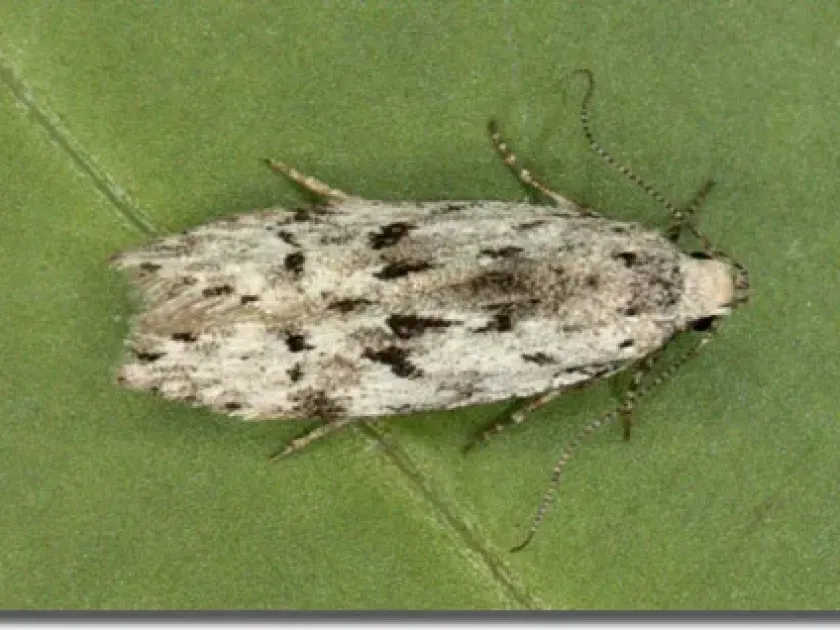
The adult moth is small, typically having a wingspan between 12 and 16 mm. Its wings feature a mottled pattern of white, gray, and dark brown scales.
This camouflage allows the moth to blend perfectly with the textured bark of the birch tree, making it difficult to spot during the daylight hours.
The larvae are typically green or yellowish-green with a dark head, reaching a maximum length of 10 mm as they mature through several instars.
Pupation occurs within small, silk-lined cocoons, usually concealed within rolled leaves or bark crevices, protecting the developing insect from predators.
What it damages
The primary host for this species is the birch tree (Betula). It feeds on leaf tissues, causing localized damage that can become severe in outbreaks.
The larvae act as leaf miners initially, feeding on the parenchyma between the leaf cuticles, leaving behind characteristic transparent patches or windows.
Heavy infestation reduces the tree's photosynthetic capacity, leading to weakened growth, premature leaf yellowing, and potential drop of foliage.
In ornamental urban plantings, the damage significantly detracts from the aesthetic value of the trees, often necessitating targeted intervention.
While mature trees can usually withstand moderate feeding, young saplings are at greater risk of being severely stressed or stunted by heavy larval grazing.
When it appears
Adult moths typically emerge in late spring, generally between May and June, to mate and lay eggs on the newly developed birch foliage.
The larval stage is the primary period of activity, occurring throughout the summer as the caterpillars feed on the leaves and grow rapidly.
Depending on local climatic conditions, the moth may complete one or two generations per year, significantly impacting the pest's population dynamics.
Winter is typically spent in the pupal or larval stage, tucked away in protective locations like leaf litter or deep crevices in the tree's bark.
Monitoring for the presence of the pest is most effective in late spring and early summer, coinciding with the peak period of egg-laying and larval emergence.
Signs of infestation
The most distinctive signs of infestation are the transparent "windows" in the leaves, created when larvae consume the internal tissue.
Larvae often pull leaf edges together using silk, creating small shelters that are visible upon close inspection of the tree canopy.
The presence of fine frass (droppings) around the feeding sites and inside leaf rolls confirms the ongoing activity of the moth larvae.
Prematurely yellowed leaves during the summer months are often a direct result of larval mining, particularly in the lower and mid-canopy sections.
- Transparent leaf patches (windows).
- Rolled or webbed leaves containing larvae.
- Accumulation of dark larval frass in the canopy.
- Increased bird activity in birch crowns.
Control measures
Integrated Pest Management (IPM) strategies are preferred, emphasizing biological control and monitoring rather than broad-spectrum chemical sprays.
Biological insecticides containing Bacillus thuringiensis are effective in managing larval populations while preserving beneficial insect species.
In landscape settings, systemic insecticides may be applied if infestation levels threaten the health or visual quality of highly valued specimen trees.
Encouraging natural predators such as insectivorous birds and parasitic wasps helps to maintain the moth population below damaging thresholds.
Proper silvicultural practices, including the removal of deadwood and maintenance of tree vigor, are essential for long-term pest resistance.
Discussion
No discussions yet — be the first.