
Northern Cardinal
Cardinalis cardinalis
Description
How to identify
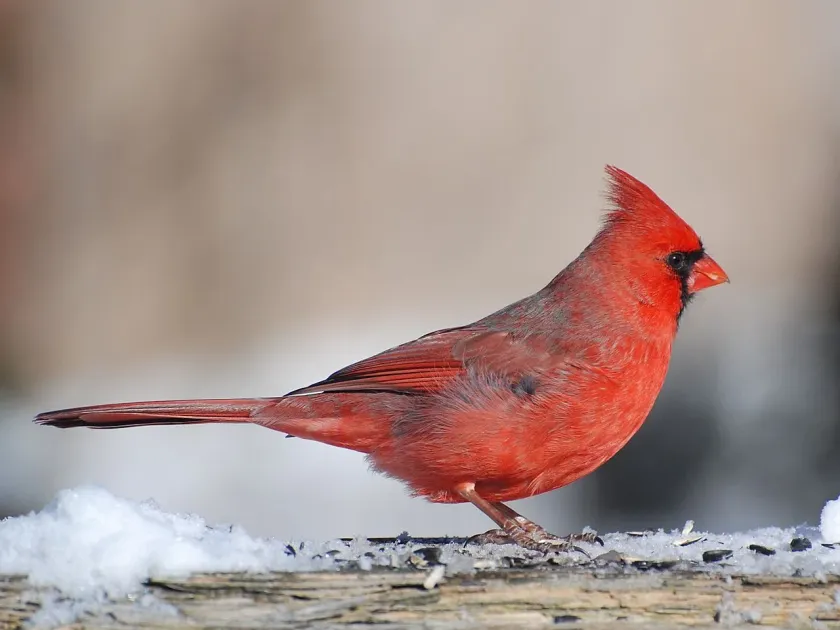
The Northern Cardinal (Cardinalis cardinalis) belongs to the family Cardinalidae in the order Passeriformes. These birds are identified by their striking appearance, especially the bright red plumage of the males.
They possess a short, thick, conical beak, which is highly efficient at crushing seeds, grains, and fruits, identifying them as potential foragers in agricultural settings.
These birds typically inhabit forest edges, shrublands, and hedgerows, from which they extend their foraging range into adjacent agricultural fields.
While often seen in pairs, Northern Cardinals can congregate in small groups during winter months or when food sources are abundant, leading to localized agricultural impact.
Recognition of both the male's vibrant color and the female's brownish-grey tone is essential for accurate monitoring of bird presence in fruit or grain operations.
What it damages
The Northern Cardinal causes damage by consuming various crops, including cereals, vegetables, berries, and the buds of fruit trees.
In cornfields, these birds peck at ears during the milk stage, causing grain loss and creating wounds that facilitate the entry of pathogens and fungi into the plant.
Sunflower crops are also vulnerable, as cardinals consume the seeds directly from the flower heads, leading to significant yield reduction in localized areas.
Fruit and berry growers frequently report losses in strawberries, raspberries, and grapes, where birds puncture the skin of the fruit, making it unmarketable.
Additionally, during late winter and early spring, cardinals often feed on the developing buds of apple and cherry trees, which can severely stunt the plant's production capacity for the coming season.
When it appears
The peak season for bird-related damage corresponds with the maturation phase of agricultural products, typically from mid-summer through late autumn.
During the winter months, when natural food sources are scarce, cardinals gravitate towards farms, grain storage areas, and bird feeders, sometimes turning to stored produce.
Early spring is a critical window for orchard protection, as birds target tender buds before other food sources become available in the wild.
Regional migration patterns are minimal for this species, meaning damage is often persistent and concentrated in areas where the birds have established territory.
Proactive monitoring should begin well before the onset of ripening to ensure that mitigation strategies are in place before feeding habits are established.
Signs of infestation
Clear evidence of cardinal activity includes missing or pecked-at corn kernels and sunflower seeds found in partially consumed flower heads.
The presence of bird droppings on leaves and fruit, combined with debris such as seed hulls or shredded plant matter, indicates active feeding sites.
Damaged or missing buds on branches of fruit trees, particularly in early spring, serve as a visible sign of avian damage to orchard health.
Observation of damaged berries, often featuring small, precise punctures, provides definitive proof of cardinal presence in small fruit plantations.
Visual sighting of the birds during their peak foraging hours in the morning and evening is a strong indicator that the crop is being targeted.
Control measures
Visual deterrents such as reflective tapes, predator decoys (e.g., owl or hawk statues), and dynamic scarecrows can effectively discourage cardinals from settling in fields.
Netting represents the most reliable physical control method, especially for protecting high-value berry crops and young orchard trees from bird access.
Acoustic deterrent systems that broadcast predator calls or distress signals are effective for dispersing groups of birds without causing long-term harm.
Cultural practices, such as prompt harvesting and the removal of weeds along field edges, help by minimizing the availability of alternate food sources.
Integrated pest management strategies should involve rotating deterrent devices to prevent the birds from becoming habituated to any single noise or visual signal.
Taxonomy
- Latin name
- Cardinalis cardinalis
- Family
- Cardinalidae
- EPPO code
- CRDNCA
Discussion
No discussions yet — be the first.