
Sand tiger shark
Carcharias taurus
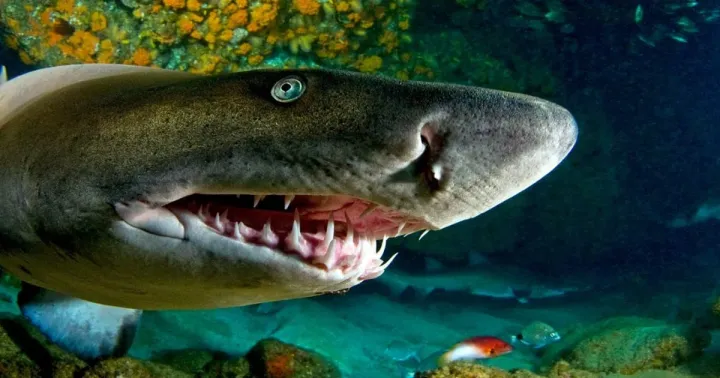
Description
How to identify
The sand tiger shark (Carcharias taurus) is a member of the Lamniformes order and the Odontaspididae family.
It is a large marine cartilaginous fish found in temperate and subtropical coastal waters around the globe.
The species is strictly adapted to aquatic environments, possessing gills for respiration and fins for movement in the water column.
Their biological classification places them as apex predators of the sea, unrelated to terrestrial herbivorous pests.
Morphologically, they possess sharp, protruding teeth designed for catching fish, rays, and smaller sharks.
What it damages
The sand tiger shark does not damage crops and is not considered a pest in any agricultural context.
As a specialized marine predator, it has no physiological ability to consume plant matter or cause damage to cultivated vegetation.
The species does not inhabit terrestrial areas where agricultural crops are grown, making any interaction between them impossible.
There are no records of this animal affecting crop health, growth, or soil quality in any agricultural field study.
Agro-industrial damage caused by marine predators of this type is non-existent within the framework of farming and gardening.
Control measures
No protection measures are required against the sand tiger shark, as it poses no threat to agricultural productivity.
Pest management programs should focus on relevant threats, such as insects, pathogens, and invasive weeds.
Implementing controls against this shark in an agricultural environment would be biologically irrelevant and economically wasteful.
Agronomic strategies remain focused on land-based challenges, which are entirely separate from marine ecological observations.
Farmers should focus on established integrated pest management (IPM) practices to secure their harvests effectively.
Taxonomy
- Latin name
- Carcharias taurus
- Family
- Odontaspididae
- EPPO code
- KRCHTA
Discussion
No discussions yet — be the first.