
Pale mottled willow
Caradrina clavipalpis
Description
How to identify
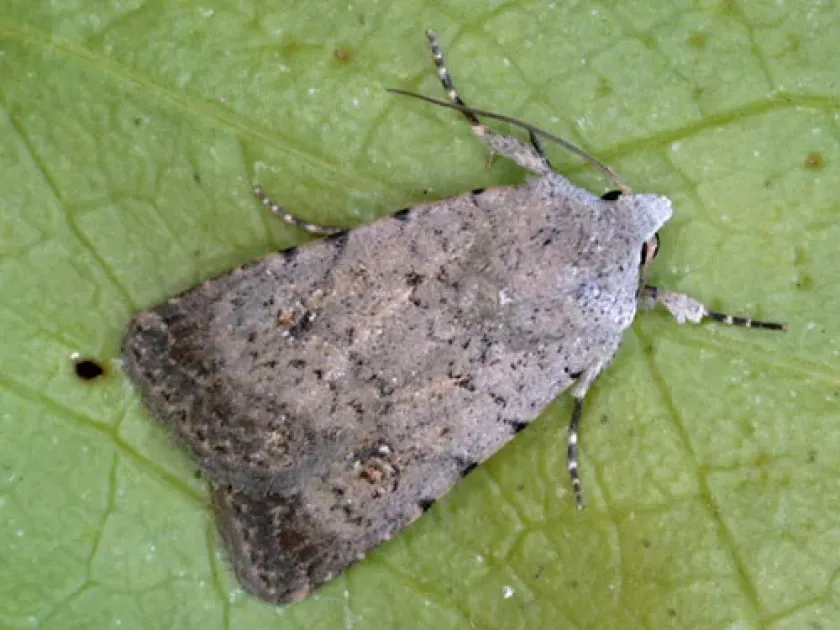
The Pale mottled willow (Caradrina clavipalpis) belongs to the Noctuidae family within the order Lepidoptera. This small moth has a wingspan of approximately 30–35 mm, with forewings varying from grey to brownish-grey, marked with fine, distinct lines.
The larvae are typically 25–30 mm long. They possess a grey-brown to yellowish-grey appearance with faint dark lateral lines, providing excellent camouflage against soil particles and plant debris.
Pupae are reddish-brown and exhibit a smooth, shiny surface. They primarily develop within the top layer of the soil or in sheltered plant residues, which serve as protection during overwintering.
In temperate climates, the species typically completes two generations per year. The adult moths are strictly nocturnal, spending the daylight hours in concealment to avoid predators.
As a polyphagous pest, the species is widely distributed across agricultural landscapes where wild hosts and crops provide year-round food sources.
What it damages
The damage is primarily caused by the larvae, which are known for their polyphagous feeding habits. They consume a wide variety of cultivated crops, especially cereals, as well as several wild weed species.
Cereal crops like wheat, barley, and rye are highly susceptible, as the larvae feed on both foliage and the developing grains within the ear, often causing significant loss of yield.
Beyond cereals, the pest can impact vegetable crops, including potatoes and tomatoes, as well as various forage grasses grown in integrated farming systems.
Larvae often congregate in areas with high levels of plant debris or grain spillage, feeding aggressively on the crop material and reducing overall plant health.
The economic impact of the pest is most pronounced during years with favourable weather conditions that accelerate larval development and lead to high population density.
When it appears
The first generation of adult moths usually emerges in late spring or early summer (May-June). Mating and egg-laying occur during the night shortly after emergence.
Larvae of the first generation feed actively during the summer months. This development stage is synchronized with the vegetative growth period of many staple agricultural crops.
A second generation of adults appears mid-to-late summer (July-August). Their offspring are particularly dangerous to grain crops that are reaching maturity.
The species overwinters primarily as mature larvae or pupae, hiding in the topsoil, under leaf litter, or occasionally in farm storage structures.
Prolonged warm autumns can extend the activity of the larvae, leading to late-season damage on emerging winter crops and seedlings.
Signs of infestation
The earliest indication of infestation is the appearance of skeletonized foliage or small, irregular holes in the leaves of host plants during the night.
Observation during evening hours or the use of light traps can confirm the presence of adult moths in the vicinity of the fields.
- Visible larval excrement (frass) accumulated on plant tissues or near the base of stems.
- Damaged ears of grain with hollowed-out kernels.
- Sparse patches in seedling rows where larvae have consumed young shoots.
Larvae can often be found by gently excavating the soil surface beneath affected plants or looking under decomposing organic matter near the base of the crop.
Severe infestations often result in visible gaps in crop stands and a notable decline in grain quality due to both direct feeding and secondary fungal infections.
Control measures
Integrated pest management starts with cultural practices, specifically the elimination of weeds that provide alternative food sources and refuges for the larvae during the off-season.
Deep autumn plowing is a crucial control measure, as it disrupts the soil habitat, burying larvae and pupae and exposing them to freezing temperatures and natural predators.
Chemical control involving approved insecticides should be implemented based on economic thresholds to minimize environmental impact and prevent resistance development.
Crop rotation and effective management of harvest residues reduce the likelihood of the pest completing its life cycle successfully within the same field year after year.
Regular monitoring using pheromone and light traps allows agronomists to track population dynamics and determine the optimal timing for targeted pest suppression.
Taxonomy
- Latin name
- Caradrina clavipalpis
- Order
- Lepidoptera (butterflies)
- Family
- Noctuidae
- EPPO code
- ELPHCL
Discussion
No discussions yet — be the first.