
Golden jackal
Canis flavescens
Description
How to identify
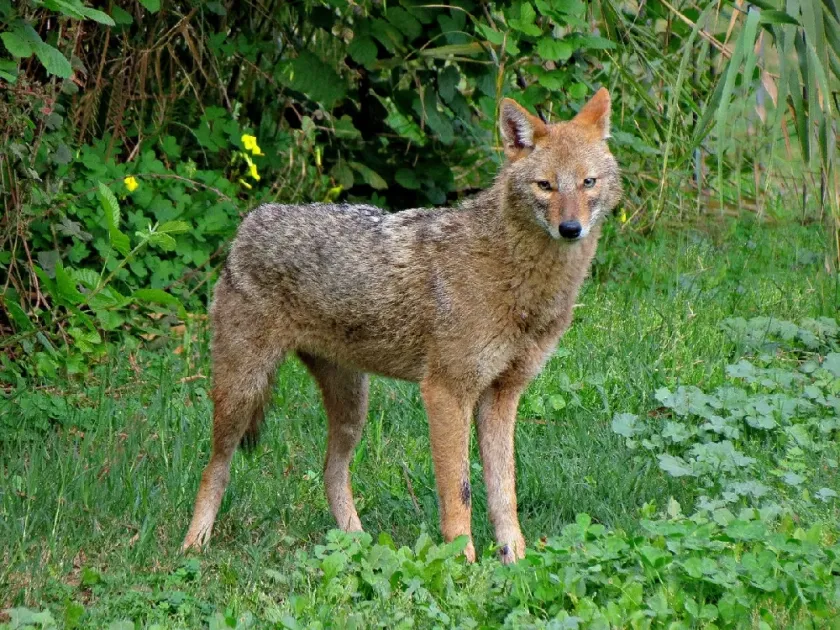
The golden jackal Canis aureus is a medium-sized canine that has recently expanded its range, becoming a significant challenge for modern agriculture.
The animal is characterized by its yellowish-brown fur and high adaptability, allowing it to thrive in various landscapes, including intensive farming areas.
Adult jackals exhibit clever social behaviors, often operating in family groups, which enhances their ability to locate food sources within large fields.
Because they are nocturnal and elusive, it is often difficult for farmers to notice their presence until significant crop damage has already occurred.
Their rapid population growth in several regions is attributed to climate change and the lack of natural competition, making them a recurring problem for producers.
What it damages
Jackals are known for causing considerable damage to corn crops by feeding on cobs during the milk stage and trampling through rows of plants.
Watermelon and melon plantations are frequently targeted, as jackals bite into the fruit to access water and sugar, rendering the produce unmarketable.
In vineyards, jackals can damage grape clusters and young vines while navigating through the rows, often leading to secondary fungal infections in the fruit.
The animals frequently cause mechanical destruction to irrigation infrastructure, specifically biting through plastic hoses, which results in significant water loss.
Furthermore, their foraging activities in fields can lead to uneven soil compaction and the destruction of the plant canopy, which negatively impacts overall crop yield.
When it appears
The peak season for jackal-related damage begins in late summer and continues through autumn, coinciding with the maturation phase of various agricultural crops.
During the hot summer months, the physiological need for hydration drives jackals to raid fields containing succulent fruits and vegetables.
The transition to harvest time makes crops particularly vulnerable, as the animals increase their foraging activity to prepare for the winter months ahead.
Seasonal patterns are also dictated by the breeding cycle, with increased movement observed when the young are being weaned and taught to hunt by the parents.
In winter, while there is less vegetation to damage, jackals may still frequent storage areas or livestock barns near fields if alternative food sources are scarce.
Signs of infestation
Identifying a golden jackal presence involves spotting characteristic paw prints that are generally more oval and compact than those of domestic dogs.
Look for half-eaten corn cobs or melons left directly in the field; these bite marks are usually quite distinct and deep due to the animal's powerful jaws.
The presence of scat containing seeds, plant fibers, and remnants of fruit skin along the edges of the field is a reliable indicator of their activity.
Auditory signs, such as high-pitched, wailing vocalizations occurring at night, confirm that a group of jackals is operating within the vicinity.
Visible damage to fencing and irrigation lines at the perimeter of the farm usually suggests a consistent entry point used by the local pack.
Control measures
The installation of electric fencing is considered the most effective physical barrier to keep golden jackals away from high-value crop areas.
Integrating motion-activated sound emitters and strobe lights can create an inhospitable environment, discouraging jackals from approaching the fields at night.
Maintaining clear perimeters by removing dense weeds, tall grass, and debris around agricultural land reduces hiding spots and potential nesting sites.
Collaboration with local wildlife management agencies to implement legal population control measures is essential in areas where the jackal density is excessively high.
Implementing a combination of deterrents, including regular monitoring and farm sanitation, provides the best defense against persistent raiding by these animals.
Discussion
No discussions yet — be the first.