
Potato wart
Cancer
Description
How to identify
Potato wart is caused by the obligate parasite Synchytrium endobioticum, a soil-borne fungus-like pathogen belonging to the Chytridiomycota phylum.
The pathogen exists mainly as resistant resting spores that can survive in the soil for decades, making it a persistent and difficult threat.
These spores require moisture and contact with susceptible potato tissue to germinate, releasing motile zoospores that infect plant cells.
The disease is highly dependent on environmental conditions, thriving best in cool, moist climates which favor the infection process.
It lacks a traditional mycelium; instead, it triggers hypertrophic and hyperplastic growth in infected host cells, leading to the formation of tumors.
What it damages
The primary host for this pathogen is the domestic potato, although some wild Solanaceae species can also act as hosts.
The infection destroys tubers, rendering them completely inedible and non-marketable, leading to total yield loss in affected patches.
The pathogen is easily spread through contaminated soil, infected seed potatoes, and the movement of agricultural equipment across fields.
Because it is a severe quarantine pest, its presence often leads to movement restrictions and bans on potato production in identified areas.
Economic damage is twofold: direct loss of harvest and the long-term restriction on land use for future potato cultivation.
Signs of infestation
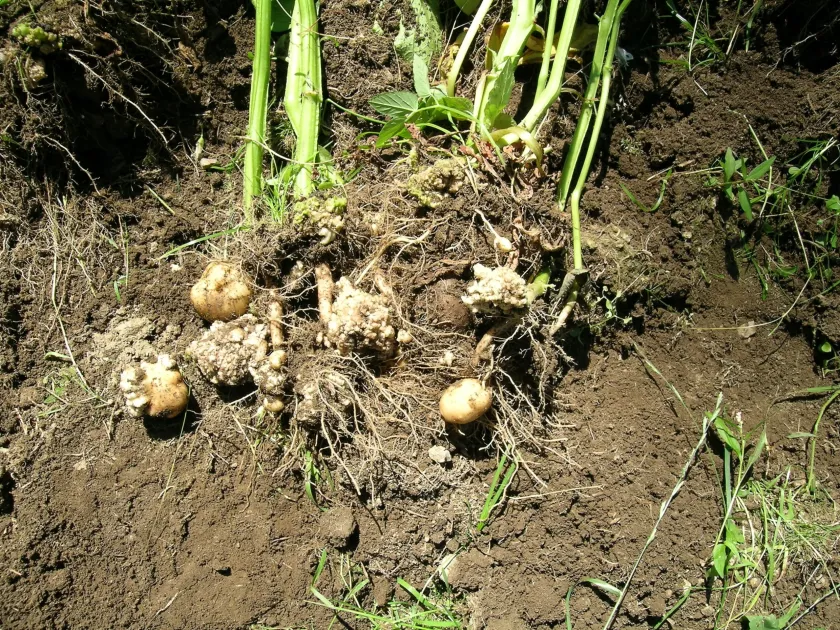
The hallmark of potato wart is the development of irregular, fleshy, cauliflower-like galls on the tubers, stolons, and stem bases.
Young galls are usually pale or skin-colored, while older galls turn dark brown or black as the tissue decays.
Heavily infected tubers may lose their original shape entirely and can be transformed into a dark, rotting mass before harvest time.
In most cases, the above-ground parts of the potato plant remain healthy-looking, which allows the disease to spread undetected during the season.
Root systems are typically unaffected, but the systemic nature of the infection within the tubers ensures the pathogen returns to the soil.
Control measures
The most effective strategy for managing potato wart is the exclusive use of resistant potato cultivars in areas known to be at risk.
Rigorous quarantine measures must be observed, including the disinfection of tools and machinery to prevent the spread of soil-borne spores.
Crop rotation should be implemented, alternating potatoes with crops that are not susceptible to the pathogen to reduce soil inoculum.
If an outbreak is detected, the affected area must be isolated, and all infected plant material should be carefully removed and burned.
- Strict monitoring of seed potato sources.
- Avoiding the movement of soil from infested fields.
- Implementation of biological soil treatments.
Soil testing is essential for early detection in areas where environmental conditions are favorable for the long-term survival of the fungus.
Taxonomy
- Latin name
- Cancer
- Family
- Cancridae
- EPPO code
- CANCSP
Discussion
No discussions yet — be the first.