
Spruce gall midge
Camptomyia strobi
Description
How to identify
The spruce gall midge is a tiny insect belonging to the family Cecidomyiidae (gall midges) within the order Diptera. Adults are microscopic flies, often virtually invisible to the naked eye due to their extremely small body size.
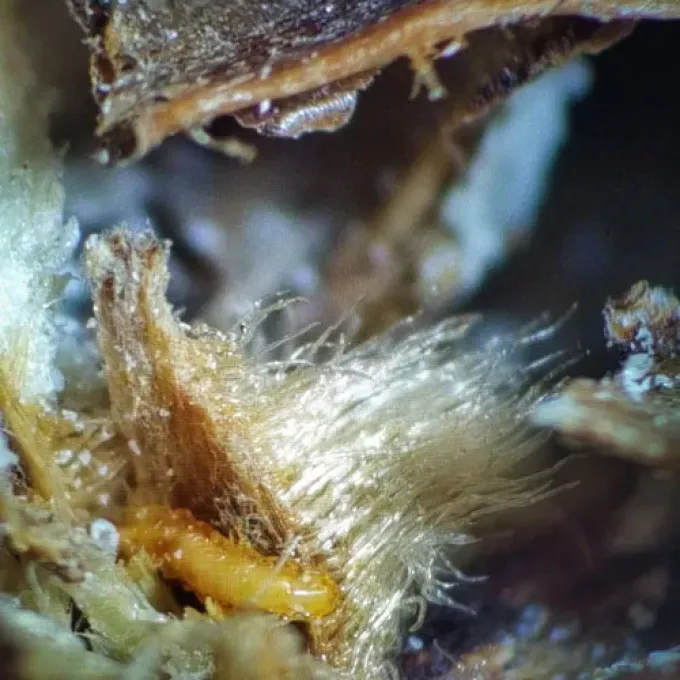
The larvae of this pest have an elongated body, typically yellowish-white or orange. They lack a distinct head and limbs, a trait common to many members of the gall midge family that develop inside plant tissues.
The insect's life cycle is closely linked to the reproductive organs of conifers. Adults maintain a concealed lifestyle, and it is the larvae that pose the main threat to forest plantations, passing through several developmental stages inside the cone scales.
Distinguishing infestations of this specific midge from other species involves identifying the precise location of larvae within the seed scale tissues. They are frequently found in areas where normal seed development within the cone has been disrupted.
The pest population can spread rapidly across forest stands and nurseries, particularly under favorable conditions for reproduction, such as high air humidity during the growing season.
What it damages
The primary target of the spruce gall midge is the cone of the Norway spruce (Picea abies). The pest prefers to lay eggs in the developing reproductive organs of the tree, which directly affects the quality and quantity of harvested seeds.
Larvae feed on the tissues of cone scales, causing deformation and stunted growth. Necrosis of the tissues is often observed at larval feeding sites, leading to premature drying of the cones or structural failure.
Severe economic losses are incurred in seed orchards, where the spruce gall midge can destroy a significant portion of the seed crop. Damaged cones often fail to open properly, which complicates the collection of seed material.
In addition to direct seed destruction, larval activity creates favorable conditions for fungal infections. Damaged tissues serve as entry points for pathogens that cause cone rot.
In forest nursery conditions, the damage caused by this species becomes critical when raising planting material, as the reduction in high-quality seed yield leads to a shortage of seedlings.
When it appears
Adult activity of the spruce gall midge begins in the spring, typically during the spruce flowering period. During this time, females fly to young cones to lay eggs under the scales.
The larval development period coincides with the active growth and maturation of cones during the summer. Throughout this period, larvae feed and undergo all stages of their metamorphosis inside the plant tissue.
By the time cones reach maturity, usually in late summer or early autumn, most larvae have completed their development. Part of the population may pupate in the soil under the tree canopy or remain within fallen cones.
The dynamics of the pest population depend heavily on the weather conditions of the current year. Warm and rainy weather during the mass flight of adults promotes a sharp increase in the population and the scale of the infestation.
The pests overwinter primarily as larvae in the soil litter or inside old cones that remain on the spruce branches until the next season, ensuring population stability.
Signs of infestation
The first sign of infestation is premature discoloration of young cones. They may acquire a yellowish or brownish hue and also lag in size compared to healthy cones on the same tree.
Upon careful inspection of affected cones, one can notice the deformation of scales and a violation of their symmetry. When the cone is opened, midge larvae are often found inside in small cavities.
The presence of resin flow on the cone surface may also indicate pest activity, as the tree attempts to localize the damage by secreting resin in response to tissue punctures by the larvae.
In later stages, cones may appear "empty" or brittle. When attempting to extract seeds, one discovers shriveled or underdeveloped seeds, or a total lack of embryos due to the damage of the nourishing tissues.
Fallen cones under the tree canopy often contain exit holes or traces of larval presence, confirming the pest's presence in the forest stand during the previous season.
Control measures
The primary control measure is forest management, including the timely collection and destruction of fallen damaged cones, where a significant portion of the pest population overwinters.
In seed orchards, it is advisable to monitor adult population levels using pheromone traps or sticky plates, which helps determine the optimal timing for protective treatments.
The application of biological insecticides based on entomopathogenic fungi or bacteria during the midge's flight period allows for the reduction of the pest population without significant harm to entomophagous insects and the environment.
In extreme cases with high infestation levels in nurseries, systemic insecticides are used, although the use of chemical agents in forest stands is limited due to environmental regulations and the difficulty of treating adult tree crowns.
- Adherence to quarantine measures during the transport of seed material.
- Creating conditions for the proliferation of natural enemies, such as parasitoids.
- Selecting pest-resistant spruce forms and clones when establishing new plantations.
Discussion
No discussions yet — be the first.