
Campodea lankesteri
Campodea lankesteri
Description
How to identify
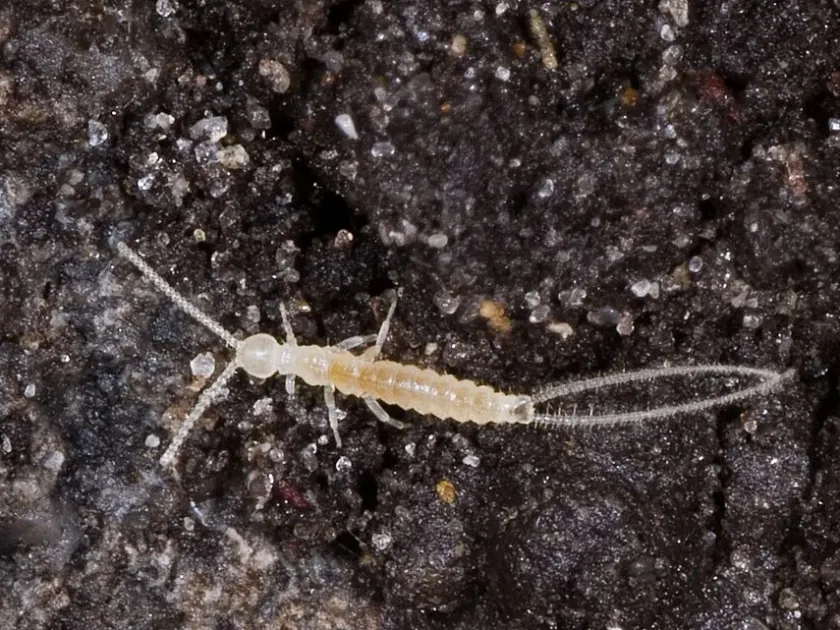
Campodea lankesteri belongs to the order Diplura and the family Campodeidae. These are minute, blind, and unpigmented arthropods that spend their entire life cycle hidden within the soil profile.
The body is elongated, soft, and segmented, typically reaching only a few millimeters in length. A key diagnostic feature is the pair of long, often multi-segmented cerci at the rear of the abdomen.
Lacking eyes, these organisms rely on highly sensitive antennae to navigate through soil pores and detect moisture and organic food sources.
They do not undergo metamorphosis, meaning nymphs resemble adults. This characteristic allows them to occupy the same ecological niche throughout their life span.
They are extremely moisture-dependent and will desiccate rapidly if exposed to dry air or direct sunlight, which dictates their preference for damp, undisturbed environments.
What it damages
Primary damage occurs when populations become dense, leading them to feed on the tender root hairs and hypocotyls of young germinating seedlings.
While primarily scavengers feeding on decomposing organic matter and fungi, they can become pests by grazing on living plant tissues under moisture-stressed or crowded conditions.
Feeding injury creates wounds on roots and stems, which serve as entry points for soil-borne pathogens, leading to stunted growth or seedling collapse.
Greenhouse settings are particularly vulnerable because the constant irrigation and consistent soil moisture support higher survival rates for these pests.
In cases of severe infestation, the cumulative feeding damage can significantly reduce stand density, necessitating replanting and increasing production costs.
When it appears
Activity is highest during periods of increased soil moisture, particularly in spring and autumn, which coincide with the critical early growth phases of many crops.
Within greenhouses, where conditions are kept artificially stable, Campodea lankesteri can maintain active populations year-round without a clear dormant phase.
Hot, dry summer conditions force the pests to migrate to deeper soil layers where micro-environmental conditions remain favorable for their survival.
Increased precipitation or over-irrigation events often trigger rapid surface movement and population expansion, leading to sudden damage clusters in seedbeds.
Continuous monitoring is advised, as their cryptic behavior often masks early-stage infestation until significant damage to root systems has already occurred.
Signs of infestation
The primary indicators are patchy seedling emergence and necrotic roots that appear chewed or frayed along the root cortex.
Small pin-prick holes or eroded tissue on stems located at the soil-air interface are symptomatic of surface-level feeding by diplurans.
Finding these pests requires careful inspection of soil clumps or using baited traps made of moist cardboard placed on the soil surface overnight.
Unexpected chlorosis and wilting of young plants, despite adequate soil moisture, often indicate subsurface root damage caused by pests like this.
The presence of fine fecal pellets or associated white fungal growth around the root zone often correlates with high concentrations of these soil dwellers.
Control measures
Effective management focuses on physical barriers and environmental manipulation, such as optimizing soil drainage to reduce the damp conditions they favor.
Soil sterilization, through steaming or approved chemical fumigation in greenhouses, is the most effective method for eradicating resident populations before planting.
If chemical control is necessary, granular insecticides applied to the soil can reduce populations, though they should be used as part of an integrated management plan.
- Maintaining proper greenhouse sanitation and removing plant debris.
- Monitoring with moist cardboard traps to determine population levels.
- Enhancing plant vigor through balanced fertilization to withstand minor feeding.
A multi-pronged approach, including cultural practices and targeted soil treatments, is essential to minimize the economic impact on nursery operations.
Taxonomy
- Latin name
- Campodea lankesteri
- Family
- Campodeidae
- EPPO code
- CMPDLA
Discussion
No discussions yet — be the first.