
Drywood termites
Calotermes
Description
How to identify
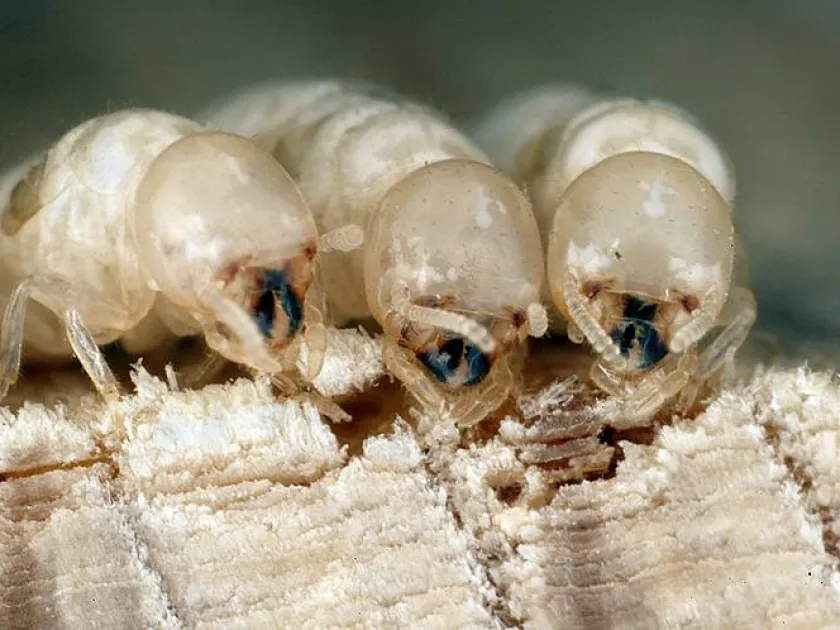
Calotermes is a genus of termites belonging to the Kalotermitidae family, commonly known as drywood termites. Unlike subterranean termites, they do not require contact with the soil to survive, nesting directly within the wood they consume.
A colony consists of several castes, including nymphs, soldiers, and reproductive adults. Soldiers are characterized by their enlarged heads and dark, powerful mandibles used for defending the colony against intruders like ants.
The morphology of these insects includes a cylindrical body, with color ranging from pale yellow to dark brown. They are highly photophobic and avoid exposure, remaining deep within their galleries throughout their life cycle.
Their life cycle consists of incomplete metamorphosis, where nymphs grow into adults without a pupal stage. This biological process leads to slow colony growth, often taking years before the colony becomes noticeable.
Because they are independent of soil moisture, they can infest trees, furniture, and building timbers located far above the ground level, making them difficult to detect and manage.
What it damages
Drywood termites attack both healthy and decaying wood. In agriculture, they pose a significant threat to fruit-bearing trees, such as citrus, grapes, and various nut trees, by boring into stems and branches.
They create complex systems of galleries within the wood, feeding on cellulose. This structural damage weakens the plant, reduces sap flow, and can ultimately lead to the death of the tree or a significant yield loss.
Besides horticultural plants, they cause severe damage to wooden infrastructure, including fence posts, decorative wooden structures, and structural timber in outdoor settings near gardens.
Damage is often cumulative. The pests consume the internal structure of the wood while leaving the outer shell intact, which makes early detection through visual inspection extremely challenging.
Infestation is most severe in tropical and subtropical regions where environmental conditions favor the steady expansion of termite galleries within hardwoods and softwoods alike.
Signs of infestation
The most distinctive sign of a drywood termite infestation is the presence of frass. These are small, granular pellets of excrement pushed out through tiny holes, often resembling sawdust or sand pile up beneath the wood.
Tapping on the surface of wood that sounds hollow indicates extensive internal gallery formation. This acoustic sign often confirms that the termites have consumed a significant volume of the interior tissue.
The swarming of winged reproductives, known as alates, usually occurs during warmer seasons. Seeing these insects emerging from wood is a clear indicator of a mature colony and potential spreading.
Small, plugged entry holes or patches on the surface of the bark or timber suggest the activity of the colony. These plugs serve as a protective barrier, keeping the gallery environment stable.
General tree decline, such as yellowing leaves or dieback of branches, may occur once the infestation has reached a level where the structural integrity of the plant is compromised.
Control measures
Prevention is the first line of defense. Ensuring that trees are kept healthy and pruning cuts are properly sealed reduces the number of entry points for termites looking for suitable wood to colonize.
If an infestation is identified, the most common immediate control measure involves the removal and destruction of infested branches or structures to prevent further migration to unaffected areas.
Direct injection of localized insecticides into termite galleries is an effective way to reach the colony. This targeted approach minimizes environmental impact while delivering high doses of toxin to the pests.
For valuable trees or structures, wood preservation treatments using borate-based formulations can provide long-lasting protection against future termite attacks by making the wood unpalatable.
In extreme cases, whole-structure or localized fumigation using specialized gases is employed. This method ensures that the gas penetrates even the smallest galleries, eradicating all life stages of the termites.
Discussion
No discussions yet — be the first.