
Italian locust
Calliptamus siculus
Description
How to identify
The Italian locust (Calliptamus italicus) is a short-horned grasshopper species belonging to the Acrididae family, commonly found in Eurasia.
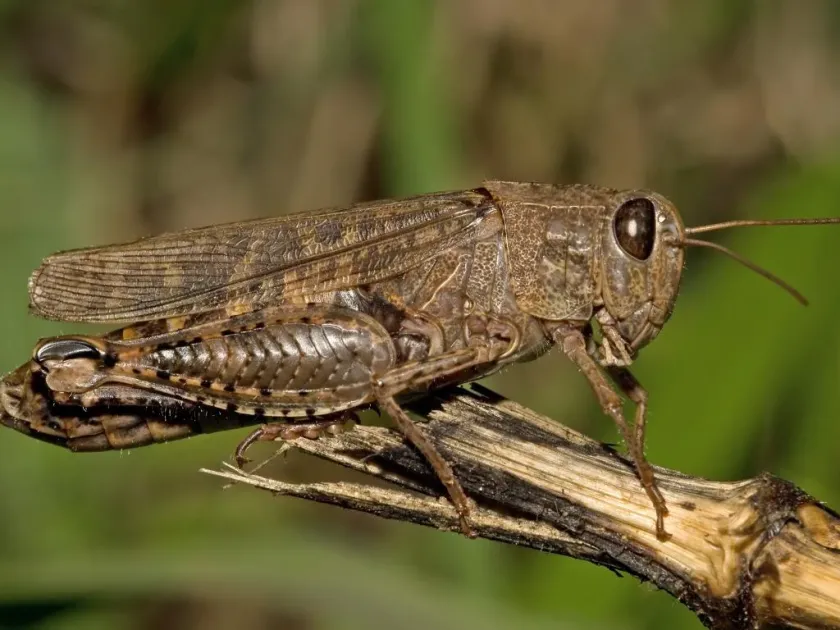
Adults typically measure between 14 and 40 mm in length, possessing a variable brownish-grey to yellow-grey coloration with dark patches.
A key diagnostic feature is the presence of bright pink or red hind wings and hind tibiae, which are easily visible when the insect jumps or flies.
The pronotum features a distinct median keel that is deeply notched by a transverse groove, a detail crucial for accurate species identification.
Females lay their eggs in curved, hardened egg pods known as oothecae, which are buried in the soil to protect them throughout the winter.
What it damages
The Italian locust is a highly polyphagous pest, capable of inflicting severe damage on a wide variety of agricultural crops throughout its range.
Primary food sources include cereals like wheat, barley, and maize, as well as industrial crops such as sunflowers, flax, and sugar beets.
In outbreaks, nymphs and adults feed voraciously on leaves, stems, and sometimes even the ears of grain, often leading to total crop failure.
They are known to target young plants, where they can quickly strip foliage, leaving only the bare stalks, which disrupts photosynthesis and growth.
Pastures and grazing lands are also susceptible, as mass populations can reduce forage quality and biomass, causing significant economic losses for farmers.
When it appears
This species completes one generation per year, with the egg stage serving as the primary method of overwintering in the soil.
Nymphal hatching typically occurs in mid-spring, triggered by warming soil temperatures and specific moisture conditions in their habitats.
The nymphal development period involves five molting stages, lasting roughly 40 to 50 days before the insects reach the sexually mature adult stage.
Adult locusts emerge in early summer, actively feeding and mating throughout the warm months to prepare for the subsequent egg-laying cycle.
Egg deposition continues until late autumn, as females seek loose, dry soil patches to deposit their egg pods before the first frosts appear.
Signs of infestation
Visual identification of an infestation starts with observing heavily damaged foliage that shows erratic, ragged edges or complete tissue removal.
- Ragged leaf margins or completely stripped plant stems.
- Presence of numerous nymphs on field edges or in early growth crops.
- High concentrations of frass (insect excrement) on soil surfaces.
- Locust swarming behavior when disturbed by field machinery or people.
- Localized patches of destroyed vegetation spreading outward from breeding sites.
When present in high densities, their constant chirping and rhythmic movement during the heat of the day are clear signs of a major infestation.
Regular scouting of field margins, fallow lands, and irrigation ditches during spring can help identify early nymphal aggregations.
Advanced stage infestations are characterized by a noticeable decrease in green cover, often described as "bare patches" in a previously healthy field.
Control measures
Effective management requires an integrated approach focusing on cultural practices and targeted chemical interventions during early life stages.
Deep plowing in late autumn or early spring is highly recommended to destroy egg pods by exposing them to birds and freezing temperatures.
Chemical control via contact insecticides is most effective when applied against nymphs of the first to third instar before they become highly mobile.
Barrier treatments around the perimeter of fields can prevent the migration of locust bands from adjacent waste lands into valuable crop zones.
Constant monitoring of population density is vital for economic decision-making, ensuring that chemical application only occurs when thresholds are exceeded.
Discussion
No discussions yet — be the first.