
Italian locust
Calliptamus ictericus
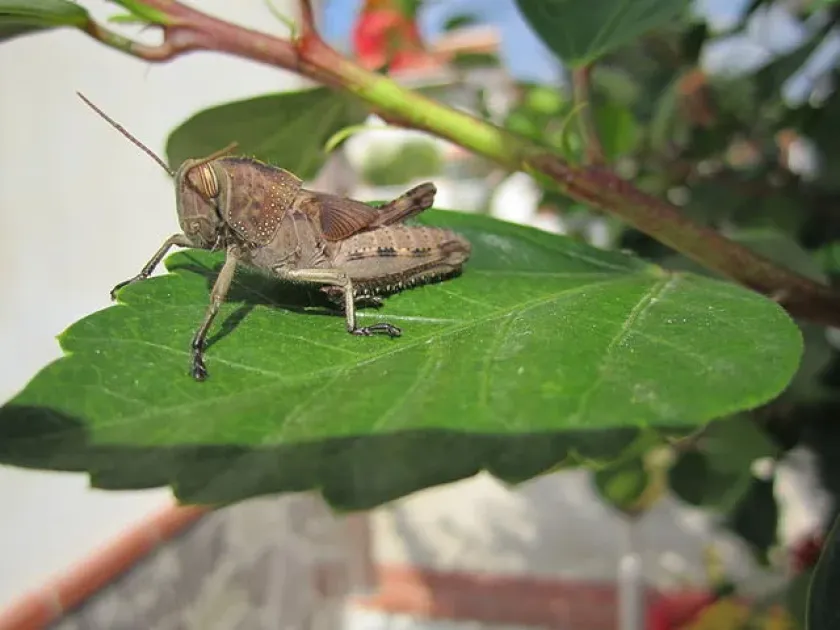
Description
How to identify
The Italian locust (Calliptamus italicus) is a species of grasshopper in the family Acrididae. Adult insects typically reach lengths of 14 to 40 mm, with females being significantly larger than their male counterparts.
Their body coloration ranges from greyish-brown to reddish-brown, often featuring mottled patterns that provide excellent camouflage against dry soils. The most distinct identification feature is their bright pink or reddish hind wings, visible during flight.
The head is characteristic of the Acrididae family, and the pronotum features a prominent longitudinal ridge. The hind tibiae are also tinged with red, serving as a reliable diagnostic trait for field identification.
Nymphs undergo five developmental stages (instars), gradually increasing in size and developing wing pads. In early stages, they look like miniature versions of adults but lack functional wings.
While often solitary, this species can exhibit swarm behavior during high-density outbreaks. These swarms, or hoppers, can migrate significant distances, devastating vegetation along their path.
What it damages
The Italian locust is a highly polyphagous pest that feeds on a wide range of agricultural crops. It is particularly known for attacking cereals such as wheat, barley, corn, and millet.
Vegetable and industrial crops are also at risk. The locust consumes the foliage of tomatoes, peppers, sunflowers, and legumes, often leading to total crop failure if left unmanaged.
Orchards and vineyards are susceptible to damage as well, as the insects can feed on tender bark, buds, and young leaves. This feeding behavior weakens the trees and vines, making them more vulnerable to secondary infections.
In years of high population density, these insects can strip entire fields of green biomass in just a few days. The resulting damage inhibits plant growth and leads to significant yield losses for farmers.
Feeding activity is most intense during the warmer months. As plants lose leaf surface area, their ability to photosynthesize decreases, resulting in stunted growth and poor harvest quality.
When it appears
The Italian locust has a univoltine life cycle, meaning it completes one generation per year. The winter is spent in the egg stage, with eggs deposited in clusters, known as egg pods, beneath the soil surface.
Nymph emergence typically begins in late spring, triggered by rising soil temperatures. Mass hatching generally occurs from late May to early June, depending on local climatic conditions.
The nymphal stage lasts for approximately 40 to 50 days, during which they feed voraciously. Adults appear in mid-summer, marking the phase where mating and egg-laying for the next season occur.
Adults remain active until late autumn, feeding until the first significant frost. The peak of their damaging activity and dispersal occurs during the months of July and August.
Monitoring for late-season egg-laying is crucial for predictive modeling. By identifying the locations where eggs are deposited, farmers can plan their cultural control measures for the upcoming season.
Signs of infestation
The primary sign of an Italian locust infestation is irregular, ragged feeding patterns on leaves. In severe cases, only the woody stems and main veins of the leaves remain.
Observations in the field during sunny weather often reveal large numbers of grasshoppers jumping or flying away upon disturbance. The flash of pink wings in flight is a clear indicator of the species presence.
Accumulations of frass (insect excrement) on the ground are common in areas where nymphs have been feeding. Movement of large hopper bands can often be heard as a distinct rustling sound.
Post-harvest soil inspections can reveal egg pods, helping to assess the potential risk for the following year. This proactive approach is essential for large-scale agricultural management.
- Defoliated stems and leaves
- Ragged edges on plant foliage
- Visible clusters of nymphs in the field
- Pink-winged adults flying when disturbed
- Accumulated frass on the soil surface
Control measures
Cultural control includes deep autumn plowing, which exposes egg pods to extreme temperatures and predators, effectively reducing the overwintering population. Proper crop rotation also helps break the pest cycle.
Chemical control involves the timely application of insecticides during the nymphal stages. Targeted spraying of infested areas is more efficient and environmentally friendly than wide-area broadcasting.
Biological control methods involve supporting natural enemies, such as birds, small mammals, and insect predators. Some fungal pathogens can also be used as part of integrated pest management programs.
Barrier treatments around field perimeters can prevent mobile hopper bands from migrating into sensitive crops. This strategy limits the need for extensive chemical use across the entire farm.
Consistent monitoring and early detection are the cornerstones of successful control. When populations exceed the economic threshold, immediate intervention is necessary to prevent significant financial loss.
Discussion
No discussions yet — be the first.