
Red-winged wood borer
Callidium rufipenne
Description
How to identify
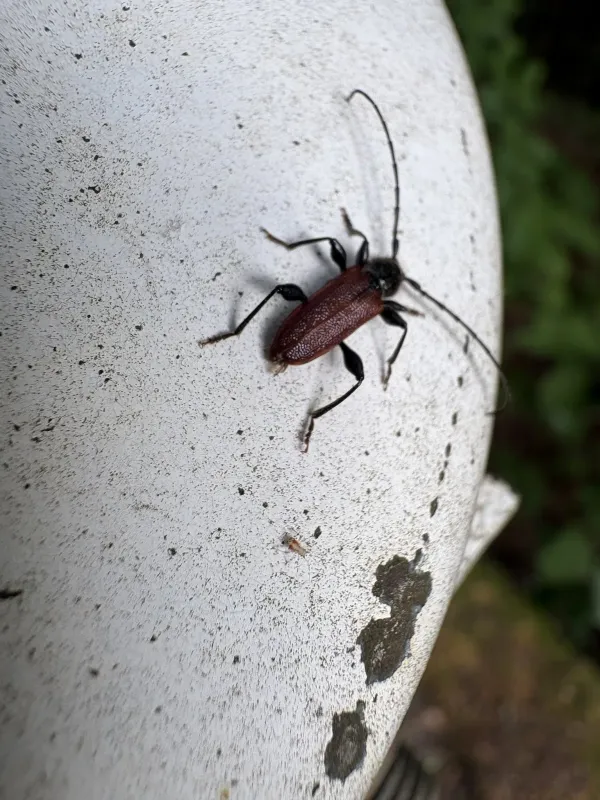
The Red-winged wood borer, scientifically known as Callidium rufipenne, belongs to the family Cerambycidae (longhorn beetles), order Coleoptera. Adult specimens are 8–15 mm in length and typically have black or dark brown bodies with distinct bright red or reddish elytra.
The elytra surface is densely punctured, giving them a matte appearance. The head and pronotum are black, sometimes displaying a metallic sheen. Male antennae are generally longer than the body, while female antennae are shorter, which serves as a primary sex-dimorphism indicator.
The larvae are typical for the family: legless, white or yellowish, with powerful chitinized mandibles designed for boring through wood. Pupation occurs inside the larval galleries created beneath the bark or within the outer layers of the sapwood.
The life cycle lasts between one and two years, depending heavily on regional climate conditions and the quality of the host tree. Optimal development occurs in warm weather with host trees providing the necessary moisture content in the bark.
While this beetle often plays a sanitary role in the wild by feeding on dying trees, it can become a significant pest in managed forests and ornamental gardens if not properly monitored.
What it damages
The primary hosts of Callidium rufipenne are coniferous tree species, most notably members of the genera Picea (spruce) and Abies (fir). It may occasionally infest other conifers when its primary hosts are unavailable.
This pest prefers stressed, weakened, damaged, or recently felled trees where the bark remains moist enough to support the initial stages of larval development.
Larvae create winding galleries in the bast and cambium layers, eventually boring deeper into the sapwood. This disrupts the tree's nutrient transport system, leading to premature branch dieback or the total death of the host plant.
Mass outbreaks are often triggered by forestry practices where logging residues or fallen branches are not removed from the site in a timely manner, providing an ideal breeding ground.
In forest nurseries and young plantations, the Red-winged wood borer can cause substantial economic losses by reducing the commercial quality of the timber and hindering the growth of young saplings.
When it appears
The flight period of adult beetles (imago) begins in late spring and continues through the first half of summer. During this time, they are most active, feeding and mating on the bark of host trees.
After mating, females lay eggs into cracks in the bark of weakened trees. Newly hatched larvae penetrate the bark and begin their destructive feeding, which persists until deep autumn.
Overwintering typically takes place at the larval stage deep inside the wood. The larvae remain dormant in their galleries until spring warmth arrives, triggering the resumption of their developmental process.
Pupation occurs in spring, usually between April and May, followed shortly by the emergence of new adults. The exit of adults from the tree is marked by the appearance of characteristic flight holes in the bark.
Monitoring the insect's phenology is critical for planning sanitary interventions, as management efforts are most successful when performed before the emergence of the new generation.
Signs of infestation
The first sign of an infestation is the presence of oval or nearly circular exit holes on the bark surface, created by adults when they bore their way out of the tree.
Beneath the bark of infested trees, characteristic winding galleries tightly packed with sawdust (frass) can be found. A significant accumulation of frass at the base of the trunk often indicates a high level of infestation.
The needles on infested parts of the tree may change color, turning yellow and falling prematurely due to the disruption of the tree's vascular system caused by larval feeding.
When the bark is removed, irregular and chaotic galleries become visible, directly damaging the cambium. This causes a loss of vitality even in trees that may appear healthy from a distance.
- Yellowing of needles.
- Presence of wood dust (frass).
- Flight holes in the bark.
- Loss of bark turgor.
- Bark dieback at larval gallery sites.
Control measures
The primary management strategy is timely sanitary felling and removal of infested trees from gardens or forests before the mass flight of the adult beetles occurs.
Strict hygiene regarding logging residues is essential: debris should be promptly removed, burned, or chipped to eliminate breeding sites for the pest.
Contact insecticides can be applied during the adult flight period; however, this requires precise knowledge of the emergence timing and is generally ineffective against larvae already established beneath the bark.
Preventive measures focus on enhancing tree vigor through proper irrigation, fertilization, and protection from mechanical bark damage, which serves as an entry point for the beetle.
The use of pheromone traps can help monitor population levels and reduce the number of adults in the area, serving as an effective tool for integrated pest management in private and forest holdings.
Discussion
No discussions yet — be the first.