
African maize stalk borer
Busseola fusca
Description
How to identify
The African maize stalk borer (Busseola fusca) is a member of the Noctuidae family, belonging to the Lepidoptera order. It is a highly destructive pest of cereal crops, particularly maize, native to Sub-Saharan Africa.
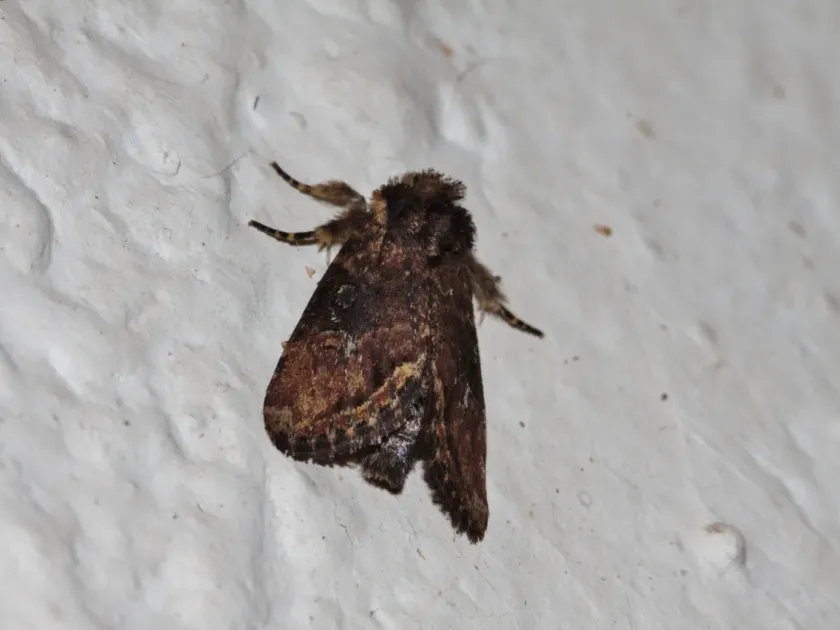
The adult moth has a wingspan of 30–40 mm. Its forewings exhibit a mottled brown and grey pattern, providing excellent camouflage against plant debris, while the hindwings are lighter in color.
Females lay eggs in batches between the leaf sheath and the stem of the maize plant. These egg masses are typically covered with scales, offering protection against both environmental stressors and predatory insects.
Larvae develop through several instars, with their body color shifting from creamy-white to a pinkish-brown hue as they mature. A distinct dark-brown head capsule is a key morphological feature for identifying the species.
Pupation takes place within the plant stem. After feeding, the larvae prepare a pupation site inside the stalk, making it a concealed stage of the life cycle that remains protected from many external factors.
What it damages
While maize is the preferred host, Busseola fusca also infests sorghum, millet, and a range of wild grasses, which can serve as alternative hosts between cropping seasons.
Larvae cause damage by feeding on young leaf tissue, creating characteristic "window-paning" or small holes in the leaves. As they grow, they bore into the stem, destroying the plant's internal vascular system.
Stem tunneling disrupts the flow of water and nutrients to the developing ear, resulting in reduced grain filling and poor quality yields. In severe infestations, the structural integrity of the stem is compromised.
Early-stage damage to the central growing point often causes the "dead heart" symptom. The central leaf wilts and turns brown, which typically results in total growth cessation and loss of the productive potential of the plant.
Large populations of larvae can cause extensive stalk breakage. This makes mechanical harvesting difficult or impossible and leads to significant losses due to lodged plants that cannot be recovered by combine harvesters.
When it appears
The life cycle of the African maize stalk borer is strongly correlated with rainfall patterns. Moth emergence is usually triggered by the onset of the rainy season, coinciding with the availability of suitable host plants.
Depending on the climatic zone, the pest can complete between one and three generations per year. Temperature plays a critical role, as higher temperatures generally accelerate the developmental speed of the larvae.
During the dry season or periods of food scarcity, the larvae enter a state of diapause inside dry plant stalks. This dormant phase allows the pest to survive harsh conditions until the next agricultural season begins.
Monitoring using pheromone traps is essential to detect the arrival of the first moths. Accurate prediction of flight periods allows farmers to apply control measures before the larvae reach the inside of the stem.
Understanding the synchronization of pest life cycles with crop development is crucial. Early planting is often suggested as an agronomic strategy to minimize the crop's vulnerability during the peak moth flight periods.
Signs of infestation
The first signs of infestation are small holes in the leaves. If observed on a younger, rolled leaf, these holes appear as symmetric rows when the leaf is fully unfurled.
Frass (larval excrement) is a reliable indicator of active infestation. It appears as sawdust-like particles accumulating in the leaf whorl or around the entry points in the stem.
A wilted, drying central leaf (dead heart) is a classic symptom. At this stage, the larva has likely already bored deep into the heart of the plant, potentially causing irreversible damage to the meristem.
- Dead heart or wilting of the central leaf.
- Visible frass or sawdust at leaf bases.
- Small holes or perforations on the foliage.
- Cross-line damage on unfolded leaves.
- Stalk lodging or snapping in the wind.
Periodic scouting of crop rows, especially at the V4-V6 growth stages of maize, is necessary to identify larvae before they move to internal tissues where they become difficult to target.
Control measures
Cultural control is a primary management strategy. This involves the destruction of crop residues after harvest, as stalks contain the dormant larvae that will start the next season's infestation.
Deep plowing or incorporating residues into the soil helps to eliminate these overwintering populations. Crop rotation with non-host crops is also highly recommended to break the life cycle of the borer.
Biological control, utilizing natural enemies like parasitic wasps, can play a significant role in reducing larval numbers in areas where sustainable agricultural practices are encouraged.
Chemical control focuses on the application of systemic insecticides at the correct window. Treatments are most effective if applied when young larvae are still on the leaf surface before they bore into the stalk.
The use of insect-resistant transgenic maize varieties is considered the most reliable solution in areas with chronic and high-pressure infestations, providing protection throughout the critical growth stages.
Taxonomy
- Latin name
- Busseola fusca
- Order
- Lepidoptera (butterflies)
- Family
- Noctuidae
- EPPO code
- BUSSFU
Discussion
No discussions yet — be the first.