
Broom seed beetle
Bruchidius villosus
Description
How to identify
The broom seed beetle (Bruchidius villosus) is a small coleopteran insect belonging to the seed beetle family, known as Bruchidae, which is notoriously difficult to manage.
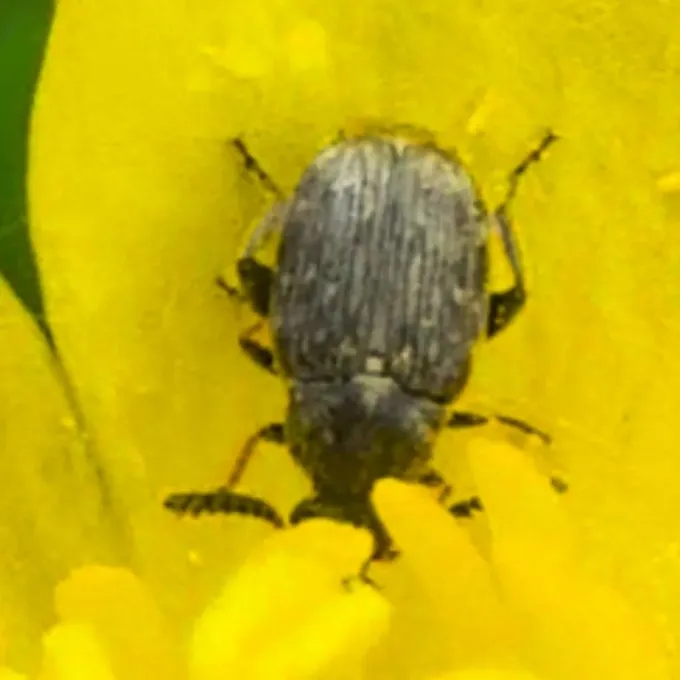
Adult beetles typically measure between 2 and 3 millimeters in length and possess a dark, robust body covered with dense, grayish or brownish hair.
Their head is usually retracted into the pronotum, and the elytra are patterned in a way that provides excellent camouflage against legume flowers and pods.
The larval stage is characterized by a grub-like appearance, being legless and creamy white, with strong mandibles designed for boring into seeds.
Identification often relies on finding exit holes in seeds or observing adult beetles during the flowering stages of their host plants.
What it damages
Bruchidius villosus primarily feeds on the seeds of legumes, with a specific preference for plants in the genus Cytisus (broom) and related species.
The larvae develop entirely within the host seed, consuming the embryo and endosperm, which renders the seed non-viable and destroys its nutritional value.
In agricultural settings, these beetles can cause severe yield losses in seed crops of perennial forage legumes, impacting both quantity and seed quality.
The structural damage caused by larvae tunneling makes the remaining seed husk susceptible to secondary infections by various molds and bacteria.
Because the damage is internal, it often remains undetected until the mature beetles emerge, leaving circular holes in the otherwise intact pods.
When it appears
Adult activity typically begins in late spring, coinciding with the peak flowering period of host legume plants, which provides necessary pollen for feeding.
Mating occurs shortly after emergence, and females proceed to lay eggs on the developing pods while the seeds are still in the early maturation stages.
The larval development takes place throughout the summer months inside the seed, where the insect completes its transformation and pupation.
Overwintering usually occurs as larvae inside seeds or as adults hiding in sheltered areas within the field or storage facilities.
The emergence of the new generation of adults usually happens in the following spring, completing the annual lifecycle of the pest.
Signs of infestation
The most diagnostic sign of an infestation is the presence of small, perfectly circular exit holes on the surface of mature legume seeds or pods.
Infested seeds are significantly lighter in weight than healthy ones and often appear dull or slightly discolored due to the internal tunneling.
Careful inspection of pods during the growing season might reveal tiny, white, oval-shaped eggs glued to the outer surface by the female beetle.
A hollow sound when seeds are shaken or the collapse of seeds under mild pressure are clear indicators that the internal content has been consumed.
Farmers can also monitor the population density by using sweep nets in legume fields during the flowering phase to detect adult beetle presence.
Control measures
Effective management begins with strict quality control of seeds used for sowing, ensuring that only non-infested material is utilized in agricultural practice.
Sanitation practices, such as the removal and destruction of crop residues after harvesting, help to reduce the carry-over of pests to the next season.
If chemical intervention is necessary, insecticides should be applied during the flowering stage, specifically targeting the period of egg-laying activity.
For stored seeds, fumigation or cold storage treatments are effective ways to kill any remaining larvae or adults before the material is distributed.
- Use of crop rotation to break the pest's reproductive cycle.
- Selection of legume varieties with shorter flowering or pod-forming periods.
- Biological control options using parasitic wasps that target larval stages.
Taxonomy
- Latin name
- Bruchidius villosus
- Order
- Coleoptera (beetles)
- Family
- Bruchidae
- EPPO code
- BRCIFA
Discussion
No discussions yet — be the first.