
Five-spotted seed beetle
Bruchidius quinqueguttatus
Description
How to identify
The Five-spotted seed beetle (Bruchidius quinqueguttatus) is a member of the Bruchidae family, known for infesting various legume species.
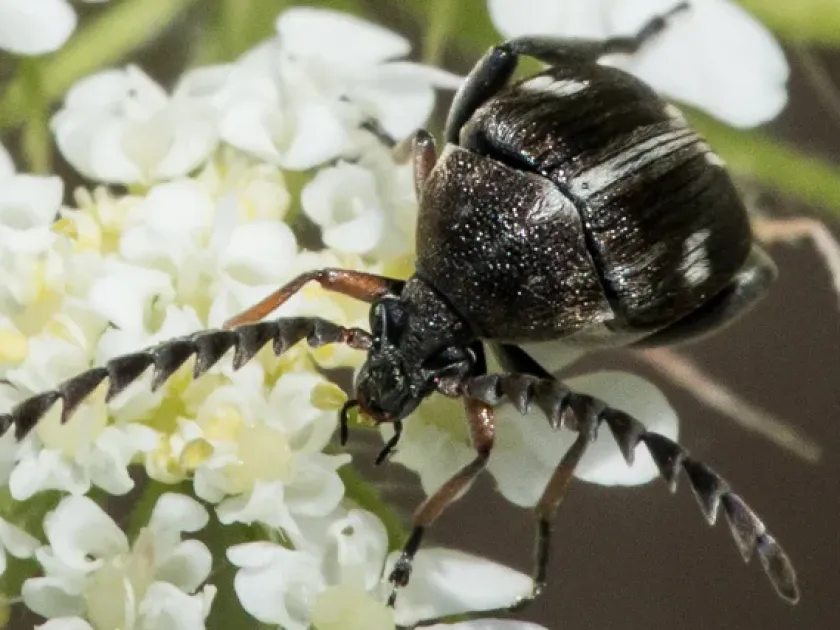
The adult beetle is characterized by its compact, oval shape and the presence of five distinctive light-colored spots on its elytra, which provides its common name.
These insects are well-adapted to life within seeds, making early detection challenging until significant damage has occurred.
The larvae are typically white or yellowish, legless, and possess specialized mouthparts for consuming the endosperm of the seed.
Field identification is facilitated by using insect nets and pheromone traps to monitor adult population levels during the crop blooming stage.
What it damages
This beetle species primarily attacks various legumes, posing a significant threat to both agricultural production and stored seed stocks.
The larvae bore into the developing seeds, consuming the embryo and endosperm, which renders the seed non-viable and reduces harvest quantity.
Infested seeds suffer from weight loss and decreased nutritional value, significantly impacting their suitability for human consumption or animal feed.
In addition to direct crop damage, the presence of the beetle in stored grain can lead to mass infestations if not managed correctly.
The economic impact is profound, as it affects both the quantity of the harvested crop and the quality of the seed intended for the next planting season.
When it appears
The beetle's life cycle is closely synchronized with the phenology of its host plants, with activity beginning in late spring as temperatures rise.
Adults typically emerge from hibernation just as legumes begin to bloom, allowing them to lay eggs on the newly formed pods.
Eggs are laid externally on the surface of the pods, and upon hatching, the young larvae immediately bore into the seeds.
Development from egg to adult takes place entirely within the seed, with the number of generations per year depending heavily on regional climate conditions.
In warmer climates, multiple generations can occur, extending the period of risk throughout the summer and into the storage period.
Signs of infestation
The earliest signs of infestation are microscopic puncture marks on the pods where females have deposited their eggs.
As the larva matures and eventually pupates, it creates a circular emergence hole in the seed coat, which is the most visible sign of infestation.
Infested seeds often appear hollowed out and may show signs of deformation or surface discoloration due to larval activity.
Inside the seed, one may find larval frass and debris, which distinguishes infested seeds from healthy ones during laboratory analysis.
- Circular exit holes on the seed coat.
- Significant reduction in seed density and weight.
- Presence of powdery frass within damaged seeds.
Control measures
Effective management requires a multi-faceted approach, emphasizing both prevention through agronomic practices and reactive chemical measures.
Crop rotation and selecting resistant or early-maturing varieties are essential cultural practices to reduce the exposure of the crop to peak beetle activity.
Chemical control, if necessary, should be applied strategically during the flowering stage to prevent egg-laying before larvae can penetrate the pods.
Post-harvest fumigation of seeds is critical for grain storage facilities to eliminate any larvae or adults that may have survived the field harvest.
Maintaining strict sanitation in storage areas, including cooling the grain, helps suppress the reproduction of any remaining beetle populations.
Taxonomy
- Latin name
- Bruchidius quinqueguttatus
- Order
- Coleoptera (beetles)
- Family
- Bruchidae
- EPPO code
- BRCIQU
Discussion
No discussions yet — be the first.