
Large Yellow Underwing
Brotolomia
Description
How to identify
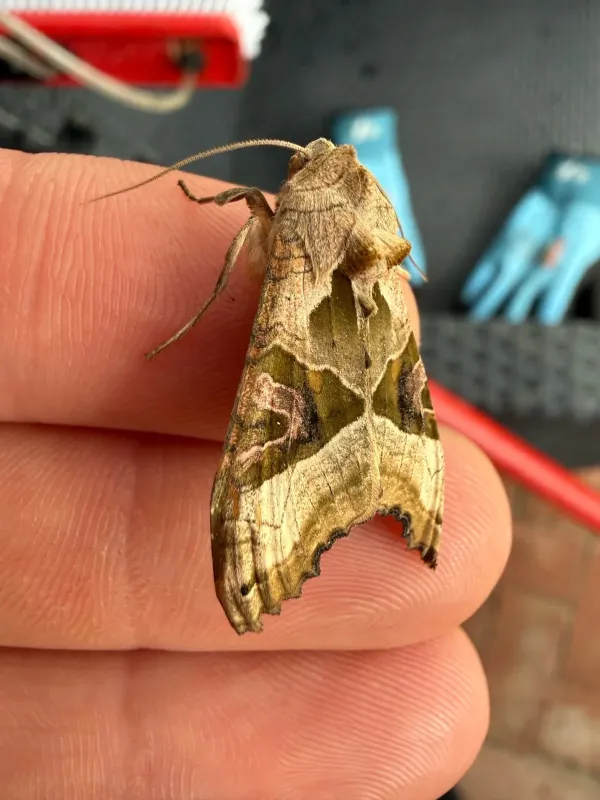
The Large Yellow Underwing (scientifically known as Brotolomia meticulosa, often referred to as the Angle Shades moth) belongs to the family Noctuidae. The adult moth has a wingspan of about 45–50 mm and mimics a dry, crumpled leaf when at rest.
The forewings are patterned with intricate ochre and brown shades, while the hindwings are lighter in color. The unique shape of the folded wings gives it a distinctive, ragged appearance.
The caterpillars can reach up to 50 mm in length. Their color range spans from bright green to brownish tones, providing excellent camouflage on the host plants.
The caterpillar's body is sparsely covered with fine setae, and the head is well-developed. It progresses through five larval instars before reaching full maturity.
The pupa is dark brown, shiny, and measures approximately 15–20 mm. It is typically found in the soil, protected by a loose, silken cocoon formed among plant debris.
What it damages
This species is a polyphagous pest, meaning it attacks a wide range of plants, including vegetables, ornamental flowers, and various weeds found in agricultural settings.
Commonly affected crops include lettuce, spinach, cabbage, and various root vegetables, as well as garden favorites like chrysanthemums and other perennials.
The caterpillars cause damage by feeding on the leaves, creating irregular holes. In cases of severe infestation, they can skeletonize the foliage, leaving only the veins behind.
Beyond the direct loss of foliage, the pest contaminates the produce with frass (excrement), rendering the harvest unmarketable and unsuitable for consumption.
Feeding on apical buds can lead to stunted plant growth, deformation of stems, and a significant decrease in total yields, especially in young plant batches.
When it appears
The lifecycle of this moth typically involves two generations per year in temperate climates. Adults of the first generation emerge in late spring to early summer.
The second generation of moths is active from August through October. In warmer regions, a partial third generation may occur under favorable climatic conditions.
Females deposit eggs in small clusters on the underside of leaves. The incubation period lasts between 5 and 10 days, depending heavily on the prevailing temperatures.
Caterpillars are primarily nocturnal feeders. During the day, they remain stationary, often hidden deep within the foliage or near the soil line to avoid predators and heat.
Overwintering occurs primarily as a pupa in the topsoil layer, though larvae may occasionally overwinter in sheltered plant debris if the weather is mild.
Signs of infestation
The first signs of infestation are ragged holes in the leaf blades, often appearing randomly across the foliage or concentrated along the leaf edges.
The presence of dark, granular frass on the leaves or the surrounding soil is a definitive indication that caterpillars are actively feeding on the plant.
Checking the plants at night with a flashlight is the most effective way to spot the larvae, as they are rarely visible during the daylight hours.
Wilted terminal shoots or drooping stems may indicate that a larva has bored into the succulent tissues of the plant to feed, causing structural damage.
- Irregular holes in leaf tissue.
- Accumulation of larval frass on soil.
- Wilted young shoots or buds.
- Presence of larvae on the underside of leaves at night.
Control measures
Cultural control measures include regular soil cultivation between crop rows to disturb pupal sites, which helps decrease the survival rate of the overwintering generation.
Maintaining a weed-free environment in and around the planting area is crucial, as weeds often serve as initial reservoirs for the moth population.
Biological control using Bacillus thuringiensis is highly effective against young larvae and serves as a sustainable alternative to broad-spectrum insecticides.
When populations exceed economic thresholds, the application of registered insecticides is necessary, ensuring that pre-harvest intervals are strictly observed.
Pheromone traps are excellent tools for monitoring moth activity, allowing growers to time their control interventions for maximum efficiency and reduced chemical usage.
Discussion
No discussions yet — be the first.