
Rice mealybug
Brevennia rehi
Description
How to identify
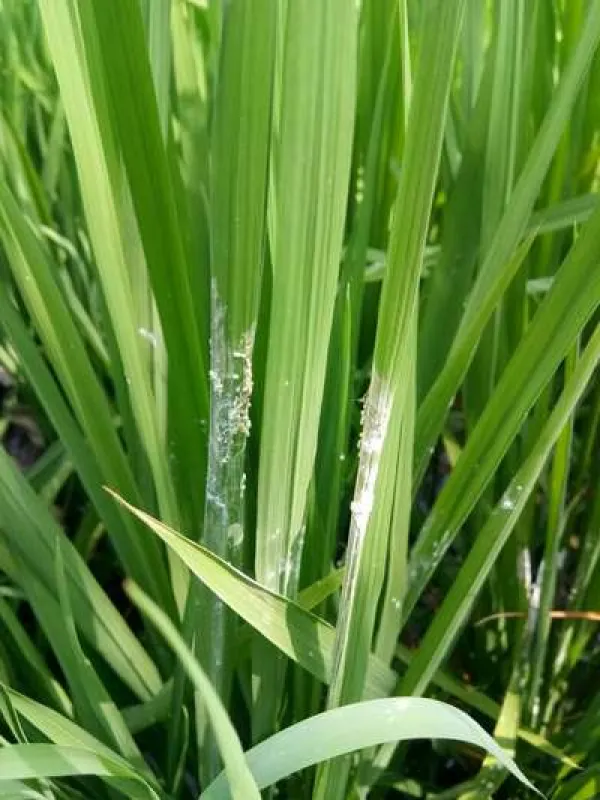
The rice mealybug (Brevennia rehi) is a small insect belonging to the order Hemiptera and the family Pseudococcidae. Adult females are oval-shaped, pinkish to yellowish, and covered in a characteristic white, waxy, mealy secretion.
Adult females typically measure between 2 and 3 mm in length. Males are rare, winged, and much smaller, equipped with antennae adapted for locating females to facilitate reproduction within the crop canopy.
Females deposit eggs in loose, white, cotton-like wax ovisacs. These egg masses are typically found on the stems or under the leaf sheaths of rice plants, providing a protected environment for the next generation.
The first-instar nymphs, commonly called crawlers, are highly mobile. Their primary objective is to disperse across the plant and locate suitable, soft tissues where they can settle and begin feeding on plant sap.
The insect prefers hidden micro-environments, typically dwelling beneath leaf sheaths near the nodes. This cryptic lifestyle makes early detection difficult and requires careful scouting of the field to identify initial infestations.
What it damages
The primary host plant for this pest is rice (Oryza sativa). However, it is known to infest various wild grass species, which serve as alternate hosts and reservoirs for the pest during the off-season.
Damage is caused by both nymphs and adults using their piercing-sucking mouthparts to extract sap. Continuous feeding on the internal fluids leads to nutrient depletion, resulting in significantly stunted plant growth.
Infested rice plants show yellowing leaves that eventually turn brown and dry out. The overall vigor of the crop is severely compromised, which impairs the plant's ability to undergo normal development stages.
Heavy infestations prevent proper panicle development. Often, the panicles fail to emerge fully from the flag leaf sheath, or they emerge empty, leading to a direct and substantial loss in grain yield.
As the insects feed, they may also act as vectors for various rice viruses. This secondary damage can be more devastating than the sap-sucking itself, potentially causing widespread crop failure in affected fields.
When it appears
The development of the rice mealybug is heavily influenced by environmental conditions, particularly temperature and humidity. Warm, humid climates are optimal for rapid population growth and multiple generations per year.
During the off-season, the pest overwinters as adults or nymphs. They typically hide in the basal parts of stalks, in soil cracks, or on the roots of perennial grasses near the edges of rice fields.
As temperatures rise during the early growing season, the surviving population migrates to the young rice seedlings. Infestations usually begin in patches and can spread rapidly across the paddy field.
The population density usually peaks during the reproductive stages of the rice plant, specifically from tillering through to the panicle initiation phase, which are the most critical times for crop health.
At the end of the cropping season, as environmental conditions become unfavorable, the insects initiate a quiescent phase, relocating to protected lower stem tissues or the soil to survive the winter period.
Signs of infestation
The most reliable sign of a mealybug infestation is the presence of white, cotton-like masses on the stems or in the leaf sheaths. These are the waxy secretions left behind by the insect colonies.
Leaves on the affected plants begin to yellow, curl, and wither. The whole plant appears chlorotic and weak compared to the surrounding healthy vegetation, leading to visible patches of yellowing in the field.
The presence of sooty mold is a common secondary sign. This fungus grows on the honeydew excreted by the mealybugs, causing a black coating on the plant stems that inhibits photosynthesis.
Under close inspection, one can find the pinkish, slow-moving adults or clusters of crawlers inside the leaf sheaths. They are often tightly pressed against the stem, making them hard to spot without peeling back the leaves.
Stunted growth, delayed heading, and malformed panicles are late-stage signs. In extreme cases, the plants may lodge or die completely if the nutrient depletion reaches a critical threshold.
Control measures
Integrated pest management starts with cultural control, specifically the rigorous removal of weeds and grasses around field bunds and irrigation channels, which act as refuge areas for the mealybugs.
Optimizing fertilizer application is essential. Excessive nitrogen can lead to overly lush, succulent plant growth, which attracts mealybugs and facilitates faster population expansion within the rice canopy.
Biological control plays a crucial role in maintaining populations at sub-economic levels. Encouraging the presence of natural predators, such as ladybird beetles and parasitic wasps, can significantly reduce infestation rates.
When infestation levels exceed the economic threshold, systemic insecticides are the most effective chemical intervention. Applications must be timed precisely to target the mobile crawler stages before they become established.
Regular monitoring of rice fields for early symptoms is vital. Early identification allows for targeted spot treatments, which prevent the pest from spreading throughout the entire paddy and protect the harvest.
Taxonomy
- Latin name
- Brevennia rehi
- Order
- Hemiptera (bugs, aphids, leafhoppers)
- Family
- Pseudococcidae
- EPPO code
- BREVRE
Discussion
No discussions yet — be the first.