
Snow flea
Boreus hyemalis
Description
How to identify
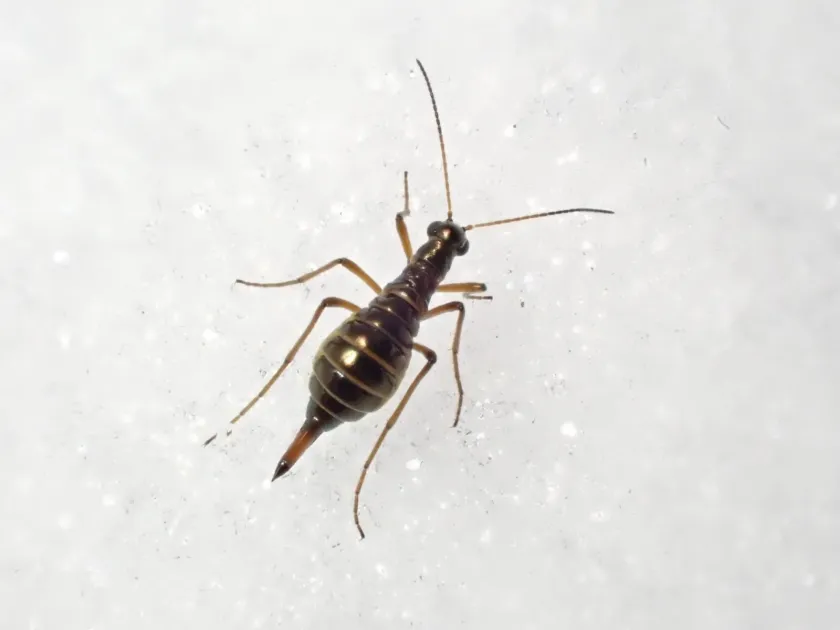
The Snow flea (Boreus hyemalis) belongs to the order Mecoptera and the family Boreidae. It is a tiny insect, typically measuring 3–5 mm in length.
The male of the species has modified, hook-like vestigial wings used for grasping the female during the mating process in winter conditions.
Females possess even smaller, scale-like wings and a long, downward-curved ovipositor, which they use to lay eggs in mossy substrates.
Their bodies are usually dark brown or black, providing a high contrast against the snow, which makes them easy to spot during winter thaws.
The general appearance is reminiscent of a scorpion fly, with an elongated head that looks somewhat like a snout, which is typical for the order Mecoptera.
What it damages
Snow fleas primarily feed on decaying organic matter, bryophytes (mosses), and sometimes small soil invertebrates present in damp environments.
They are generally considered harmless to agriculture and gardening, as they do not feed on the tissues of living economic crops.
While reports of them appearing in nurseries exist, they rarely cause any measurable damage to healthy plant seedlings or commercial vegetation.
Any perceived feeding activity on plants is likely incidental, occurring only when natural food sources like moss are scarce or inaccessible due to ice.
Therefore, they do not require any specialized pest management strategies in an agricultural context.
When it appears
As the name suggests, the Snow flea is most active during the coldest months of the year, including late autumn, winter, and early spring.
They are frequently observed moving across the surface of the snow during warm spells when temperatures rise slightly above the freezing point.
Their lifecycle involves a complete metamorphosis: egg, larva, pupa, and adult. The larval stage develops in the soil or leaf litter throughout the warmer months.
Adults emerge during winter for the sole purpose of finding a mate and reproducing, which is why they are so visible in the middle of the winter season.
Their physiological adaptations allow them to remain mobile at temperatures that would be fatal to most other insect species.
Signs of infestation
The primary sign of their presence is the observation of small, dark, jumping or crawling insects on the snow cover on sunny winter days.
They tend to aggregate in specific locations, often near the base of trees or where moss-covered patches are exposed through the snow.
No specific plant damage symptoms, such as wilting or chewing patterns, are typically associated with this species in agricultural settings.
In indoor greenhouses, one might notice them on the glass or the soil surface if they have been introduced with natural potting materials or moss.
Their presence is usually noticed only due to their high visibility against the white background of a snowy landscape.
Control measures
There are no established chemical control measures for the Snow flea, as they are not classified as a plant pest in modern agronomy.
Standard horticultural practices, such as removing excess garden debris and controlling moss overgrowth, are sufficient to discourage their local population.
Since they are natural inhabitants of forest soils, their presence in a garden is a sign of a healthy, moist ecosystem rather than an infestation.
If they accidentally enter indoor cultivation areas, mechanical removal or simple sanitation is enough to resolve the situation without using pesticides.
It is recommended to leave them undisturbed, as they perform a minor ecological role in the decomposition of organic matter in the soil.
Taxonomy
- Latin name
- Boreus hyemalis
- Family
- Boreidae
- EPPO code
- BOREHY
Discussion
No discussions yet — be the first.