
Pine shoot beetle
Blastophagus
Description
How to identify
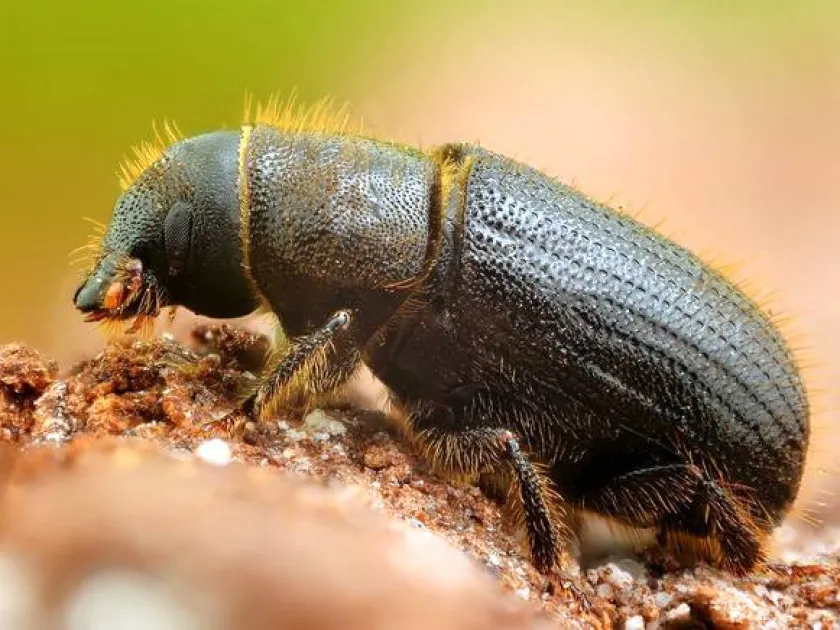
The Pine shoot beetle (lat. Tomicus piniperda, formerly Blastophagus piniperda) belongs to the Curculionidae family, subfamily Scolytinae (bark beetles). The adult insect is a cylindrical beetle, 3.5 to 5 mm long, with a shiny black or dark-brown body covered with fine hairs.
Adults exhibit typical bark beetle morphology: the head is tucked under the pronotum, and the antennae are clubbed. The larvae are legless, white, with yellowish-brown heads, reaching up to 5 mm in length. They develop under the bark, where they form their distinctive galleries.
During its life cycle, the Pine shoot beetle goes through egg, larval, pupal, and adult stages. The insect's entire life is closely linked to coniferous species, making it one of the most significant phytophagous pests in forest ecosystems and plantations.
This species can be distinguished from closely related ones by the structure of the maternal gallery: it is always strictly longitudinal, with a single larval gallery branching off at an angle and gradually widening.
Optimal conditions for the Pine shoot beetle include the presence of weakened trees with thick bark, where the beetles can complete their breeding and feeding processes effectively.
What it damages
The primary host of the Pine shoot beetle is the Scots pine, though it can infest other conifers including spruce, larch, and fir. The greatest damage is inflicted upon young pine stands and mature trees that are under physiological stress.
The pest attacks the tree in two stages: first, the beetles bore into the bark at the lower part of the trunk for reproduction, and then young adults move to the crown to feed on shoots. This shoot damage causes mass needle fall and significantly weakens the tree.
The harm manifests as an interruption of sap flow: the severing of the vascular system leads to premature yellowing of needles and subsequent drying of the entire crown. Weakened trees then become susceptible to secondary pests.
A particular danger is posed by mass outbreaks of the beetle during periods of drought or following windthrow damage. In such conditions, beetle density can multiply rapidly, leading to the quick death of large forest patches.
Economic losses arise not only from the loss of valuable timber but also from reduced aesthetic value in parks and the loss of protective functions of shelterbelts, which play an important ecological role in the region.
When it appears
The flight of overwintered beetles begins in early spring as soon as air temperatures reach +10...+12 degrees Celsius. This period often coincides with the start of sap flow in coniferous species.
The breeding and egg-laying process occurs throughout the spring months, followed by larval development under the bark. A new generation of young adults emerges in late summer, typically in July or August.
After emergence, young beetles begin supplemental feeding in the crowns of healthy trees, boring into the tips of young shoots. This feeding continues until the arrival of stable autumn cold weather.
Adults primarily overwinter at the base of old tree trunks or in the forest floor near the roots. Overwintering occurs in a state of diapause, allowing them to withstand significant sub-zero temperatures.
Thus, the pest's life cycle spans the entire warm season, with activity peaks occurring in the spring (trunk infestation) and late summer (shoot infestation).
Signs of infestation
The primary sign of the Pine shoot beetle's presence is "boring dust"—fine sawdust that accumulates at the base of the trunk or in bark crevices. This is the result of the adults creating maternal galleries.
The presence of large numbers of fallen young shoots under trees in late summer indicates active feeding by young beetles. These shoots often feature a clean internal channel, which causes them to snap off in the wind.
Visual inspection of the bark reveals entrance holes created by the beetles. If the bark begins to flake off, revealing characteristic radial or longitudinal galleries underneath, it indicates an advanced stage of infestation.
Gradual needle discoloration from green to yellow, followed by the reddening of the crown, is a late-stage sign, indicating that the tree is likely beyond recovery as all vital processes have been disrupted.
- Appearance of resin funnels on the bark.
- Mass aggregation of beetles in tree crowns in late summer.
- Wilting of pine apical shoots.
- Presence of "boring dust" at the trunk base.
- Bark damage by woodpeckers (indirect evidence of larval presence).
Control measures
The foundation of protection is forest management: timely selection and removal of infested trees from the forest before the next generation of pests emerges.
The use of trap trees is an effective control method. Several weakened trees are left in the stand during the beetle's activity period; once infested, they must be mandatory felled and processed.
In parks and ornamental plantings, chemical protection is used: spraying trunks with contact insecticides during the mass flight period to prevent beetles from penetrating the bark.
Maintaining high levels of biodiversity is crucial. Encouraging insectivorous birds, especially woodpeckers, which prey on larvae and adults under the bark, helps reduce population numbers naturally.
Sanitary clearing of forest areas of logging debris, brushwood, and deadwood deprives the pest of hibernation and breeding sites, which is a fundamental requirement for controlling its numbers over large territories.
Discussion
No discussions yet — be the first.