
Italian hangingfly
Bittacus italicus
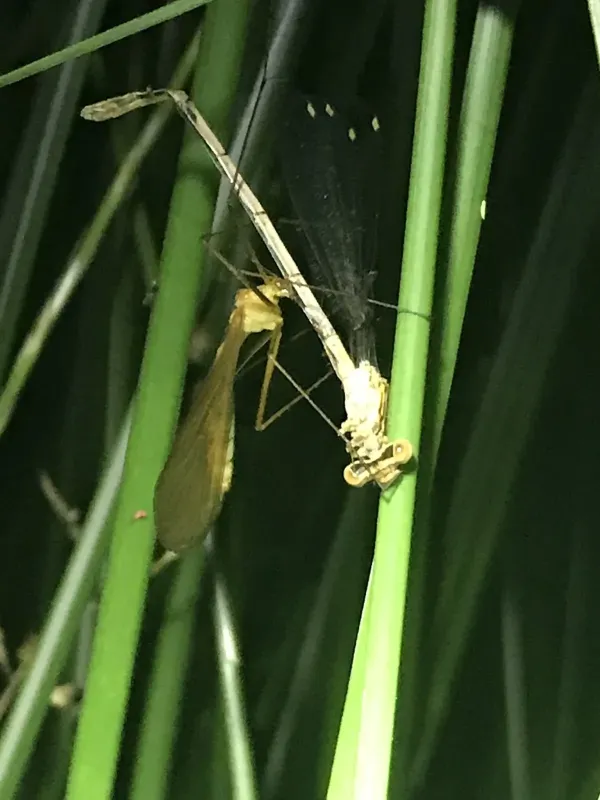
Description
How to identify
The Italian hangingfly (Bittacus italicus) is a member of the order Mecoptera and the family Bittacidae. It is frequently confused with crane flies due to its similar appearance.
It possesses a slender body and very elongated legs, which are specialized for capturing prey while the insect hangs suspended from vegetation.
The wings are clear and feature a distinct network of veins, which serves as a key morphological feature for identification in the field.
Males are easily recognized by their upturned abdomen, which bears a resemblance to a scorpion, although they are perfectly harmless to humans.
Their coloration ranges from yellowish-brown to dark brown, providing excellent camouflage against stems and dry leaves during the summer months.
What it damages
The Italian hangingfly is primarily a predator rather than a plant pest, meaning it does not feed on plant tissues or sap in a damaging way.
Its primary diet consists of small insects, which it hunts by perching on plants and snatching prey mid-air or off the surface of leaves.
While it is generally beneficial by preying on smaller insects, large populations may occasionally impact the local balance of beneficial insect predators.
There are no recorded instances of direct economic damage to agricultural yields, such as destruction of fruit, seeds, or leaves.
In an agricultural context, it is considered a secondary species that typically does not require any specific management or control strategies.
When it appears
The activity of the Italian hangingfly is concentrated in the summer, typically peaking between June and August in temperate climates.
Its life cycle involves a larval stage that lives in soil or leaf litter, where it survives by consuming decaying organic matter.
Pupation occurs underground, and the emergence of adults coincides with warm, humid weather conditions favorable for hunting.
Adults are most active during dusk and early morning hours, often retreating to dense foliage during the hottest parts of the day.
The total lifespan of the adult stage is relatively short, leading to a natural decline in the population by the end of August.
Signs of infestation
Signs of presence are limited to the visual observation of adults hanging from the undersides of leaves or stems in a characteristic dangling posture.
There are no diagnostic plant symptoms such as necrosis, leaf mining, or wilting, as the insect does not engage in phytophagy.
A high density of hangingflies may correlate with a reduction in the populations of small, soft-bodied insects within a localized area.
Occasional presence of small droppings on leaf surfaces may indicate areas of high activity for these predatory insects.
- Adults seen hanging from vegetation.
- Low numbers of small Diptera or mites in areas where hangingflies are present.
Control measures
No formal control measures are required for Bittacus italicus because it is not an agricultural pest and does not threaten plant health.
Standard cultural practices, such as keeping fields and gardens clear of excessive dry debris, naturally limit the available habitat for their larvae.
Broad-spectrum insecticide use is strongly discouraged, as it eliminates beneficial predatory species and disrupts natural biological pest control.
Promoting a healthy environment with diverse vegetation is sufficient to maintain their population at levels that do not impact garden balance.
Always perform a field survey to verify insect density before considering any intervention, though intervention is practically never necessary.
Taxonomy
- Latin name
- Bittacus italicus
- Family
- Bittacidae
- EPPO code
- BITTIT
Discussion
No discussions yet — be the first.