
Myrtle whitefly
Bemisia myricae
Description
How to identify
The Myrtle whitefly (Bemisia myricae) is a small sap-sucking insect belonging to the family Aleyrodidae. Adult insects are characterized by their small size, typically 1–1.5 mm, and a covering of white, waxy, powdery material on their wings and body.
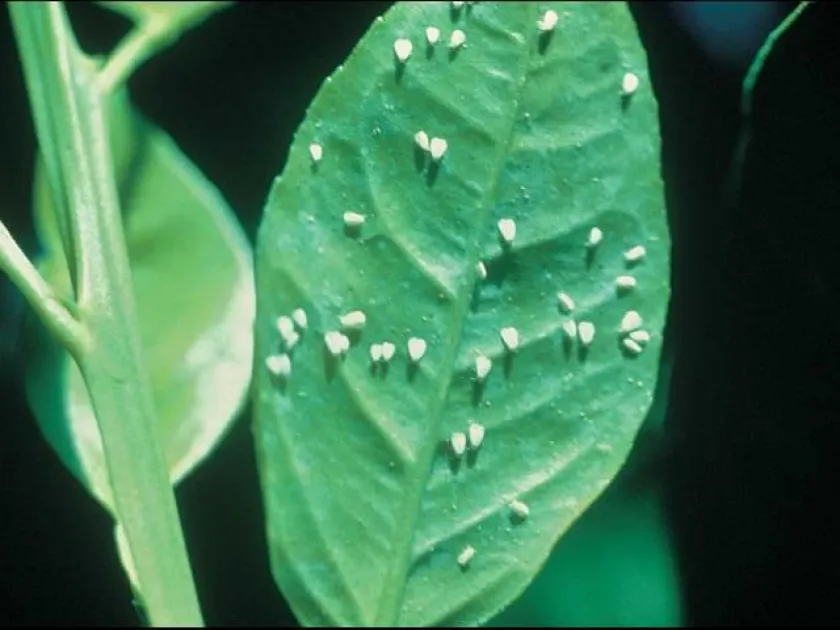
The developmental cycle consists of eggs, several nymphal stages (often referred to as crawlers), and the adult phase. Nymphs are generally immobile and attached to the abaxial (underside) surface of the leaves.
Identification of this specific species is complex due to its similarity to other whitefly species, such as the silverleaf whitefly. Precise determination often requires specialized microscopic inspection of the pupal case structures.
The species exhibits strong adaptability to various climatic conditions, which has facilitated its distribution across diverse agricultural environments and protected greenhouse ecosystems.
Monitoring programs typically employ yellow sticky traps, which attract and capture adult whiteflies, providing essential data on population density and the timing of peak flight activity.
What it damages
As a highly polyphagous pest, the Myrtle whitefly impacts a broad spectrum of crops, including various vegetables, ornamental plants, and berry-producing shrubs. It poses a significant threat to industrial plant production.
In greenhouses, where favorable temperature and humidity are maintained, these pests can thrive throughout the year, causing cumulative damage to young seedlings and mature, high-value crops alike.
Whiteflies damage plants by feeding on phloem sap, which depletes the plant's nutritional resources, stunts development, and reduces total yield quantity and quality significantly.
Beyond physical damage, the whitefly acts as a vector for various plant pathogenic viruses, potentially leading to total crop failure if infection levels are not mitigated promptly.
Heavy infestations lead to leaf senescence and defoliation, while the excretion of honeydew encourages the development of secondary pathogenic fungi, further damaging the plant's photosynthetic capacity.
When it appears
The activity of Bemisia myricae is closely tied to ambient temperature. Warm, dry weather conditions during spring and summer are optimal for rapid population growth and development.
In greenhouse settings, seasonal fluctuations are largely negated by climate control systems, allowing the whitefly to complete multiple overlapping generations throughout the entire year.
Outside of the growing season, whiteflies can persist on persistent weeds or protected niches in structures, waiting for favorable conditions to expand their colony once the growing season begins.
The early vegetative stage of crop development is particularly critical, as the introduction of the pest during this period can compromise the entire plant architecture for the rest of the season.
Increased photoperiod and intensity of solar radiation contribute to increased metabolic rates of the pest, resulting in faster egg-to-adult maturation cycles during peak summer months.
Signs of infestation
The primary symptom of infestation is chlorosis, where leaves turn yellow and eventually curl. Inspecting the underside of affected leaves will reveal the presence of tiny, white, scale-like nymphs.
A distinctive sign is the secretion of honeydew, a sticky substance that coats the leaves. This honeydew promotes the growth of sooty mold, which manifests as a black, velvety layer on foliage.
Plants affected by a Myrtle whitefly colony typically show signs of stunted growth, reduced vigor, and in severe cases, the shedding of flowers and developing fruit sets.
Chlorotic spotting on leaves that gradually spreads is a clear indication of localized sap depletion caused by feeding nymphs and adult insects on the plant's vascular tissue.
- large clouds of white insects appearing when plants are disturbed;
- sticky, shiny residue on foliage and fruit surfaces;
- black sooty mold growth on leaf surfaces;
- premature blossom or fruit drop;
- general leaf yellowing and visible decline in plant health.
Control measures
Management of the Myrtle whitefly relies on an integrated pest management (IPM) strategy that prioritizes sanitation, biological control agents, and, as a final resort, judicious chemical usage.
Biological control includes the release of specific parasitoids like Encarsia formosa or predatory mites such as Amblyseius swirskii, which are highly effective in stable greenhouse environments.
Chemical control programs must implement insecticide rotation based on their mode of action to prevent the development of resistance. Systemic products are often preferred for their ability to protect foliage from within.
Sanitary practices, such as removing infested plant debris and controlling reservoir weeds around production areas, are essential to minimize the initial pest load at the start of the season.
The installation of yellow sticky traps should be part of the standard operating procedure for greenhouses, serving both as an early warning system and a tool for mass trapping adult insects.
Discussion
No discussions yet — be the first.