
Goldingi whitefly
Bemisia goldingi
Description
How to identify
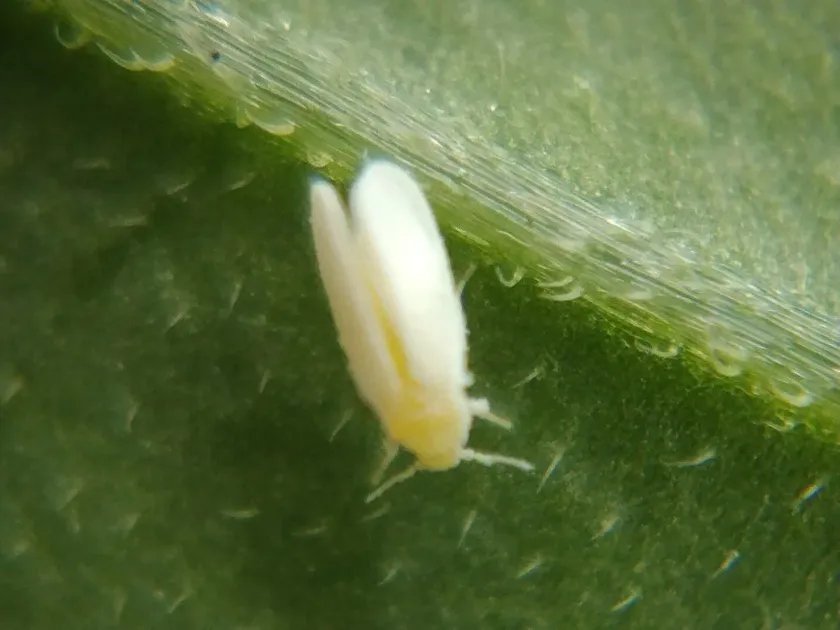
The Goldingi whitefly (Bemisia goldingi) is a member of the Hemiptera order and the Aleyrodidae family. It is a small, sap-sucking insect characterized by a pale, yellowish-white body and wings covered in a waxy powder.
Adults measure approximately 1–1.5 mm in length. Due to their small size and specific coloring, they are often overlooked until a significant population has already established itself on the host plant.
The life cycle includes egg, several nymphal stages, and the adult stage. The nymphs, particularly in their final stages (puparia), are flattened and stationary, remaining firmly attached to the undersides of leaves.
Morphological identification of Bemisia goldingi is challenging because it closely resembles other species within the Bemisia tabaci complex. DNA-based diagnostics are often required for precise identification in research and monitoring.
This pest is highly adaptable to both controlled greenhouse environments and tropical outdoor settings, making it a persistent challenge for growers globally.
What it damages
This whitefly species infests a wide range of horticultural crops, with a particular affinity for members of the Solanaceae family, including tomatoes, peppers, and eggplants.
Feeding occurs through the piercing and sucking of plant phloem sap by both nymphs and adults. This deprives the plant of essential nutrients, leading to stunted growth and reduced vigor.
The excretion of honeydew is a significant secondary issue. This sticky substance promotes the rapid growth of sooty mold, which physically blocks sunlight and impairs the plant’s ability to perform photosynthesis.
Perhaps the most critical damage is the transmission of plant viruses. Bemisia goldingi acts as a vector for various viral diseases, which can cause severe systemic symptoms and catastrophic yield losses.
High infestation levels lead to leaf chlorosis, premature yellowing, and leaf drop, significantly reducing the market value and health of the cultivated crops.
When it appears
The development rate of Bemisia goldingi is highly temperature-dependent, with optimal activity occurring between 25°C and 30°C. High humidity levels also facilitate faster population growth.
In outdoor conditions, the pest is most active during the warmer summer months. In contrast, greenhouse environments allow for year-round reproduction, as the stable climate prevents any natural winter dormancy.
A single generation can complete its development in as little as two to four weeks depending on the host plant and climatic conditions, allowing for rapid outbreaks.
Monitoring should be most intense during early spring and summer when the population typically begins to explode, potentially migrating from alternate host weeds to commercial crops.
Long-distance dispersal often occurs through the trade of infested nursery plants, highlighting the importance of quarantine procedures at the farm or nursery level.
Signs of infestation
The most immediate sign of infestation is the presence of small, white flying insects when the canopy of the plant is disturbed or shaken.
Sticky residue or honeydew on the lower leaves, often followed by the appearance of dark, fuzzy sooty mold, is a clear indicator of long-term feeding activity.
Plants may exhibit generalized symptoms such as yellowing of the foliage, leaf curling, and a general lack of vitality despite adequate fertilization and irrigation.
- Yellow spots (chlorosis) appearing on leaf surfaces.
- Accumulation of sticky honeydew and sooty mold.
- Deformation or curling of young, succulent leaves.
- Presence of tiny scale-like nymphs on the undersides of leaves.
If viral infection has occurred, look for characteristic patterns such as vein clearing, mosaic patterns, or severe stunting of the growing points.
Control measures
Integrated Pest Management (IPM) is the most effective approach to handling Bemisia goldingi. It involves a combination of biological, physical, and chemical controls.
Biological control using parasitoid wasps (such as Encarsia formosa) and predatory bugs (like Macrolophus pygmaeus) can effectively reduce populations without the use of harsh chemicals.
Sanitation is paramount: removing weeds that act as reservoir hosts and ensuring that greenhouse structures are cleared of plant debris helps to break the pest's life cycle.
Chemical control should be applied judiciously. Rotating different classes of insecticides is essential to minimize the risk of the whitefly population developing resistance.
Sticky yellow traps should be utilized as a primary monitoring tool, as they not only trap adults but also provide essential data on the timing of population peaks for better spray timing.
Discussion
No discussions yet — be the first.