
Silverleaf whitefly
Bemisia argentifolii
Description
How to identify
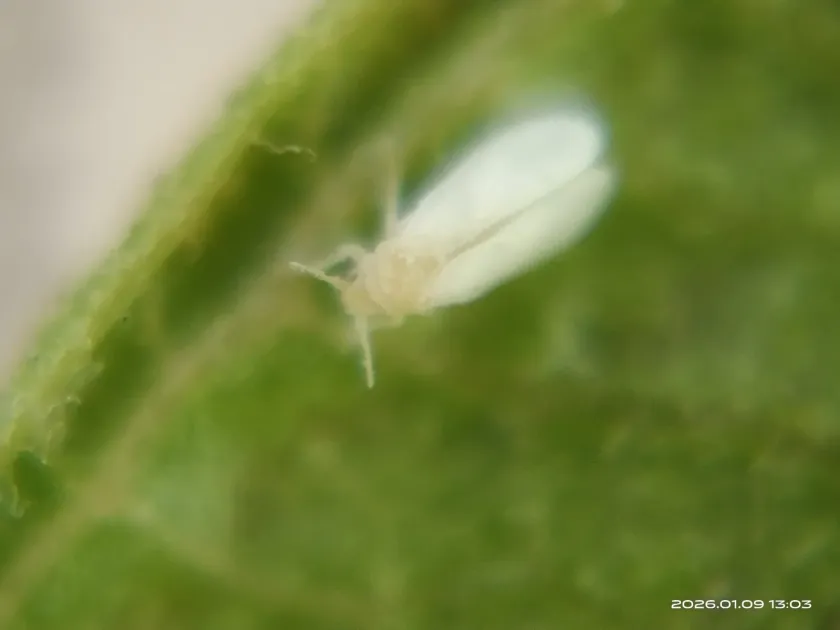
The silverleaf whitefly (Bemisia argentifolii) is a highly destructive insect belonging to the family Aleyrodidae. Adults are approximately 1 mm long, possessing two pairs of wings covered with a white, powdery wax.
This species is morphologically similar to other whitefly species, making visual identification challenging. It is often distinguished by its specific host preference and the severe physiological disorders it induces in plants.
The life cycle consists of the egg, four nymphal instars, and the adult stage. Eggs are usually deposited on the underside of young leaves, often in circular patterns, attached by a short stalk.
Silverleaf whitefly development is highly temperature-dependent, with the cycle accelerating significantly in warm environments. In greenhouse conditions, they can maintain continuous breeding, quickly leading to overlapping generations.
Adults are strong fliers and can easily migrate between fields and greenhouses, facilitated by wind currents or human activity when moving infested plant material.
What it damages
This pest is an extreme polyphage, attacking a vast array of crops including tomatoes, cucumbers, squash, beans, and ornamental flowers. It causes both direct and indirect damage to these species.
Direct feeding by nymphs and adults removes plant sap, leading to stunted growth, leaf chlorosis, and reduced vigor. In severe cases, the entire plant can wither and die due to intense sap depletion.
The silverleaf whitefly is a primary vector for numerous plant viruses, such as Tomato Yellow Leaf Curl Virus (TYLCV). The transmission of these pathogens is often more economically devastating than the direct feeding damage.
The species is particularly notorious for causing "silverleaf" symptoms in cucurbits, where toxic saliva injected during feeding leads to the characteristic metallic or silver appearance of foliage.
Economic losses are compounded by the accumulation of honeydew on foliage, which supports the growth of sooty mold, reducing the plant's ability to perform photosynthesis and spoiling the quality of harvestable produce.
Signs of infestation
Visual presence of small, white insects flitting around the plant canopy when foliage is disturbed is the most common early indicator of a silverleaf whitefly infestation.
Examining the undersides of leaves reveals small, immobile, scale-like nymphs. These nymphs are often transparent or yellowish and become more apparent as they mature to the pupal stage.
A sticky, shiny residue on leaves, known as honeydew, is a classic sign. This substance often attracts ants and eventually turns black due to the rapid colonization by sooty mold fungi.
Plant growth patterns might change, with leaves showing curling, yellowing, or abnormal patterns. In squash, the development of a distinct silver color on leaves is a hallmark diagnostic sign of this specific species.
Fruits may exhibit uneven ripening, blotchy coloration, or internal white tissue development, significantly reducing their marketable value in agricultural operations.
Control measures
Integrated Pest Management (IPM) is essential for controlling Bemisia argentifolii. This begins with sanitation, such as removing weeds and crop debris that serve as reservoirs for whitefly populations.
Yellow sticky traps are standard tools for monitoring population levels. These traps allow growers to detect early arrivals and time chemical or biological interventions effectively.
Biological control agents, including parasitic wasps like Encarsia formosa or predators such as Macrolophus pygmaeus, are highly effective when released early in the crop cycle.
Chemical control relies on systemic insecticides, but growers must exercise caution and rotate chemical classes to avoid the rapid development of pesticide resistance in whitefly populations.
- Implement strict greenhouse hygiene and exclusion methods.
- Utilize biological control agents as the primary defense strategy.
- Rotate insecticides with different modes of action to manage resistance.
Discussion
No discussions yet — be the first.