
Barentsia
Barentsia
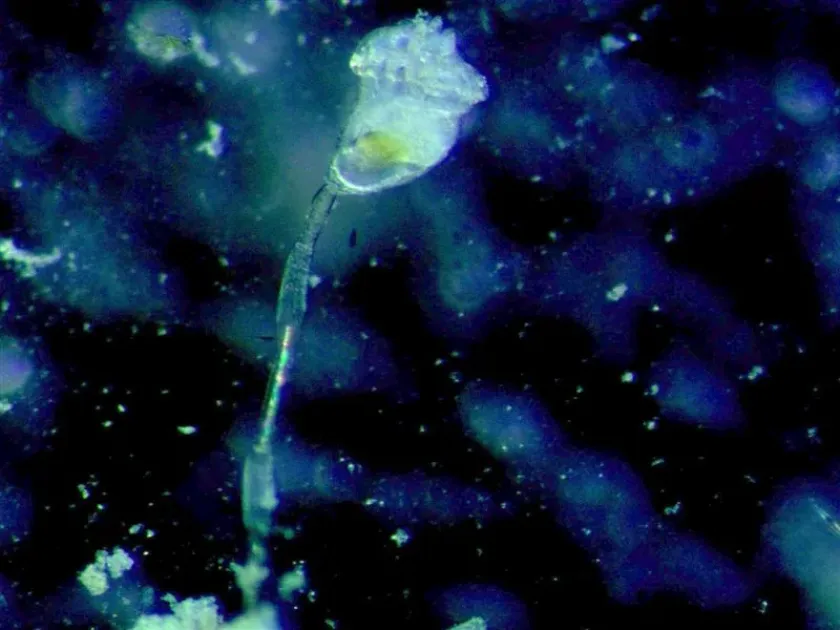
Description
How to identify
Barentsia is a genus of colonial sessile organisms belonging to the phylum Kamptozoa (also known as Entoprocta) and the family Barentsiidae.
These organisms consist of individuals, called zooids, which are attached to a substrate by a flexible, muscular stalk that allows for movement.
The upper part of the zooid features a calyx equipped with a crown of tentacles used for filter-feeding on suspended organic particles.
They are characterized by a highly branched colony structure, enabling them to form dense mats on various underwater surfaces.
Their reproduction involves both sexual processes and vegetative budding, which facilitates rapid colonization of new habitats.
What it damages
Barentsia is recognized as a problematic biofouling organism in the marine aquaculture and mariculture industry.
The colonies settle heavily on cage nets, water supply pipes, pumps, and the shells of cultivated mollusks like oysters and mussels.
This fouling restricts water flow, reduces oxygen levels within the cages, and impairs the growth performance of the farmed stock.
Accumulation on technical infrastructure leads to increased mechanical load, pump failure, and significant maintenance costs for farmers.
Competition for suspended food particles can further negatively impact the productivity of filtration-feeding species in the vicinity.
When it appears
The proliferation of Barentsia is strongly influenced by water temperature, salinity, and nutrient availability in the environment.
Active colonization typically peaks during spring and summer months when environmental conditions favor larval development and dispersal.
In artificial aquaculture systems, internal temperatures often support the sustained growth and reproduction of colonies throughout the year.
High nutrient levels, often resulting from excess feed, create an environment conducive to massive expansion of the colonies.
The life cycle patterns of Barentsia are synchronized with local hydrographic seasons, determining the period of most intensive fouling.
Signs of infestation
An early sign of infestation is the appearance of a fuzzy, brownish, or grayish layer on structural elements or submerged equipment.
Under visual inspection, small, tree-like structures with distinct calyces are visible attached to the surface by flexible stalks.
Significant obstruction of filter meshes and drainage systems is a major indicator that the fouling density has become critical.
Mechanical failures or increased strain on water circulating pumps often correlate with heavy colonization by these organisms.
In severe cases, the colonies form a dense, mat-like cover that obscures the underlying substrate completely.
Control measures
Effective management requires rigorous maintenance and the implementation of biofouling prevention strategies.
Regular mechanical cleaning using high-pressure sprayers or brushes is the most common method for removing established colonies.
Anti-fouling treatments and specialized net coatings are used to prevent the initial attachment of Barentsia larvae.
Operational control, including managing feed waste to prevent nutrient spikes, helps keep biofouling levels manageable.
- Mechanical scrubbing and pressure washing
- Use of anti-fouling coatings for nets
- Monitoring water quality and organic load
- Periodic removal of fouled equipment for descaling
Taxonomy
- Latin name
- Barentsia
- Family
- Barentsiidae
- EPPO code
- BARESP
Discussion
No discussions yet — be the first.