
European corn borer
Balaena
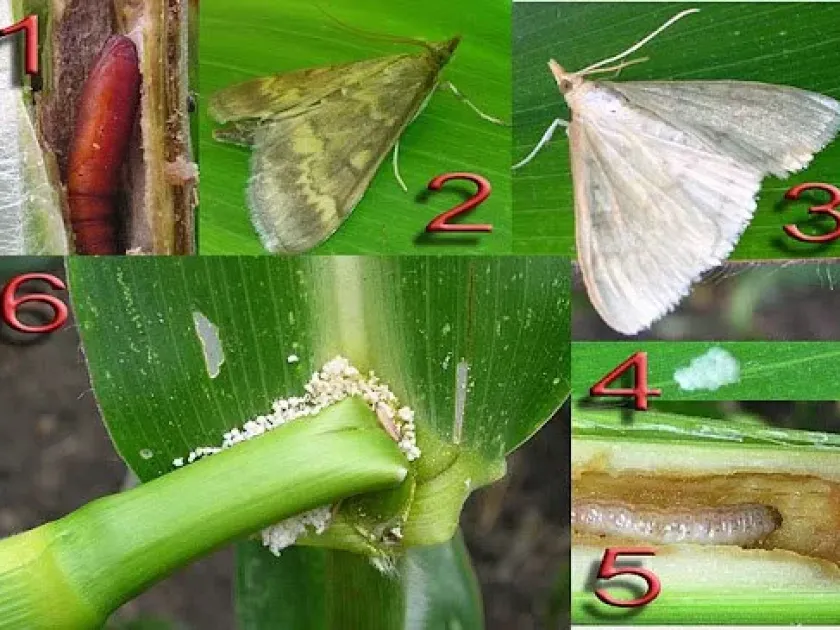
Description
How to identify
The European corn borer (scientific name Ostrinia nubilalis) is a significant moth pest in the family Crambidae. The adult moth has a wingspan of approximately 25-30 mm and is characterized by a yellowish-brown color with wavy dark bands across its wings.
The larvae are light gray to pinkish-colored caterpillars with a dark stripe down the back and a distinct brown head. They are the primary damaging stage of this insect, growing up to 2.5 cm long.
Females deposit eggs in masses on the underside of corn leaves. These egg masses appear as white or creamy, flat, scale-like clusters, typically containing 15 to 50 individual eggs.
The pupal stage occurs within the plant debris or the stalk itself. The pupae are dark brown, spindle-shaped, and are protected from the environment until the moth emerges.
As a highly adaptable species, it has spread across various agricultural zones, making it a major concern for maize production globally due to its wide host range and lifecycle flexibility.
What it damages
While maize is its primary host, the European corn borer is a polyphagous insect that also attacks sorghum, millet, hemp, peppers, potatoes, and various green beans.
The larvae bore into the stalks, ear shanks, and leaves, disrupting the plant's vascular system. This tunneling reduces the plant's ability to transport water and essential nutrients to the developing ear.
Feeding damage can lead to stunted growth, reduced ear size, and lower grain quality. In severe cases, the stalks become weakened and prone to lodging, leading to significant yield loss during harvest.
Openings created by the larvae serve as entry points for various secondary fungal pathogens, including stalk and ear rots, which further degrade grain quality and yield.
The total loss caused by this pest is a combination of direct tissue destruction and the physiological stress induced by the infestation, which makes the plant more susceptible to environmental drought.
When it appears
The lifecycle begins with the emergence of adult moths in late spring or early summer, depending on regional temperatures and seasonal heat units.
Moths are nocturnal, meaning they are active at night and seek refuge in dense vegetation or the underside of leaves during daylight hours to avoid predation.
Larval development typically peaks during the mid-vegetative stages of the corn crop. In warmer regions, the insect can complete two or more generations per season, increasing the pressure on crops.
The timing of the second generation is critical, as these larvae often attack the maturing ears, causing damage directly to the yield-bearing components of the plant.
Overwintering occurs in the larval stage, primarily inside corn stalks or cob remnants, where they enter diapause until spring temperatures provide the cue for pupation.
Signs of infestation
Early-season infestation is often marked by "shot-hole" patterns on the leaves, caused by young larvae feeding on the developing leaf tissue before the leaves fully unfurl.
The most tell-tale sign of deeper infestation is the presence of sawdust-like frass (excrement) located at the entry holes in the stalk, leaf axils, or on the ear silk.
A broken tassel or a drooping ear is often a symptom of severe internal tunneling, which weakens the mechanical structure of the corn plant.
Visible tunnels or galleries within the stalk can be confirmed by slicing the stem open during inspection, revealing the presence of larvae or their pupal cases.
At the ear stage, larvae may tunnel into the ear cob, causing premature drying of the husk or damaged kernels that are visibly eaten or rotting.
Control measures
- Utilize crop rotation to break the lifecycle of the borer and limit its population density in fields.
- Adopt deep tillage practices to bury corn residue, which helps eliminate overwintering sites for the larvae.
- Incorporate biological control agents such as Trichogramma wasps, which parasitize corn borer eggs and prevent hatching.
- Apply synthetic insecticides strategically based on field scouting thresholds, targeting larvae before they penetrate the stalks.
- Plant genetically modified maize hybrids (e.g., Bt-corn) that produce insecticidal proteins, offering robust, season-long protection.
Taxonomy
- Latin name
- Balaena
- Family
- Balaenidae
- EPPO code
- BALESP
Discussion
No discussions yet — be the first.