
Philippine fruit fly
Bactrocera philippinensis
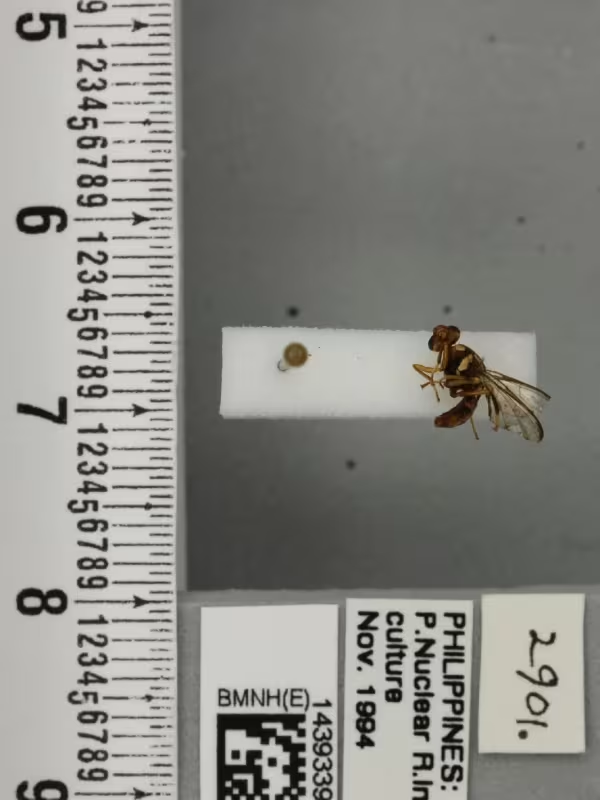
Description
How to identify
The Philippine fruit fly (Bactrocera philippinensis) is a significant pest belonging to the Tephritidae family. Its morphological features make it visually similar to other members of the genus Bactrocera, often complicating field identification.
Adult flies are typically 6-8 mm long with a distinct, slender body. They feature a dark coloration with yellow markings on the thorax and abdomen, and clear wings with a narrow dark stripe along the costal margin.
Females deposit eggs in clutches under the skin of ripening fruits using a sharp ovipositor. The eggs are creamy-white, elongated, and oval-shaped.
Larvae are legless, tapered, and reach about 10 mm in length when mature. They are generally white or yellowish-white, and their mouthparts are adapted for rapid tissue degradation.
Pupation occurs in the soil or within fallen fruit. The pupae are enclosed in barrel-shaped, brown-colored puparia, which are resistant to harsh environmental conditions.
What it damages
This species is highly polyphagous, meaning it attacks a wide variety of fruit and vegetable crops. It is particularly devastating in tropical and subtropical regions where fruit production is concentrated.
Primary hosts include mango, papaya, guava, and citrus species. When primary hosts are unavailable, the fly can infest secondary fruit crops, expanding its range of damage.
Larvae tunnel through the fruit flesh, causing internal breakdown and rot. This activity renders the fruit completely unsuitable for human consumption or commercial trade.
Infested fruit typically drops prematurely from the tree. In many cases, the presence of bacteria and fungi following larval feeding accelerates the decay process significantly.
Without intervention, infestation rates can result in total crop loss, posing a massive economic threat to local and international agricultural markets.
When it appears
The life cycle of the Philippine fruit fly is closely tied to host availability and climatic conditions. In tropical climates, reproduction occurs continuously throughout the year.
Adult activity is most pronounced during warm and humid weather. They feed on nectar, honeydew, and other sugary substances, which are essential for maturation and egg production.
Under optimal conditions, with temperatures between 25 and 30 degrees Celsius, the entire development cycle can be completed in as little as three to four weeks.
In regions with distinct seasons, the fly overwinters in the pupal stage, buried in the soil. Rising spring temperatures trigger the emergence of adults, who then begin searching for suitable fruit for oviposition.
The spread of this pest is often facilitated by human activity, particularly the movement of infested fruit, making it a critical focus for international agricultural quarantine services.
Signs of infestation
The earliest signs of infestation are tiny puncture wounds on the fruit surface, created by the female during egg-laying. Sometimes, dark spots or discoloration form around these sites.
As larvae develop inside, the fruit may exhibit soft spots, irregular bumps, or lesions. A pungent, fermented odor often emanates from heavily infested fruit as decay progresses.
Cutting open an infested fruit reveals tunnels filled with developing larvae. In advanced stages of infestation, the fruit flesh becomes liquid and loses its structural integrity.
Fruit drop is a major field indicator. If fallen fruit displays small holes or soft patches, it is a strong signal that Bactrocera philippinensis is active in the area.
To detect the presence of adults before significant damage occurs, farmers and inspectors use specialized traps baited with male-attracting lures or food-based attractants.
Control measures
Integrated Pest Management (IPM) is essential for controlling this fly. Quarantine measures must be strictly enforced to prevent the transport of infested produce between regions.
Cultural control involves the rigorous collection and destruction of fallen fruit. Burying fruit deeply or using heat treatment ensures that larvae cannot reach the soil to pupate.
Male annihilation technique (MAT) using pheromone traps is a highly effective method to reduce the population. By attracting and killing males, the mating cycle is significantly disrupted.
Chemical control can be used, typically through bait sprays containing insecticides. These are applied in spots to minimize chemical usage while targeting adult flies that come to feed.
The Sterile Insect Technique (SIT), which involves releasing large numbers of sterilized males into the field, has proven effective in suppressing populations in established areas.
Discussion
No discussions yet — be the first.