
Papaya fruit fly
Bactrocera papayae
Description
How to identify
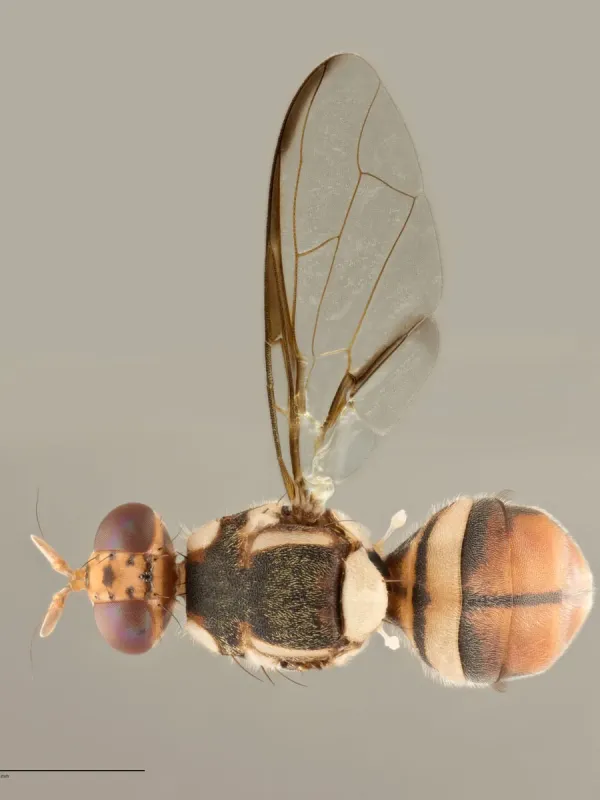
The papaya fruit fly belongs to the Diptera order and the Tephritidae family. The adult fly has a distinctive yellow-brown body with black markings on the thorax and abdomen.
Its wings are hyaline with a characteristic dark costal band along the anterior edge, which is a key identification feature for this species. Adults typically measure about 6–8 millimeters in length.
Larvae are legless, creamy-white maggots that reach about 10 millimeters in size at their mature stage. They possess a conical body shape typical of the Bactrocera genus.
Eggs are elongated, smooth, and white or cream-colored. Females deposit them deep into the fruit flesh using a sharp ovipositor to protect them from external environmental factors.
Pupae develop in the soil or within fallen fruit. They are encased in a brownish, cylindrical puparium that protects the insect during diapause or unfavorable conditions.
What it damages
This species is a highly destructive polyphagous pest that threatens a wide range of crops, including papaya, mango, citrus, guava, and bananas.
It is capable of infesting over 200 plant species, making it a major quarantine pest of significant concern for tropical and subtropical fruit production globally.
The damage is primarily caused by larvae feeding on the fruit pulp, which turns into a watery, rotten mass. This leads to premature fruit drop and complete loss of market value.
Oviposition punctures created by females serve as entry points for secondary pathogens, including bacteria and fungi, which accelerate the decomposition of the fruit.
Besides direct yield loss, the presence of this pest imposes severe trade restrictions on agricultural exports, causing substantial economic consequences for affected regions.
When it appears
The biology of the fly is closely tied to ambient temperature and moisture levels, with warm, humid conditions being optimal for rapid reproduction.
The life cycle from egg to adult can be completed in as little as 3 to 5 weeks, depending on the host fruit variety and regional climate conditions.
A single female can lay hundreds of eggs throughout her lifespan, often infesting multiple fruits, which contributes to the rapid population growth of the pest in an orchard.
Wintering or periods of dormancy occur in the pupal stage within the upper layers of the soil, allowing the population to persist through off-seasons.
Population peaks are generally observed during the ripening seasons of preferred host crops, necessitating intensive monitoring and control measures during these periods.
Signs of infestation
The first sign of infestation is the presence of oviposition punctures on the fruit surface, often accompanied by small discolored spots or necrotic patches around the site.
Affected fruits often turn yellow prematurely, become soft, and fall to the ground before they reach full maturity, which is a classic indicator of larval infestation.
Upon cutting open an infested fruit, one can observe multiple larvae feeding within the pulp, accompanied by galleries and early stages of internal rot.
The presence of adult flies in the orchard, detected through pheromone trap monitoring, acts as an early warning sign of increasing infestation pressure.
Secondary infections often result in a foul smell emanating from fruit still on the tree, signaling that internal degradation is already well underway.
Control measures
The primary control measure is strict phytosanitary quarantine to prevent the introduction of this pest into new areas through international trade.
Cultural practices include the systematic collection and disposal of all fallen fruit to interrupt the life cycle and reduce the number of pupating larvae in the soil.
Male annihilation technique using pheromone traps is highly effective for population monitoring and significantly reducing the fertilization rate of females.
Protein-bait insecticide sprays are used to target adults, providing an effective way to manage fly populations while minimizing harm to beneficial insects.
- Biological control: Use of specific parasitoid wasps that prey on the larvae of the fruit fly.
- Post-harvest treatment: Heat treatment or cold treatment of exported fruit to ensure the elimination of hidden eggs and larvae.
Discussion
No discussions yet — be the first.