
Alfalfa looper
Autographa californica
Description
How to identify
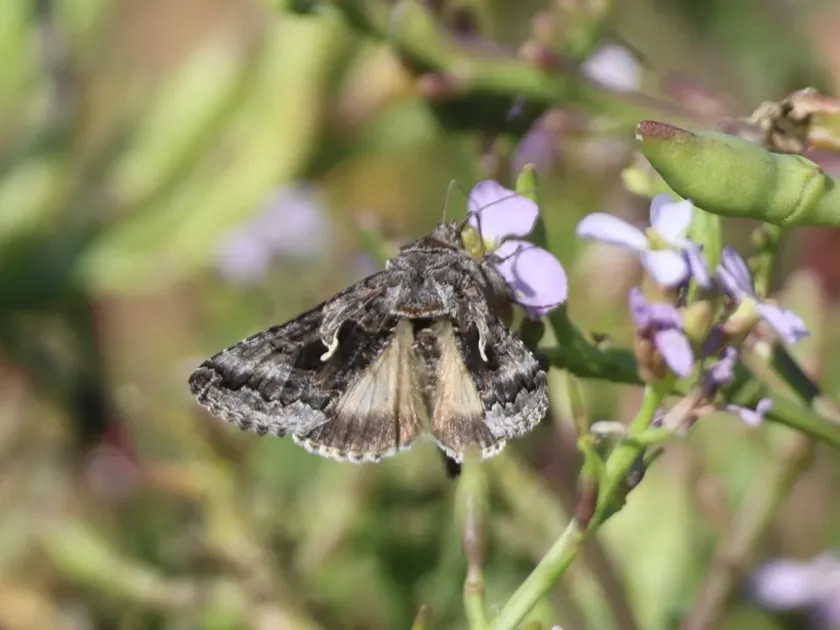
The alfalfa looper (Autographa californica) is a moth belonging to the Noctuidae family. The adult moth features a wingspan of 30–40 mm with greyish-brown forewings, which typically display a characteristic silver-white, gamma-shaped mark, making it identifiable in the field.
The larvae, known as loopers, pass through five instars. They are typically light green with thin white longitudinal stripes. A distinctive feature is their locomotion: they possess only three pairs of prolegs, forcing them to move in a loop-like, arching motion, which gives them their common name.
Pupation occurs within a loose silk cocoon, often hidden on the undersides of leaves or within debris in the plant canopy. The pupa transitions from a light green hue to a dark brown color as it nears the adult emergence stage.
The life cycle varies based on climate but generally spans two to three generations per year. Warm and stable weather conditions accelerate the developmental stages, allowing populations to surge rapidly within a single growing season.
Female moths deposit their eggs primarily on the undersides of leaves. A single female can lay several hundred eggs, ensuring that the next generation is well-distributed across the field, especially in dense crop canopies.
What it damages
The alfalfa looper acts as a polyphagous pest, damaging crops such as alfalfa, clover, soybeans, sugar beets, and various vegetables. Larvae are the primary agents of destruction, consuming substantial amounts of foliage as they grow.
Early-stage larvae skeletonize leaves, consuming the soft tissue while leaving the veins intact. Later, more mature larvae consume entire leaf sections, which significantly reduces the photosynthetic capacity of the plant and limits overall biomass accumulation.
Beyond foliage, the larvae may feed on flower buds and reproductive organs. In seed production fields, this behavior is particularly devastating, often leading to substantial reductions in seed quality and overall market yield.
Plant damage creates entry points for secondary pathogens, including fungal and bacterial infections. Once a plant is weakened by looper feeding, it becomes more susceptible to diseases that can compromise its health further and reduce harvest quality.
Economic damage thresholds vary, but in alfalfa, significant feeding pressure warrants intervention when population density exceeds 5 to 10 larvae per square meter, depending on the crop's vigor and development stage.
When it appears
Adult moths typically emerge in late spring when temperatures consistently reach 12–15 degrees Celsius. This initial flight represents the first opportunity for monitoring and early management interventions in the field.
Peak activity usually occurs during the summer months (June and July). During this period, the population of larvae often reaches its maximum density, which correlates with the most vigorous growth phases of many host crops.
As temperatures drop in the autumn, activity slows, though a partial third generation may occur in warmer climates. The pest typically overwinters in the pupal stage, buried in the soil or protected within plant refuse.
Environmental stressors, such as heavy precipitation or rapid temperature fluctuations, can reduce larval survival. However, the species' high reproductive capacity allows it to rebound quickly once favorable conditions return.
Field monitoring using pheromone traps for adults is essential for detecting the start of the season. Early detection allows for targeted management before the larval populations become widespread and difficult to control.
Signs of infestation
Early signs of an infestation include small, transparent windows appearing on leaves where young larvae have fed. Upon inspection, the small, cream-colored eggs may be found attached to the underside of leaf surfaces.
As the infestation progresses, leaves exhibit irregular, jagged edges or a lace-like appearance due to extensive feeding. This type of damage is often easy to spot during routine field scouts as it differs significantly from other insect feeding patterns.
The presence of dark, granular frass (excrement) on the leaves and stems is a reliable indicator of active feeding sites. When larvae are numerous, the cumulative effect of their frass and feeding can lead to noticeable wilting.
Silken webbing spun by the larvae between leaves or around buds is a classic sign of the looper. This webbing acts as a protective retreat, making the insects harder to reach with contact-based control methods.
General yellowing or thinning of the foliage suggests a critical infestation level. If these signs are observed across a large portion of the field, it indicates that the pest has already reached a level requiring urgent control.
Control measures
Cultural control measures include effective weed management, as weeds serve as alternative hosts for the pest. Deep plowing after harvest can help disturb and destroy pupae residing in the soil, effectively reducing the overwintering population.
Biological control options involve the release of natural enemies such as Trichogramma wasps, which parasitize the eggs of the alfalfa looper. Additionally, biological insecticides based on Bacillus thuringiensis are effective and environmentally friendly.
Chemical control is utilized when larval populations surpass economic injury levels. Insecticides targeting the larval stage, such as pyrethroids or organophosphates, should be applied according to local regulations and safety guidelines.
To prevent resistance, it is critical to rotate chemical modes of action. Always ensure that the timing of the application aligns with the period of peak larval activity, which is often in the evening hours when they are most exposed.
Integrated Pest Management (IPM) strategies, which combine cultural practices, biological controls, and judicious chemical use, provide the most sustainable long-term success in managing the alfalfa looper while preserving beneficial insect populations.
Taxonomy
- Latin name
- Autographa californica
- Order
- Lepidoptera (butterflies)
- Family
- Noctuidae
- EPPO code
- AUTGCA
Discussion
No discussions yet — be the first.