
Silver Y Moth
Autographa
Description
How to identify
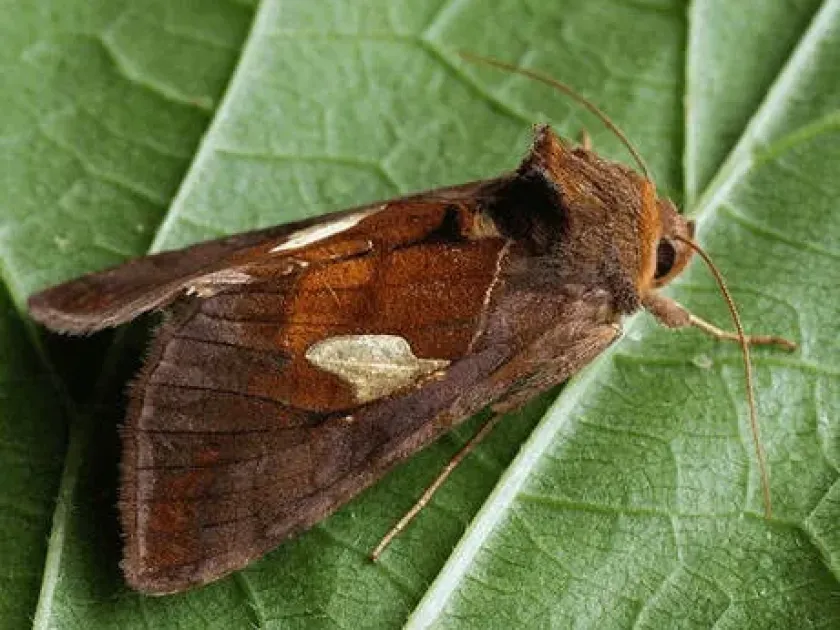
The Silver Y moth (Autographa) belongs to the Noctuidae family of the order Lepidoptera. These medium-sized moths are named after the metallic, silvery Y-shaped mark on their forewings.
Adult moths have a wingspan ranging from 30 to 45 mm. Their bodies are covered in dense hairs, and their coloration varies from grayish-brown to dark brown, providing excellent camouflage against tree bark or dry vegetation.
The larvae, or caterpillars, differ from other noctuid moths by having fewer developed abdominal prolegs (only three pairs instead of five). Consequently, they move with a looping gait, similar to inchworms.
The caterpillars are typically bright green with longitudinal white stripes along their backs and sides, making them difficult to spot against the foliage of host plants.
Pupae develop within loose white silken cocoons, which the larvae spin in folded leaves or on the soil surface hidden among plant debris.
What it damages
The Silver Y moth is a polyphagous pest capable of damaging a wide range of agricultural crops, including vegetables, industrial crops, and ornamental plants.
It poses a significant threat to soybeans, sugar beets, potatoes, and various brassica species (cabbage). The pest is also frequently found on tomatoes and sunflowers.
During the early stages of the life cycle, young larvae feed on the leaf parenchyma, creating small window-like patches without piercing the lower epidermis.
As they mature, the larvae consume the entire leaf blade, leaving only large veins behind, which leads to a substantial loss of photosynthetic leaf surface area.
Heavy infestation leads to stunted plant growth, reduced photosynthetic activity, and a significant decrease in overall yield and crop quality.
When it appears
Silver Y moths primarily overwinter as pupae or early-instar larvae, sheltering in the soil or plant litter, which allows them to survive harsh winter conditions.
Adult moths of the first generation emerge in the spring once air temperatures reach the threshold required for mating and egg-laying activity.
Several generations can develop throughout a single growing season. The population density often peaks in the second half of summer, coinciding with the active growth stages of most crops.
Moderate temperatures and high air humidity create favorable conditions for mass reproduction, facilitating rapid larval development.
In the autumn, the final generation of larvae pupates, preparing for the diapause period and completing the annual cycle in a given region.
Signs of infestation
One of the first visual signs of a Silver Y moth infestation is the presence of irregular, shaped holes in the leaves of host plants.
Upon closer inspection, individual hemispherical yellowish eggs, deposited by females, can be identified on the undersides of leaves.
The presence of larvae is easily detected by their characteristic looping movement when disturbed or touched.
Frass (larval excrement) accumulating on the leaves or on the ground beneath affected plants is another clear indicator of active feeding by the pest.
In severe cases, massive defoliation, slowed growth rates, and deformation of young leaves at the growing points can be observed.
Control measures
Agronomic control methods include deep autumn plowing (tillage), which helps destroy pupae overwintering in the upper soil layers.
Effective weed management is essential, as many common weeds serve as reservoir hosts for young larvae before they move to primary crops.
The use of pheromone traps allows for precise monitoring of moth flights, enabling producers to predict larval emergence and schedule targeted protective treatments.
Chemical control involves the application of systemic or contact-stomach insecticides that are effective against lepidopteran pests during the larval hatching period.
- Biological preparations based on Bacillus thuringiensis demonstrate high selective efficacy against young caterpillars, reducing the chemical load on the agroecosystem.
Taxonomy
- Latin name
- Autographa
- Order
- Lepidoptera (butterflies)
- Family
- Noctuidae
- EPPO code
- AUTGSP
Discussion
No discussions yet — be the first.