
Australothele jamiesoni
Australothele jamiesoni
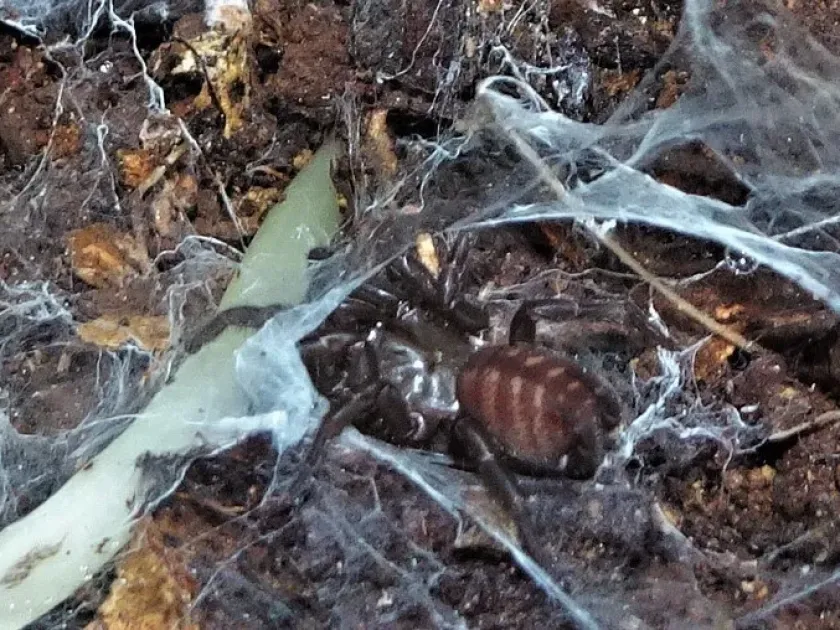
Description
How to identify
Australothele jamiesoni is a spider species belonging to the Euagridae family. While primarily a predator, its presence in agricultural fields can be a concern due to its unique construction habits.
This species is characterized by its funnel-shaped webs, often found in soil crevices or near the base of plants. It has a robust build, typical of funnel-web dwelling spiders, and is adapted to environments with high humidity.
Taxonomically, it is classified within the Mygalomorphae suborder, a group known for longevity and resilience to environmental stressors, which allows them to persist in managed landscapes for extended periods.
In the field, it is often confused with other ground-dwelling spiders, but its distinct long posterior spinnerets and specific web architecture are key diagnostic features for accurate identification.
Understanding the biology of this spider is crucial for integrated pest management, as its role as a predator of insects often overlaps with its role as a nuisance in crop cultivation.
What it damages
Australothele jamiesoni is not a phytophagous species; it does not consume plant tissue. Therefore, it causes no direct nutritional damage to crops such as eating leaves or roots.
However, the indirect damage is linked to the extensive silk production. The dense webbing can cover lower leaves and stems, significantly reducing the surface area available for photosynthesis.
The accumulation of debris and dust on these webs creates an unsightly appearance and may lead to sanitary issues, reducing the market value of the harvested produce.
Furthermore, dense web nests can trap moisture at the base of the plant, potentially creating an environment conducive to the development of fungal pathogens and rot in the stem collar area.
In large-scale operations, particularly in greenhouses, the webbing can interfere with automated irrigation systems and mechanical equipment, complicating maintenance and daily agricultural tasks.
When it appears
The activity of these spiders is heavily influenced by seasonal temperature and humidity fluctuations. They are most active during warm, humid months when prey availability is at its highest.
During the peak of the growing season, adult spiders expand their territories, establishing new nests in dense vegetation. This is when growers are most likely to encounter their web structures.
In colder months or during severe dry spells, the spiders enter a state of dormancy, retreating into their deep burrows within the soil to survive harsh environmental conditions.
Spring monitoring is essential as young spiders begin to emerge and disperse. Early detection of small funnel webs can prevent the establishment of larger, more problematic colonies.
Autumn activity is often associated with mate-seeking, which can lead to increased visibility of spiders on the surface of the soil and plant stems before they prepare for overwintering.
Signs of infestation
The primary sign of infestation is the presence of silk funnels at the base of crops. These funnels often lead into dark, narrow retreats in the soil or structural cracks.
Visually, the silk appears as a thick, white, and often dirty-looking matting that adheres to the lower stem or soil surface, differentiating it from light, sparse spider mite webbing.
The presence of molted exoskeletons near the web entrance is a definitive sign of an active and growing spider population within the area of the crop.
Leaf yellowing or necrosis in the lower canopy, caused by shading from the webbing, serves as an indirect indicator that a dense spider nest may be present nearby.
At night, using a flashlight to scan the base of plants is the most effective way to identify the spiders themselves, as they often sit at the edge of their funnels waiting for prey.
Control measures
Management of Australothele jamiesoni focuses on physical exclusion and habitat modification rather than relying solely on chemical pesticides.
Regular cleaning of greenhouse structures and the removal of debris near the base of plants are highly effective methods to disrupt the spider's nesting sites and discourage colonization.
- Maintaining optimal humidity levels to reduce spider nesting attraction;
- Physical removal of silk funnels during routine field inspections;
- Improving soil drainage to prevent overly moist niches favored by these spiders;
- Ensuring adequate plant spacing to increase airflow and reduce nesting sites;
- Using biological controls to manage populations of insects that serve as the spider's prey.
Chemical control should be reserved for severe infestations where the webbing creates a significant operational hazard, utilizing products that target spiders while minimizing harm to beneficial insects.
Finally, keeping field margins clear of excessive weeds and organic debris helps restrict the migration of spiders into the main production areas.
Taxonomy
- Latin name
- Australothele jamiesoni
- Family
- Dipluridae
- EPPO code
- ASLTJA
Discussion
No discussions yet — be the first.