
Moon jelly
Aurelia aurita
Description
How to identify
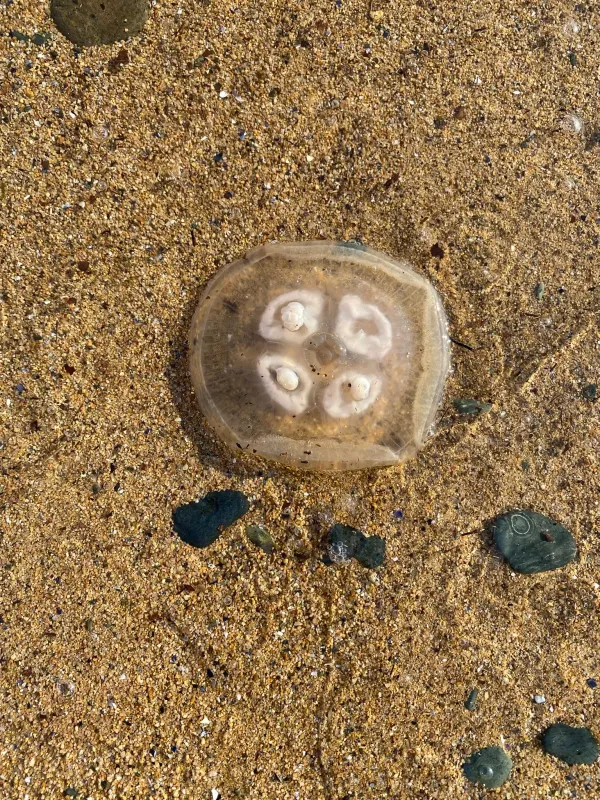
The moon jelly (Aurelia aurita) is a scyphozoan jellyfish from the Ulmaridae family, easily recognized by its translucent bell and four horse-shoe shaped gonads in the center.
While not a plant pest, it is a significant environmental factor for agriculture that relies on marine or estuarine water sources for irrigation and hydroponics.
The life cycle includes a sessile polyp stage that attaches to submerged surfaces, followed by the medusa stage that drifts with currents and can form massive swarms.
The body is composed mostly of water, making it prone to disintegration upon contact with industrial water intake systems.
Despite their delicate appearance, their sheer volume makes them a formidable mechanical obstacle in coastal agricultural settings.
What it damages
The primary damage caused by Aurelia aurita is the severe clogging of water intake structures and filtration systems used in precision irrigation.
As jellyfish are pulled into pumps, they are shredded, creating a gelatinous mass that blocks emitters, nozzles, and fine filters throughout the system.
The organic matter from decaying jellyfish can significantly degrade water quality, raising nutrient levels and promoting microbial growth that harms crop health.
This disruption forces costly operational shutdowns and risks crop failure due to irregular water supply and contamination of the nutrient solution.
Corrosion of equipment and increased maintenance expenses are long-term economic consequences for farms affected by jelly blooms.
When it appears
Jellyfish blooms typically occur during the warmer summer months when water temperatures favor their rapid development and growth.
Early autumn often brings a decline in populations, but the decomposition of dead jellyfish during this period can overload local water filtration systems.
The timing of these events is highly dependent on regional water temperatures and the availability of plankton, their primary food source.
Polyp colonies may persist throughout the year on underwater structures, acting as a constant potential source for new blooms.
Monitoring the environmental conditions at the water intake is crucial for predicting the risks posed by these organisms.
Signs of infestation
The first sign of infestation is a sudden drop in water pressure and reduced flow rate at the irrigation points.
Visual inspection of filtration intake screens usually reveals gelatinous residues or translucent tissues clogging the mesh.
In hydroponic setups, water turbidity and a sulfurous odor are clear indicators of jellyfish tissue decomposition within the system pipes.
Observing a high density of small jellyfish medusae near the pump station is a warning sign of an impending intake failure.
Uneven growth or signs of water stress in crops can signal that the irrigation distribution network has been partially blocked.
Control measures
Automated, self-cleaning coarse filters are the most effective mechanical solution for preventing jellyfish debris from entering the system.
Installing secondary protective meshes or barriers around the water intake helps minimize the quantity of jellyfish entering the pumps.
UV-C irradiation and advanced water treatment can help neutralize organic particles and prevent the growth of harmful bacteria resulting from decay.
Regular maintenance of all mechanical and filtration components is essential during the high-risk summer blooming season.
- Automatic backwash filtration systems.
- Protective coarse screening at intakes.
- Frequent pump and valve inspections.
Taxonomy
- Latin name
- Aurelia aurita
- Family
- Ulmaridae
- EPPO code
- AURLAU
Discussion
No discussions yet — be the first.