
Red-necked footman
Atolmis rubricollis
Description
How to identify
The red-necked footman, known scientifically as Atolmis rubricollis, is a moth species belonging to the Erebidae family.
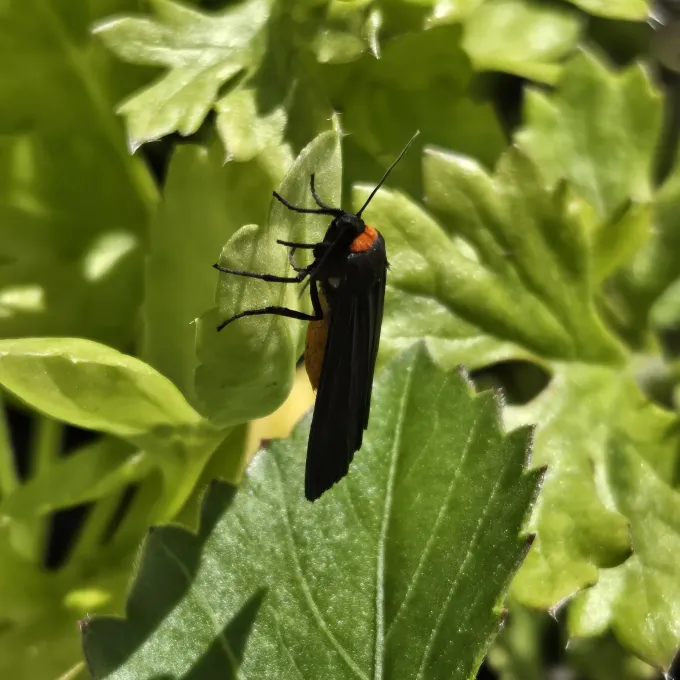
Adult moths are easily identified by their soot-black wings and a striking red or orange collar located on the prothorax.
The larvae are approximately 25 millimeters long and are densely covered with short dark hairs, characteristic of many footman moth species.
These moths have a wingspan typically ranging from 30 to 35 millimeters, making them medium-sized insects within their family.
The distinctive red collar provides a warning signal, which is a common trait among many toxic or unpalatable moth species.
What it damages
The primary food source for red-necked footman larvae is the lichen that grows on the bark and branches of mature trees.
By grazing on lichens, the larvae clean the bark, which is generally not considered a significant threat to the tree's survival.
However, during periods of high population density, larvae may extend their feeding to conifer needles, causing minor defoliation.
In forest ecosystems, excessive grazing by large populations can affect the aesthetic and biological value of the bark surface.
While the moth is rarely classified as a primary pest, it can contribute to the stress of already weakened trees in dense forest stands.
When it appears
The adult moths are typically active during the summer months, with the peak flight period occurring in June and July.
They are primarily nocturnal insects, often attracted to artificial light sources at night, which is how they are most frequently observed.
The species overwinters in the larval stage, hiding within bark crevices or protected spots in the leaf litter during winter months.
Pupation takes place inside a silken cocoon, which is typically constructed in a sheltered area on the host tree or nearby vegetation.
There is generally one generation per year, and the life cycle is tightly synchronized with the summer growing season of the lichens.
Signs of infestation
The most visible sign of infestation is the patchy removal of lichen cover from tree trunks and large branches.
The presence of hairy larvae crawling on the bark during late spring or early summer is a clear indicator of their activity.
One can also observe remnants of cocoons or the presence of the adult moths near infested areas during the twilight hours.
- Patches of bare bark where lichen previously existed.
- Active, hairy caterpillars found on tree trunks.
- Presence of distinctive black moths with red collars.
Regular monitoring of tree trunks during the larval stage is the most reliable way to assess the current population density.
Control measures
In most forestry and horticultural contexts, no direct control measures are required because the damage is usually cosmetic.
If intervention is necessary, encouraging natural predators such as birds and parasitic wasps can help maintain population balance.
Biological insecticides, specifically those containing Bacillus thuringiensis, can be effective if larval numbers become exceptionally high.
Maintaining high forest diversity and healthy tree stands helps to naturally regulate the population of these moths.
Preventative management, such as avoiding the excessive clearing of lichen-rich habitats, can minimize the local impact of these insects.
Discussion
No discussions yet — be the first.