
Oak pit scale
Asterolecanium quercicola
Description
How to identify
The oak pit scale (Asterolecanium quercicola) belongs to the Asterolecaniidae family, order Hemiptera. This is a small insect that leads a sedentary lifestyle, attaching itself firmly to the bark of young tree branches.
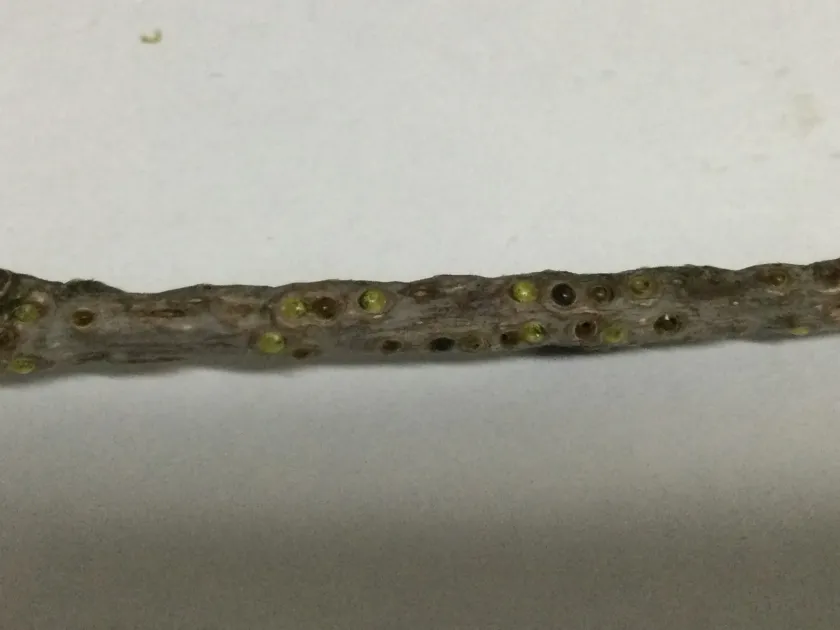
Adult females of this species have a characteristic rounded or oval body, protected by a dense, yellowish-green waxy scale. These formations often merge, creating a visual impression of roughening or a specific coating on the bark surface.
The biology of the pest is closely linked to its host: females are sessile, and their development occurs under a protective cover. Throughout their lives, they suck sap from the plant's tissues, leading to the depletion of the tree's metabolic resources.
Reproduction occurs mainly through sexual means, although many scale insect species exhibit parthenogenetic cycles. Eggs are laid under the female's scale, where they are protected from adverse external factors until the nymphs hatch.
First-instar nymphs, known as "crawlers," are the only mobile stage. It is during this period that the pest disperses to new parts of the crown or neighboring trees, aided by wind or movement along branches.
What it damages
The primary host plant for this pest is the oak (Quercus). Depending on the conditions, it can infest young saplings in nurseries as well as mature trees in forest stands, parks, and arboretums.
Damage is primarily inflicted on young shoots and branches, where nutrient concentrations are highest. The prolonged feeding of the insects leads to a disruption of normal sap flow in the affected parts of the plant.
In areas of mass infestation, bark deformation, cracking, and gradual tissue necrosis are observed. This creates entry points for secondary infections, including fungal diseases and bacterial necrosis.
Weakened trees lose their decorative appeal and become less resistant to other abiotic factors, such as drought or frost. Chronic infestation can lead to the dieback of individual structural branches.
In nursery conditions, mass reproduction of the pit scale can significantly reduce the biomass growth of saplings, making them unsuitable for reforestation due to low viability.
When it appears
The pest's life cycle is typically annual. The species overwinter at the stage of fertilized females or older-instar nymphs that are firmly attached to the shoot bark.
In spring, with the onset of sap flow and rising average daily temperatures, the pests resume active feeding. During this period, intense growth and development of the insects occur under their protective scales.
The emergence of crawlers typically occurs in late spring or early summer. This is a critical period when the population is most vulnerable to external factors and chemical treatment.
Throughout the summer season, nymphs find suitable feeding sites, anchor themselves, and begin secreting their waxy scale. By autumn, the pests reach maturity and prepare for winter dormancy.
Monitoring pest density should be conducted during the "crawler" stage, as this is the most effective time to prevent the spread of colonies throughout the tree.
Signs of infestation
Signs of infestation include the appearance of specific yellowish or greenish waxy plaques on young bark, resembling small growths. With heavy infestation, they form solid crust-like coverings.
Noticeable yellowing and premature leaf drop on affected branches are indirect signs of severe tree exhaustion. Leaves may also become deformed and smaller in size.
The presence of depressions or necrotic spots on the bark where females are attached indicates deep damage to the cambium and bark tissues. This leads to the twisting and distortion of young shoots.
Clusters of scales are often visible on the undersides of branches; when scraped off, they leave distinct pits. The bark underneath appears dry, lifeless, and peels away easily.
- Loss of turgor in young shoots.
- Presence of a "waxy coating" on young branches.
- Stunted apical growth of the plant.
- Appearance of secondary fungal infections (sooty mold).
- Dieback of bark at the sites of scale localization.
Control measures
Effective management includes the use of systemic insecticides, which penetrate plant tissues and affect the pest as it feeds on the sap.
Applications must be timed to coincide with the crawler stage, as the waxy scale of adults reliably protects them from most contact-based pesticides.
In forest stands and parks, biological methods are justified, including the introduction or encouragement of entomophages—natural enemies of scale insects, such as parasitoid wasps and predatory beetles.
An important element of agronomy is maintaining tree health through regular watering and fertilization, which boosts the plant's own defense mechanisms against pests.
When infestation foci are detected on saplings, pruning and disposing of heavily damaged shoots is recommended to prevent further spread of the pest within the site.
Discussion
No discussions yet — be the first.